Saint William of Gellone
c. 755 - May 28, c. 812
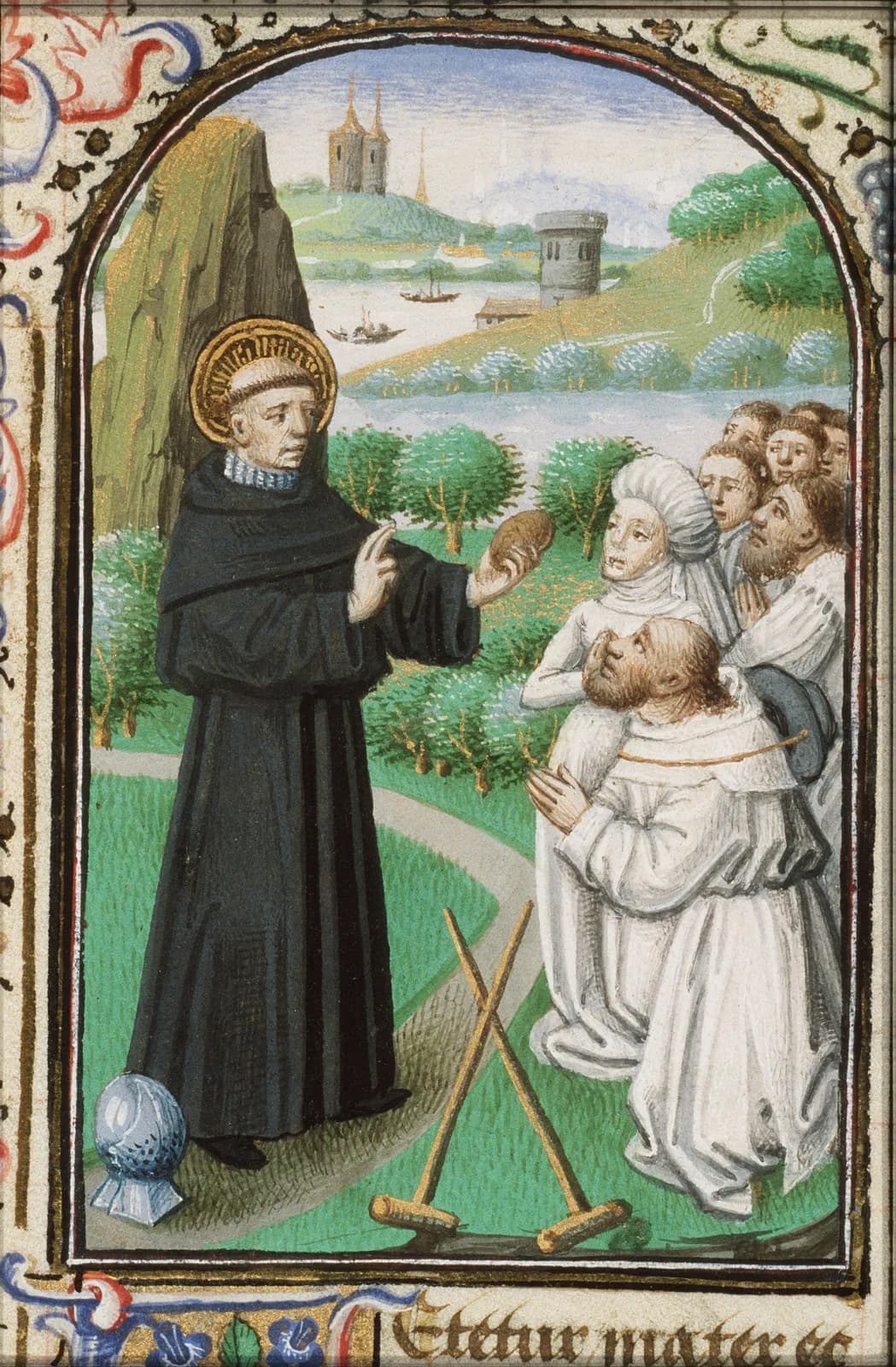
- Also called
- William of Toulouse, William of Aquitaine; Guilhem in Occitan; Guillaume au Court Nez in the epics 124
- Patron of
- Saint-Guilhem-le-Désert, Campins in the province of Barcelona, and armorers, according to katolsk.no 2
Saint William of Gellone was count of Toulouse under Charlemagne, fought the Saracens in the south of France, and then gave it up to become a monk in a valley near Lodève. 14 He founded the abbey of Gellone, now Saint-Guilhem-le-Désert, in 804, put it under his friend Benedict of Aniane, and died there as a monk about 812. 12 The epic poets made him Guillaume au Court Nez; the Church remembers the man who put on the habit. 34
A count at Charlemagne's court
William was born about 755, the son of Theoderic and Aldana. 1 Douglas Webster, in the 1912 Catholic Encyclopedia, says he "was in some way connected with the family of Charles the Great, at whose court he was present as a youth." 1 The Norwegian bishops' saints database (katolsk.no) says some sources make his mother a daughter of Charles Martel, which would make William and Charlemagne cousins, but that this is disputed. 2
In 790 he became the second count of Toulouse. 1 Webster adds that "He is by some writers also given the title of Duke of Aquitaine"; katolsk.no gives him that title outright, and says Charlemagne put him in place of the deposed count Chorso to defend the young kingdom of Aquitaine, where Charlemagne's son Louis was king. 12
katolsk.no also says that as a young man he came to know Witiza, son of the count of Maguelone, who would later turn his life. 2 Witiza, Johann Peter Kirsch writes in the encyclopedia, served at the Frankish court, left it for the monastery of Saint-Seine, and in 779 founded his own monastery on his land beside the little river of Aniane, taking the name Benedict. 5 katolsk.no dates Aniane to 780. 2
Against the Saracens
Webster puts his military career in one sentence: "The great emperor employed him against the Saracen invaders from Spain, whom he defeated at Orange." 1 katolsk.no fills it in. 2 In 793 an army sent by the emir of Córdoba sacked the country around Narbonne; William met it on the Orbieu, was beaten, and fought hard enough that the raiders turned back into Spain. 2 He took part in the capture of Barcelona in 801, and Orange became his residence. 2
Those campaigns made his name in the south, and in the next centuries they made him a hero of song. 2 Webster says he is "the hero of the ninth-century 'Roman de Guillame au court nez'," and Georges Goyau, writing on the diocese of Montpellier, says that "under the name of 'Guillaume au Court Nez'" he "became the hero of a celebrated epic chanson." 14 katolsk.no names La Prise d'Orange and Aliscans among the poems. 2 The poems are not the life. Webster says "the story of his life is told in a more reliable form" by an anonymous biography. 1
He married twice. katolsk.no names his wives as Cunegunde and Guitburga, and says his testament of 804 names his parents, two brothers, two sisters and four sons. 2 One of his sons was Bernard of Septimania, whose wife Dhuoda wrote a handbook of Christian life for their own son, and named William's children in it. 2
Gellone
"In 804 he founded a Benedictine monastery, since called S. Guilhem le Desert, in the valley of Gellone, near Lodeve in the Diocese of Maguelonne," Webster writes, "and subjected it to the famous St. Benedict of Aniane, whose monastery was close at hand." 1 Goyau says he founded it "on the advice of St. Benedict of Aniane." 4 katolsk.no dates the foundation to December 14, 804, and says monks came from Aniane to fill it. 2
He did not enter at once. katolsk.no says he spent a little longer at court, then asked Charlemagne's leave and gave up his titles, and asked for a gift for the new house: a relic of the True Cross the emperor had received from the patriarch of Jerusalem. 2 On his way south he hung up his arms in the church of Saint-Julien at Brioude. 2
Webster gives the year simply: "Two years later (806) he himself became a monk at Gellone, where he remained until his death." 1 katolsk.no gives the day, June 29, 806, the feast of Saints Peter and Paul, and says he received the habit from Benedict of Aniane, who became his spiritual guide. 2 It says he took the humblest work in the house and never held office in it. 2
The Roman Martyrology sums him up in one line: a man of the highest standing at the imperial court, bound to Saint Benedict of Aniane by deep affection, who took the monastic habit and lived in it with great integrity. 3
Death, and a quarrel between two abbeys
He died at Gellone on May 28, about 812. 14 katolsk.no gives 812 and notes that some say 814. 2 Webster says his testament granting property to Gellone, and another document putting the monastery under the abbot of Aniane, were printed by Mabillon. 1
That second document later mattered a great deal. katolsk.no says that in the eleventh century, as pilgrims came in numbers and his body was moved to a place of honor under the choir, Gellone and Aniane quarreled over whether Gellone was independent, both sides produced forged documents, and Rome settled the matter in Gellone's favor about 1092. 2 It says Pope Alexander II canonized him in 1066. 2
The sources disagree about when his life was first written. Webster says an anonymous author wrote it "soon after the saint's death, or before the eleventh century according to Mabillon, or during the eleventh century according to the Bollandist Henschen." 1 katolsk.no calls it a twelfth-century Vita written by the monks to exalt their founder. 2 It adds that his relics were dispersed in the Revolution in 1793; most of what survives is in Toulouse, while an arm reliquary and the cross reliquary remain at Saint-Guilhem. 2
What is Saint William of Gellone the patron saint of?
Saint William of Gellone's feast day
Saint William of Gellone's feast day is May 28, the day of his death. 1 The current Roman Martyrology keeps him on that day, at the monastery of Gellone in Gallia Narbonensis. 3 katolsk.no adds a feast of his translation on March 5, and says the diocese of Poitiers keeps him on April 9. 2 It also notes that February 10 is sometimes given, and that from the thirteenth century artists often confused him with Saint William of Maleval. 2
Praying with Saint William of Gellone
William had the career the poets later sang about: command in the field, the emperor's trust, a great county in the south. 12 He gave it up in his fifties and went to live in a valley as one monk among others. 12
He did it slowly, and with help. The friend who had already made the same change, Benedict of Aniane, advised the foundation, gave him the habit, and kept the house under his own abbey. 124 William did not lead it; katolsk.no says he took the lowest work there for the six years left to him. 2
His name went two ways after his death. One became a hero of song, and the other a saint whose abbey and its claims were argued over with forged charters. 24 What the Martyrology chose to keep is plainer than either: a friendship, a habit, and an honest life lived in it. 3
Saint William of Gellone, pray for us.
Sources
- 1.Douglas Raymund Webster, "St. William of Gellone," The Catholic Encyclopedia, Vol. 15 (New York: Robert Appleton Company, 1912).
- 2."Den hellige Vilhelm av Gellone (~755-812)," Den katolske kirke (katolsk.no), Catholic Diocese of Oslo (in Norwegian).
- 3.Roman Martyrology, entry for May 28, "San Guglielmo, monaco," as printed in "Santo del giorno," Conferenza Episcopale Italiana (in Italian).
- 4.Georges Goyau, "Montpellier," The Catholic Encyclopedia, Vol. 10 (New York: Robert Appleton Company, 1911).
- 5.Johann Peter Kirsch, "St. Benedict of Aniane," The Catholic Encyclopedia, Vol. 2 (New York: Robert Appleton Company, 1907).
Saints to turn to next
Others in this collection who are turned to for some of the same things.
- Saint Agnes of Montepulcianoc. 1268 - April 1317Work and vocationDiscernment
- Saint Albert ChmielowskiAugust 20, 1845 - December 25, 1916DiscernmentWork and vocation
- Saint Andrew Avellino1521 - November 10, 1608DiscernmentWork and vocation
- Saint Angela MericiMarch 21, 1474 - January 27, 1540Work and vocationDiscernment