Saint William of Bourges
1150 - January 10, 1209
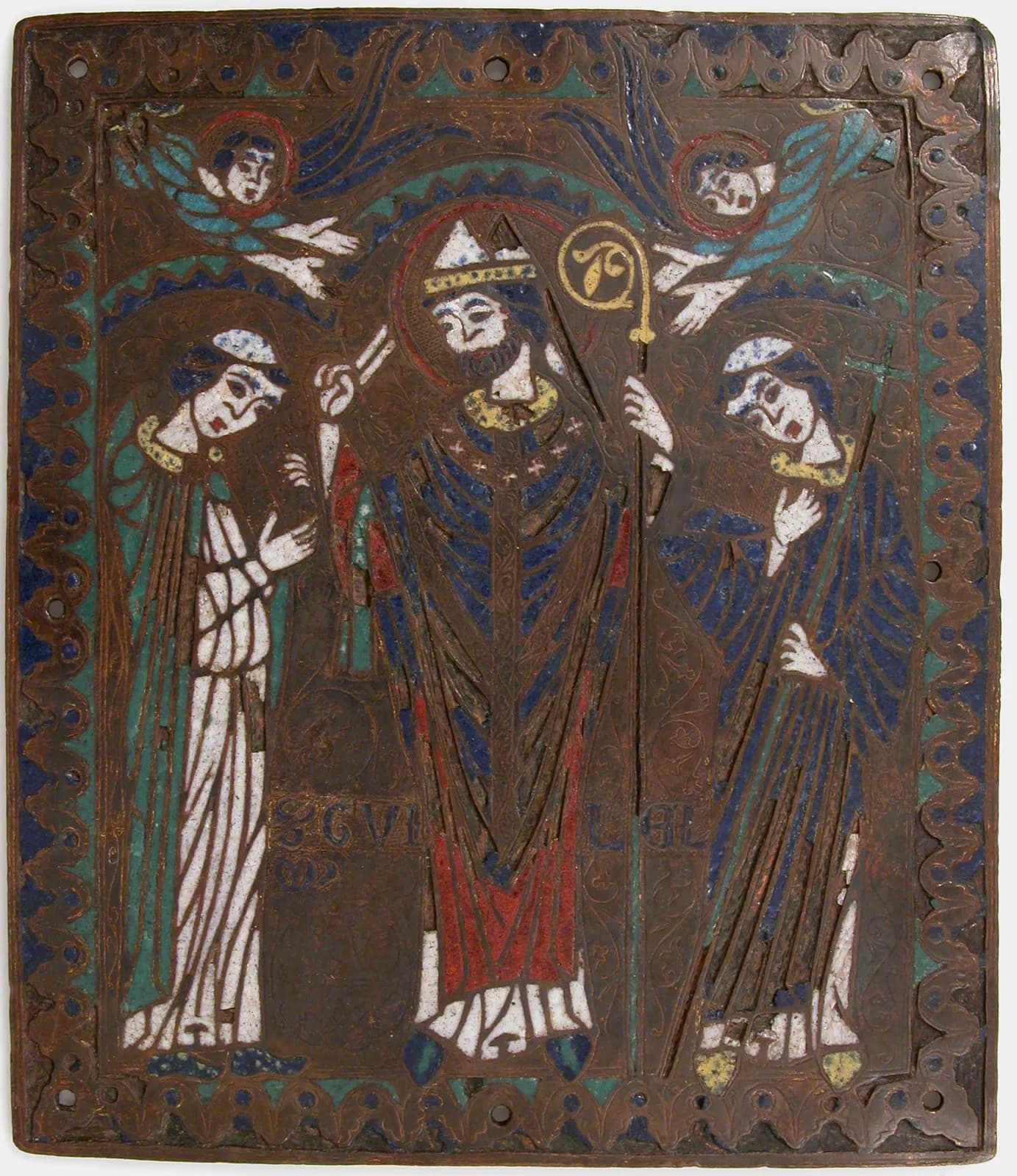
Saint William of Bourges was a Cistercian abbot who was chosen archbishop of Bourges in 1200, accepted only when the pope and his own order commanded him to, and went on living as a monk until his death in 1209. 123 He wore a hair shirt, ate no meat, put the poor first and won back many Albigensians. 12 He died lying on ashes, at his own request, and was canonized nine years later. 12
From canon to monk
katolsk.no says William was born in 1150 at the castle of Arthel in Nevers, on the Loire, and that his father, Baldwin, was Count of Nevers. 1 Alban Butler, whose life of him Catholic.net publishes in Spanish, says only that he came of an illustrious family of Nevers. 2 He is also called William of Donjeon, or William Berruyer. 12
His father meant him for knighthood and the crusade, katolsk.no says, and made the mistake of leaving his education to the boy's uncle, Peter, archdeacon of Soissons. 1 The boy forgot arms and fame and decided to become a priest. 1 He was made a canon of Soissons while still young, and then a canon of Paris. 12
He wanted solitude, and withdrew to the abbey of Grandmont, where he lived the life of that austere order faithfully until, as Butler puts it, a dispute between the choir monks and the other brothers broke the peace. 12 He then joined the Cistercians, an order known for its holiness, and took the habit at Pontigny; katolsk.no dates this to 1167. 12 The Roman Martyrology gives the same turn in its own words: burning with a desire for solitude and meditation, he became a Cistercian monk at Pontigny. 3
Abbot of Chaalis
He was soon made abbot of two smaller houses that depended on Pontigny: first Fontaine-Jean, in the diocese of Sens, in 1184 by katolsk.no's dating, and then, in 1187, Chaalis near Senlis. 12 Butler calls Chaalis a much more important monastery, built by King Louis the Fat in 1136. 2
Butler's portrait of him as abbot is of a gentle man. He always counted himself the last of the monks, he says, and the mildness of his speech showed the joy and peace of his soul; his goodness was attractive in spite of the severity of his penances. 2
An archbishop chosen by lot
Henri de Sully, archbishop of Bourges, died in September 1200. 1 The clergy of the city asked Eudes, Bishop of Paris and Henri's brother, to help them choose, and since they all wanted a Cistercian abbot, three abbots' names were laid on the altar. 12 After prayer Eudes drew William's name, which most of the votes had already favored. 12 It was November 23, 1200. 12
Butler defends the method: drawing lots would have been superstition if the electors had expected a miracle, but all three men seemed equally fit, and the choice was left to God's ordinary providence. 2 William was overwhelmed by the news and would never have accepted if Pope Innocent III and the Abbot of Cîteaux, his superior, had not ordered him to. 12 He left his solitude in tears, Butler says, and was consecrated soon after. 2
A monk in the archbishop's chair
The Roman Martyrology says that as head of the Church of Bourges he never set aside the austerity of monastic life. 3 Butler says he doubled his penances, on the ground that his office bound him to sacrifice himself for others as much as for himself. 2 He wore a hair shirt under his habit and dressed the same in winter and summer. 12 Butler says he never ate meat, though his guests found a good table; katolsk.no says he abstained from red meat. 12
He took the poor as his first charge, and helped them in body and soul, saying that God had sent him above all for them. 12 katolsk.no says he was much sought after as a confessor. 1 The Martyrology in the Italian bishops' edition says he was distinguished for his charity to the clergy, to prisoners and to the needy; the Spanish text names clergy, captives and the unfortunate. 23 Butler adds that he was gentle with repentant sinners and unbending with the unrepentant, but never called in the civil power against them, as was then the custom, and that this won him more than one conversion. 2
He was not a soft man in defense of his Church. When nobles usurped its rights, Butler says, he was not cowed by threats of confiscation and took the case to the king. 2 katolsk.no says he defended its rights and lands against the civil power successfully, even against King Philip Augustus himself. 1 It adds that he rebuked the king over his divorce and remarriage. 1 His own chapter and clergy opposed him more than once, and Butler says his humility and patience carried the day. 12
The Albigensians, and a bed of ashes
The Albigensian heresy flourished in France at the time, and William converted many of its followers. 12 Goyau's encyclopedia article on Bourges records that the principal councils held there in later years, in 1225 and 1226, "dealt with the Albigenses." 4 William himself was preparing a mission to them when his last illness came on. 12
Ill as he was, he insisted on preaching a farewell sermon to his people, and the fever rose and forced him to put off the journey. 12 The next night, Butler says, sensing the end, he asked to anticipate the night office that was sung at midnight, made the sign of the cross on his lips, and could get out only its first two words. 2 He signed to those around him to lay him on a bed of ashes, and died there on January 10, 1209: just after midnight, by katolsk.no's account, and at dawn by Butler's. 12
He was buried in the cathedral of Bourges, and many miracles were attributed to him; katolsk.no says it was claimed he worked eighteen in life and eighteen after death. 12 His remains were placed in a shrine in 1217, and Pope Honorius III canonized him the following year, on May 17, 1218, by katolsk.no's date. 12 The shrine stood behind the high altar. 1 katolsk.no says the Huguenots later burned the relics in the cathedral and scattered the ashes, and that relics given to Chaalis and to a church in Auvergne were scattered by Calvinists, gathered again by the people, and lost once more in 1793. 1
What is Saint William of Bourges the patron saint of?
katolsk.no names Saint William of Bourges as the patron saint of children. 1 It gives no reason, and none of the other sources consulted mentions a patronage. Goyau's article lists him simply as "St. Guillaume de Donjeon (1200-09)" among the later bishops of a see that once counted fifteen saints in its first centuries. 4
Saint William of Bourges's feast day
Praying with Saint William of Bourges
William did not want to be a bishop. He had already left two canonries and one monastery in search of a quieter life, and the election by lot took him out of it again. 12 He went because he was told to, by the pope and by his abbot. 12
What he did with the office was to keep living as a monk and to treat the poor as his first business. 123 He was firm with nobles who took his Church's land and with a king who left his wife, and patient with a chapter that resisted him. 12 With people who had left the faith he would argue and wait, but he would not hand them over to the authorities. 2
He died trying to finish one more mission, and spent his last breath on the opening words of the night office. 12 His life is a fair one to pray with for anyone who has been handed a responsibility they did not seek, and who wants to carry it without losing the prayer that came before.
Saint William of Bourges, pray for us.
Sources
- 1."Den hellige Vilhelm av Bourges (1150-1209)," Den katolske kirke (katolsk.no), Catholic Diocese of Oslo (in Norwegian).
- 2.Alban Butler, "Guillermo de Bourges, Santo," from Vida de los Santos, with the Roman Martyrology entry for January 10, Catholic.net (in Spanish).
- 3.Roman Martyrology, entry for January 10, "San Guglielmo, vescovo," as printed in "Santo del giorno," Conferenza Episcopale Italiana (in Italian).
- 4.Georges Goyau, "Bourges," The Catholic Encyclopedia, Vol. 2 (New York: Robert Appleton Company, 1907).
Saints to turn to next
Others in this collection who are turned to for some of the same things.
- Saint Nicholas of Tolentino1245 or c. 1246 - September 10, 1305 or 1306PrayerPoverty and simplicity
- Saint Agnes of Bohemiac. 1200-1205 - March 1281 or 1282Poverty and simplicityPrayer
- Saint Aidan of Lindisfarnec. 590 - August 31, 651Poverty and simplicityPrayer
- Saint Alexius of RomeFifth century, by traditionPoverty and simplicityPrayer