Saint Willehad
c. 745 - November 8, 789
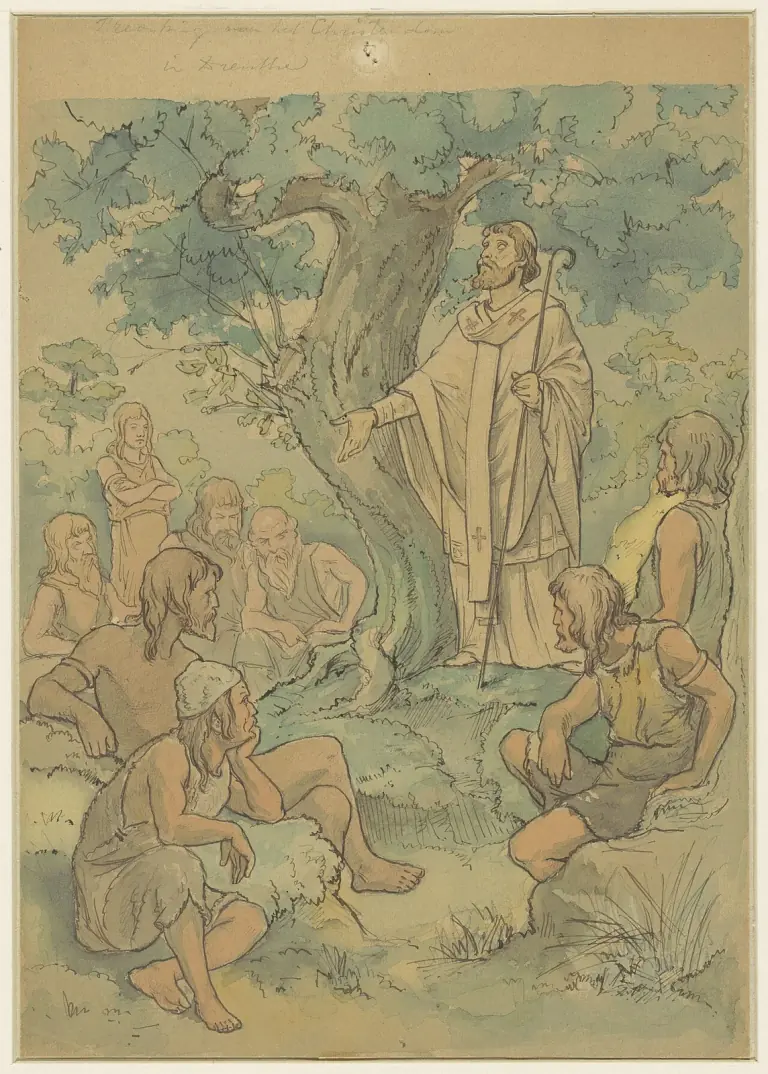
- Also called
- Willehadus, Villehad 3
Saint Willehad was a priest from Northumbria, a friend of Alcuin, who preached in Frisia and then among the Saxons between the Weser and the Elbe, and in 787 became the first bishop of Bremen. 13 Twice his mission was broken up by violence, once in Drenthe, where a sword stroke at his neck was stopped by the cord of the reliquary he wore, and again in the Saxon rising of 782, which killed many of his companions. 23 He died of a fever on November 8, 789, a week after consecrating his wooden cathedral, and his feast is November 8. 14
From York to Frisia
He was born in Northumbria, before 745 according to the Catholic Encyclopedia and in 745 according to katolsk.no. 13 He was a friend of Alcuin, and probably studied at York under Saint Egbert. 13 Butler says his austerity, humility, obedience and constant prayer led his bishop to ordain him priest. 2
The example of the English missionaries who had gone before him, Willibrord in Frisia and Boniface in Germany, "seemed a reproach to him," Butler writes. 2 With the approval of King Alchred of Northumbria he crossed to Frisia: between 765 and 774 according to the encyclopedia, about 765 according to katolsk.no, and about 772 according to Butler. 123
The Martyrology of Baronius called him a disciple of Boniface. The encyclopedia and katolsk.no both say he cannot have been, since Boniface had left England in 718 and died in 754. 13 The current Roman Martyrology, as the Italian bishops print it, says instead that he spread the Gospel in Frisia and Saxony "after" Boniface. 4
Dokkum, Humsterland and Drenthe
He began at Dokkum, where Boniface and his companions had been killed. 123 Butler says he prayed with many tears on the spot, and baptized a great number of people. 2
Farther on, he had little success. 1 At a place the encyclopedia calls Hugmarke, now Humsterland, the people cast lots to decide whether he and his companions should be put to death, and the lots spared them. 23
He went on to Drenthe, where at first things went well. 12 Then some of his companions began destroying the pagan shrines, and the people turned on the missionaries. 23 Butler, citing Saint Anskar, tells how one man swung a sword at Willehad's neck with force enough to take off his head, and the blow only cut the cord on which he wore a small case of relics. 2 katolsk.no tells the same story and remarks that it looks suspiciously like one told of Willibrord on the island of Walcheren. 3
Among the Saxons
In 780 Charlemagne sent him to Wigmodia, the newly conquered Saxon country between the lower Weser and the Elbe, where Bremen now stands. 13 Butler calls him "the first missionary who passed the Elbe"; katolsk.no says he was the first to cross the Weser, and that some of his companions went on beyond the Elbe. 23 He built many churches. 1
In 782 the Saxons rose under Widukind and killed every missionary they could catch. 123 Butler names some of the dead: a priest named Folcard and his companion Emming, and Benjamin, Attrebanus and Gerwal. 2 Willehad escaped by sea to Frisia. 23
He went to Rome to lay his mission before Pope Adrian I. 123 Then, while the war went on, he spent about two years at Willibrord's monastery of Echternach, gathering his scattered fellow workers, praying at Willibrord's tomb, and copying books, among them the letters of Saint Paul. 123 In 785, with Widukind baptized and peace made, he went back. 23
Bishop of Bremen
At Charlemagne's request he was consecrated bishop of the Saxons at Worms in July 787, on the 13th according to the encyclopedia and katolsk.no and on the 15th according to Butler, and he fixed his see at Bremen, which, Butler says, seems only then to have been founded. 123
Butler describes how he lived as bishop. He ate bread with honey, herbs or apples, and allowed himself fish only when his health failed and Pope Adrian ordered it. 2 He drank no wine except at the altar. He said Mass every day, often in tears, and usually recited the whole psalter every day, sometimes two or three times. 2
He built his cathedral of wood, and on Sunday, November 1, 789, consecrated it in honor of Saint Peter. 123 A few days later, on a missionary journey, he fell ill with a fever. 13 One of his disciples begged him in tears not to leave his flock so soon. Butler gives his answer: "Withhold me not from going to God. The sheep of mine I recommend to him who intrusted them to me, and whose mercy is able to protect them." 23
He died on November 8, 789, at Blexen on the Weser. 123 katolsk.no says he was forty-four, the last of the great English missionaries of the eighth century. 3 Butler counts thirty-five years of missionary work, and two years, three months and twenty-six days as a bishop. 2
His relics and his Life
The encyclopedia and katolsk.no say he was buried where he died, and that his successor Willeric later moved his body into the stone church he had built at Bremen. 13 Butler says his body was carried to Bremen "with great pomp" and buried in his cathedral. 2 katolsk.no adds that Saint Anskar, bishop of Bremen from 847, enshrined the relics in 860 in the new stone cathedral. 3 They were lost at the Reformation. 13
His Life was written by a cleric of Bremen some time after 838, and Anskar wrote the book of his miracles. 13 katolsk.no notes that his fame spread to Denmark, whose church was then under Hamburg-Bremen, and that he is shown in art holding a model of a church, often of the cathedral he founded. 3
What is Saint Willehad the patron saint of?
Saint Willehad's feast day
Saint Willehad's feast day is November 8, the day of his death. The current Roman Martyrology, as the Italian bishops print it, enters him that day at Bremen as a bishop, born in Northumbria and a friend of Alcuin, who founded the see of Bremen and governed it wisely. 4 Butler and katolsk.no give the same day. 23
The encyclopedia records that a feast on July 13 once kept the date of his consecration, that his feast was later neglected and forgotten, and that in 1901 the Congregation of Rites allowed it again in the dioceses of Münster, Osnabrück and Paderborn "on a vacant day after 8 November." 1 katolsk.no gives the same history. 3
Praying with Saint Willehad
His mission failed more often than it succeeded. He was driven from Humsterland and Drenthe, and the Saxon rising destroyed his churches and killed his companions. 123
What he did in the gap is worth noticing. He went to Rome, and then sat in a monastery for two years, praying at the grave of the man whose work he was continuing and copying out Saint Paul. 12
Butler's picture of him as bishop is of a man who prayed the psalter daily and said Mass in tears, ate little, and would not slow down when he was ill. 2
He consecrated his cathedral and was dead within the week. His last recorded words hand his flock back to the one who had given it to him. 23
Saint Willehad, pray for us.
Sources
- 1.Francis Mershman, "St. Willehad," The Catholic Encyclopedia, Vol. 15 (New York: Robert Appleton Company, 1912).
- 2.Alban Butler, "St. Willehad, Bishop of Bremen and Apostle of Saxony," November 8, in The Lives of the Fathers, Martyrs, and Other Principal Saints, Vol. XI (Derby: Thomas Richardson and Son, 1846).
- 3.Per Einar Odden, "Den hellige Villehad av Bremen (745-789)," Den katolske kirke (Catholic Church in Norway), katolsk.no (in Norwegian).
- 4.Roman Martyrology, entries for November 8, Santo del giorno, Conferenza Episcopale Italiana (in Italian).
Saints to turn to next
Others in this collection who are turned to for some of the same things.