Saint Alexander of Constantinople
Died at the age of 98, after 23 years as bishop
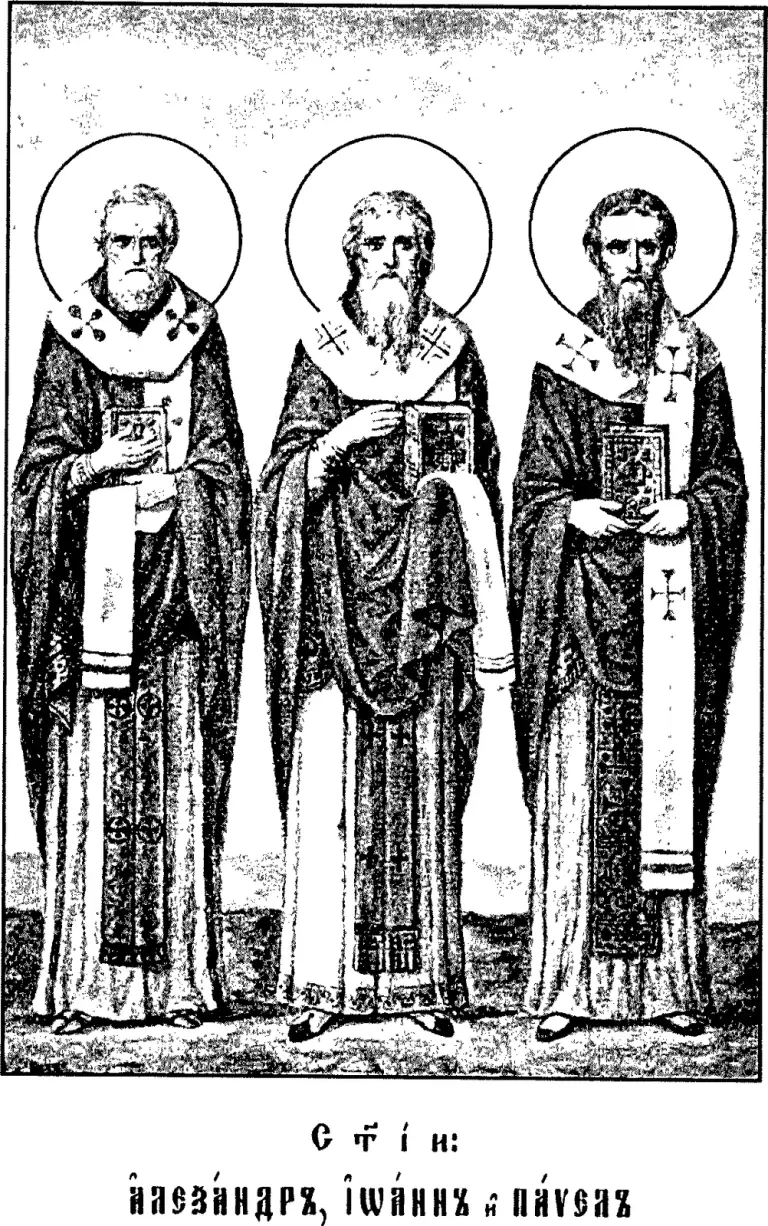
Saint Alexander was bishop of Constantinople in the years after the Council of Nicaea, an old man who held the see for twenty-three years and lived to ninety-eight. 57 When Arius, recalled by the emperor Constantine, was to be received into communion in his church, Alexander refused, was threatened with deposition, and lay face down on the floor of the sanctuary in prayer; before the appointed day came, Arius was dead. 146 The Church commemorates him on August 28. 2
Bishop of the new capital
Socrates, writing in the next century, says that Alexander had succeeded Metrophanes as bishop of Constantinople some time before Arius came there. 4 Theodoret, listing the great bishops of that generation, writes that "Alexander, illustrious for his apostolic gifts, governed the church of Constantinople." 8
The Council of Nicaea had condemned Arius, a priest of Alexandria who taught that the Son of God was not eternal. 4 But Arius had friends at court, chief among them Eusebius, bishop of Nicomedia, and by the last years of Constantine's reign the emperor had been persuaded to recall him. 46 When Arius returned to Alexandria and the city rose against him, Constantine summoned him to Constantinople to account for himself. 4
Under threat
Constantinople divided into two parties, Socrates says, some insisting that the Nicene Creed must not be touched and others that Arius's opinion was reasonable. Eusebius of Nicomedia "had violently threatened that he would cause him to be immediately deposed, unless he admitted Arius and his followers to communion." 4 Sozomen says Alexander first tried to dissolve the council the Eusebians had gathered in the city, and when that failed, "openly refused all covenant with Arius," saying it was neither just nor canonical to undo the vote of the bishops assembled at Nicaea "from nearly every region under the sun." 6
What troubled him, Socrates says, was not his own deposition but the danger to the faith. Regarding himself as "the constituted guardian of the doctrines recognized, and the decisions made by the council at Nicæa," he did everything he could to keep them from being violated. 4
The emperor, meanwhile, examined Arius himself, and Arius signed the Nicene faith and swore to it. Socrates reports, but marks as hearsay, that Arius had written his own opinion on a paper carried under his arm, so that he swore truly to what he held. 4 Athanasius says that Constantine dismissed him with the words, "If your Faith be right, you have done well to swear; but if your Faith be impious, and you have sworn, God judge of you according to your oath." 1 The emperor then ordered Alexander to receive him. 4
The night in the sanctuary
The fullest account is Athanasius's, written to the monk Serapion, from the report of the presbyter Macarius, who was with Alexander. 1 After Arius left the emperor, the followers of Eusebius tried to bring him into the church, and Alexander refused, "saying that the inventor of the heresy ought not to be admitted to communion." They answered: "As we have caused him to be invited by the Emperor, in opposition to your wishes, so tomorrow, though it be contrary to your desire, Arius shall have communion with us in this Church." It was Saturday. 1
Alexander went into the church, stretched out his hands to God, and lay face down on the pavement of the sanctuary. Macarius prayed with him and heard what he asked: "If Arius is brought to communion tomorrow, let me Your servant depart, and destroy not the pious with the impious; but if You will spare Your Church (and I know that You will spare), look upon the words of Eusebius and his fellows, and give not your inheritance to destruction and reproach, and take off Arius, lest if he enter into the Church, the heresy also may seem to enter with him." 1
Socrates tells it slightly differently. He says Alexander told no one what he meant to do, shut himself alone in the church called Irene, and lay weeping beneath the altar "for many successive nights and days," asking that if Arius were right, he himself might not live to see the appointed day, and that if he held the true faith, Arius might suffer the punishment due to his impiety. 4 Sozomen says he "continued all the night in prayer." 6 Theodoret reprints Athanasius's account whole. 9
The death of Arius
That Saturday afternoon Arius walked through the city surrounded by his supporters. Near the Forum of Constantine he was seized by a sudden pain and went aside to relieve himself, and there he died. 46 Athanasius describes it in the words Acts uses of Judas, "falling headlong he burst asunder in the midst," and says that Arius "was deprived both of communion and of his life together." 1
Not everyone read it the same way. Sozomen records three opinions: some thought Arius had died of a sudden disease of the heart, or of excitement that his affairs were going his way; others that it was a judgment on his impiety; and his own followers that it was brought about by magic. 6 Athanasius had no doubt that it was the Lord's judgment between the threats of Eusebius and the prayer of Alexander. 1
Athanasius is careful about what Alexander did next. He celebrated the Communion "with piety and orthodoxy," praying with all the brethren and glorifying God, "not as exulting in his death (God forbid!), for 'it is appointed unto all men once to die,'" but because the matter had been settled in a way beyond human judgment. 1 Athanasius himself admits that he hesitated a long time before writing about the death at all, "fearing lest any one should suppose that I was exulting in the death of that man." 1
His successor
Alexander died at ninety-eight, after twenty-three years as bishop, without having ordained anyone to succeed him. 57 Asked by his clergy whom he wanted, he named two men and left the choice to them. 57
The historians record his words differently. In Socrates, he said that if they wanted a man "competent to teach, and of eminent piety," they should elect Paul, a young presbyter he had ordained himself; but if they wanted "a man of venerable aspect, and external show only of sanctity," they might take the aged deacon Macedonius. 5 In Sozomen, the contrast is gentler: Paul if they wanted a man "good in Divine matters and one who is apt to teach," Macedonius if they wanted one "conversant with public affairs, and with the councils of rulers." 7 Paul was elected, which Socrates says was "more in accordance with the suffrage of the deceased." 5
While Alexander lived, Socrates adds, those who held the faith of Nicaea in Constantinople always had the advantage; after his death the contest became doubtful. 5
What is Saint Alexander of Constantinople the patron saint of?
Saint Alexander of Constantinople's feast day
Saint Alexander of Constantinople's feast day is August 28. The current Roman Martyrology commemorates him on that day as the bishop of Constantinople whose apostolic prayer, as Saint Gregory Nazianzen writes, crushed the head of the Arian impiety. 2 The 1897 English edition of the Martyrology also has him on August 28, as "an aged and celebrated man, through whose efficacious prayers" Arius was condemned by the judgment of God. 3
Praying with Saint Alexander
Alexander was an old man facing a direct order from the emperor and the threats of a powerful bishop. 45 He did the one thing left to him: he went into his church and prayed. 14
His prayer, as Macarius heard it, offered his own life first. If Arius was to be received, he asked to be taken. 1 He did not ask to win; he asked that the Church be spared. 1
When the answer came, Athanasius, telling the story, was careful to say that Alexander did not rejoice at a man's death. 1 He went to the altar and gave thanks with his people. 1
At the end of his life he was still thinking about who would teach them. 57
Saint Alexander of Constantinople, pray for us.
Sources
- 1.Saint Athanasius, Letter 54, to Serapion, concerning the death of Arius, trans. Archibald Robertson, Nicene and Post-Nicene Fathers, Second Series, Vol. 4 (1892).
- 2.Roman Martyrology, entries for August 28, Santo del giorno, Conferenza Episcopale Italiana (in Italian).
- 3.The Roman Martyrology, August 28 (Baltimore: John Murphy & Co., 1897).
- 4.Socrates Scholasticus, Ecclesiastical History, Book I, chapters 37-38, trans. A. C. Zenos, Nicene and Post-Nicene Fathers, Second Series, Vol. 2 (1890).
- 5.Socrates Scholasticus, Ecclesiastical History, Book II, chapter 6, trans. A. C. Zenos, Nicene and Post-Nicene Fathers, Second Series, Vol. 2 (1890).
- 6.Sozomen, Ecclesiastical History, Book II, chapter 29, trans. Chester D. Hartranft, Nicene and Post-Nicene Fathers, Second Series, Vol. 2 (1890).
- 7.Sozomen, Ecclesiastical History, Book III, chapter 3, trans. Chester D. Hartranft, Nicene and Post-Nicene Fathers, Second Series, Vol. 2 (1890).
- 8.Theodoret, Ecclesiastical History, Book I, chapter 2, trans. Blomfield Jackson, Nicene and Post-Nicene Fathers, Second Series, Vol. 3 (1892).
- 9.Theodoret, Ecclesiastical History, Book I, chapter 13, "Extract from the Letter of Athanasius on the Death of Arius," trans. Blomfield Jackson, Nicene and Post-Nicene Fathers, Second Series, Vol. 3 (1892).
Saints to turn to next
Others in this collection who are turned to for some of the same things.