Saint Benno of Meissen
c. 1010 - 1106
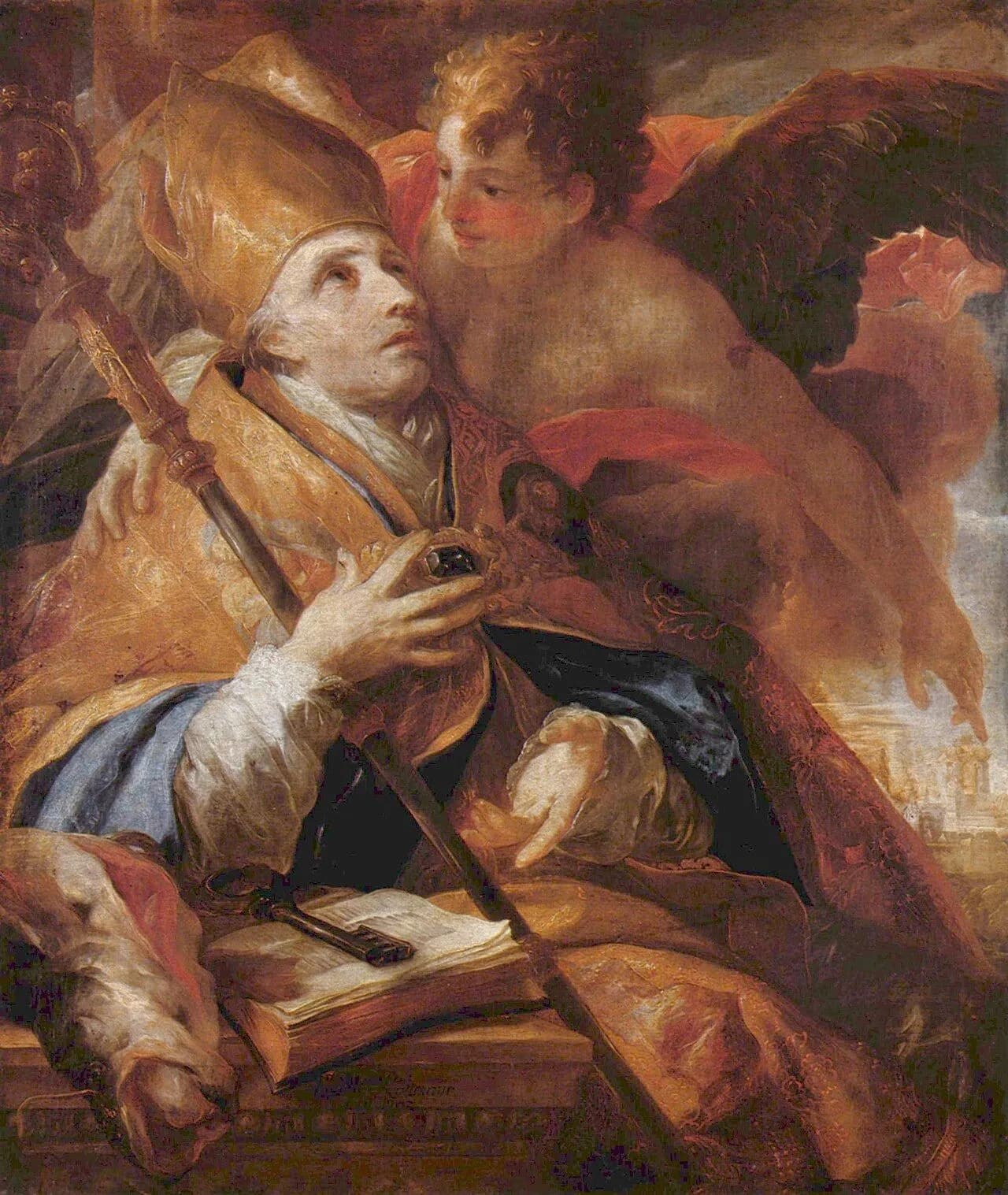
- Born
- About 1010, at Hildesheim, by later tradition 1; the encyclopedia says this "cannot be proved" 2
Saint Benno was bishop of Meissen, in Saxony, for forty years in the late eleventh century, through the worst of the struggle between the German emperor Henry IV and the popes. 12 He was imprisoned by the emperor, deposed by the emperor's bishops and driven out of his diocese, and yet he died at Meissen, an old man, in 1106. 124 The Church canonized him only in 1523, as Luther's revolt was spreading through Saxony, and his bones were later carried off to Munich, which has kept him as its patron ever since. 123
What can be known
The fullest account of his early life comes from a biography written in 1512, four centuries after his death, by Hieronymus Emser, a doctor of canon law. 1 According to the Norwegian biography that follows it, Benno was born in 1010 at Hildesheim, the son of a Saxon count, Frederick of Bultenberg, was handed over at five to his kinsman Saint Bernward, bishop of Hildesheim, and became a Benedictine monk at St. Michael's there. 1 Elected abbot in 1042, he is said to have resigned after three months because he did not think himself up to it. 1
The Catholic Encyclopedia is blunt about all of this. His parentage, his education by Bernward and the date of his birth "cannot be proved to be historically correct." 2 What is certain, it says, is that he was a canon of Goslar about the middle of the eleventh century and that he was made bishop of Meissen in 1066. 2 At Goslar he was also, katolsk.no adds, chaplain to the emperor Henry III, and he ran its school for seventeen years. 1
A bishop in the investiture conflict
Meissen was a frontier diocese on the Elbe, reaching east into lands where many of the people were still pagan Slavs, known as Wends. 23 The Norwegian biography describes Benno as a just and merciful bishop who cared greatly for the dignity of the liturgy, introduced chant at Meissen as he had learned it in Hildesheim, visited his diocese every year and gave nearly all his income to the poor. 1
The trouble came from the young king. Henry IV crushed the Saxon nobility with heavy taxes and forced labor, and in 1073 they rose against him. 12 On Benno's part in it the sources do not agree. The encyclopedia's article on him says simply that he "took part in the revolt of the Saxon nobles." 2 The same encyclopedia's article on Meissen says that "he had taken no part in the Saxon revolt." 3 katolsk.no splits the difference: he had encouraged the nobles earlier, then stayed neutral so as not to put his missionary work at risk. 1
Either way he suffered for it. After Henry's victory in 1075 Benno was taken prisoner. The Benno article says he was held "for a year," and the Norwegian biography agrees, dating it 1075 to 1076; the Meissen article says nine months. 123
Deposed, restored, and an antipope
Once free, he sided with Pope Gregory VII against the king. 123 katolsk.no has him stay away from the synod at Worms in 1076 where Henry and his bishops declared the pope deposed, travel to Rome, and later join the princes who elected Rudolf of Swabia as rival king. 1 In 1085 Henry's bishops deposed him. 12 The encyclopedia names his replacement, an imperial partisan called Felix. 2 The Benno article and katolsk.no put this at the synod of Mainz; the Meissen article says he was deprived of his office because he had taken part in the Gregorian synod of Quedlinburg. 123
How he got his diocese back is the least comfortable part of the story. The encyclopedia says that three years later "Benno recognized the Antipope Wibert (Clement III) and obtained his see again," and only "at a later date" separated himself from the schismatic party and recognized Urban II. 2 katolsk.no tells it the same way, dating his return to 1088 and his submission to Urban to 1097. 1 Lins, in the Meissen article, says that after Gregory's death Benno made peace with Henry and was reappointed in 1086. 3
The Roman Martyrology remembers none of this complication. It says that he was driven from his see and sent into exile because he wished to preserve the unity of the Church and fidelity to the Roman Pontiff. 4 Both things are true of a man who lived forty years in a divided Church: he lost his see for the pope and, for a time, regained it through the wrong one.
The Apostle of the Wends
According to later tradition, Benno gave his last years to missions among the Slavs to the east. 2 The Meissen article says that after his restoration he "devoted himself entirely to missionary work among the Slavs." 3 katolsk.no calls him the Apostle of the Wends and notes that the Sorbs of Saxony, their descendants, have kept their Catholic faith to this day. 1 The encyclopedia adds that he "was reputed to be the founder of the cathedral of Meissen" and became the most venerated bishop the diocese had. 2
He died at Meissen, probably on June 16, 1106, and was buried in the cathedral. 12
The fish and the key
He is painted with a fish holding a key, and the story behind it is told in two versions. In the encyclopedia's, Benno, setting out for Rome, gave the key of Meissen Cathedral to one of the canons "with the command to throw it into the Elbe as soon as Henry IV should be excommunicated." 2 The canon did. When Benno came home, "a large fish was caught in the Elbe and the key was found hanging to one of its fins." 2 In the Norwegian telling the canons were to lock the cathedral and throw the keys into the river if the king's troops besieged the town, and the keys turned up in the fish's stomach. 1 katolsk.no points out the echo of the coin in the fish's mouth in Matthew's Gospel. 1
A gentler story has him tell the croaking frogs in a field to be quiet, and then remember that the canticle of Daniel calls on everything that moves in the waters to bless the Lord, and tell them to carry on. It is told of other saints as well. 1
A canonization against Luther
Benno was canonized by Pope Adrian VI in 1523. 12 The Meissen article is candid about why: the canonization, urged by Bishop John VII of Schleinitz, "was intended to offset the progress of the Lutheran teaching." 3 When the relics were raised in 1524 (on May 16, according to the encyclopedia, or June 16, according to katolsk.no), Luther answered with a pamphlet titled Against the New Idol and Old Devil to Be Raised at Meissen. 12
Saxony went Protestant in 1539. 13 The Norwegian biography says Benno's grave was broken open so the bones could be thrown into the Elbe, but the bishop had already removed them to his castle at Stolpen. 1 In 1576 Duke Albert V of Bavaria had them brought to Munich, and in 1580 they were laid in the Frauenkirche, now the cathedral, where katolsk.no says his torn cope, his staff and his miter are also shown. 12
What is Saint Benno the patron saint of?
Saint Benno is the patron saint of Munich, and has been, the encyclopedia says, since his relics arrived there. 2 katolsk.no adds Old Bavaria, Meissen, Berlin and Görlitz, and the dioceses of Dresden-Meissen and Munich-Freising. 1 He is also listed as patron of fishermen and of cloth makers, and is invoked against plague, drought and storms, and for rain. 1
Saint Benno's feast day
Saint Benno's feast day is June 16. The Roman Martyrology enters him on that day, the encyclopedia gives the same date, and katolsk.no says it is an obligatory memorial in the Archdiocese of Munich and Freising and a solemnity in the city of Munich itself. 124 June 16 is also the day he probably died. 2
Praying with Saint Benno
Benno spent most of his episcopate caught between powers far larger than his diocese: an emperor who imprisoned him, a pope he sided with, rival kings, rival popes. 12 The sources cannot even agree which side of a rebellion he stood on. 23 A reader who expects a saint to have picked the right side at every turn will not find one here. What the record shows is a bishop who kept trying to get back to his people and, when he did, went back to work among them. 13
The canonization adds its own lesson. He was declared a saint four centuries after he died, partly as a weapon in a new fight, and Luther mocked him for it. 23 And yet the devotion outlasted the polemic. When Saxony went Protestant, Catholics carried his bones to safety, and Munich has kept him ever since. 12
The legends that stuck to him are small and domestic: a key at the bottom of a river, a fish, a field full of frogs. 12 They suggest that the people who remembered him thought of him less as a party to great quarrels than as an old bishop who expected God to look after the keys of his church.
Saint Benno of Meissen, pray for us.
Sources
- 1.Per Einar Odden, "Den hellige Benno av Meissen (1010-1106)," Den katolske kirke (the Catholic Church in Norway), katolsk.no (in Norwegian).
- 2."Benno, Saint," The Catholic Encyclopedia (New York: Robert Appleton Company, 1907-1912), unabridged entry as published by Catholic Answers.
- 3.Joseph Lins, "Meissen," The Catholic Encyclopedia, Vol. 10 (New York: Robert Appleton Company, 1911).
- 4.Roman Martyrology, entry for June 16, "San Benno, vescovo," as printed in "Santo del giorno," Conferenza Episcopale Italiana (in Italian).
Saints to turn to next
Others in this collection who are turned to for some of the same things.