Saint Vladimir of Kiev
956 - July 15, 1015
- Born
- 956, son of Sviatoslav and grandson of Saint Olga 1
- Ruler of Kiev
- From 980 1
- Wife
- Anna, sister of the Byzantine emperor Basil II 1
- Died
- July 15, 1015, at Berestova 1
Saint Vladimir was the pagan prince of Kiev who was baptized in 988 and brought his people into the Church with him. 12 John Paul II called him "the protagonist of the Baptism in 988," whose heritage he traces first of all in "the Russian, Ukrainian and Byelorussian nations." 2 He had come to his throne by a war in which his brother was killed, and he died in 1015 on the way to fight his son. 1 His feast is July 15. 14
A pagan prince
He was born in 956, the grandson of Saint Olga, who had become a Christian and could not persuade her own son to follow her. 12 That son, Sviatoslav, "lived and died a pagan and brought up his son Vladimir as a pagan chieftain," in the words of the Catholic Encyclopedia. 1 Vladimir was the third son, born to a woman of the court the encyclopedia calls Olga Malusha, and when his father divided his lands the boy was given Novgorod, which his two brothers had refused. 1
War broke out between those brothers after Sviatoslav died in 972. Yaropolk defeated Oleg, and Vladimir, fearing he was next, fled to Scandinavia. 1 He came back a few years later with an army, retook Novgorod, and marched south. He captured Polotzk, killed its prince, and married the prince's daughter, who had been promised to Yaropolk. Then he besieged Kiev. Yaropolk fled, surrendered, and was killed, and in 980 Vladimir was master of the whole country. 1
The encyclopedia does not soften what kind of ruler he was at first. He had five wives, and by them ten sons and two daughters. 1 He set up statues and shrines to Perun and the other Slavic gods in Kiev, and he spent the 980s at war on his borders. 1
The baptism of 988
Christianity was already present around him. John Paul II, writing for the millennium in 1988, notes that a Christian church stood in Kiev in 944 and that Olga was baptized about 955. 2 The encyclopedia says the faith "had been making secret progress throughout the land" since her day. 1
How Vladimir himself came to it is told in the old Chronicle of Nestor, which the encyclopedia follows. He sent envoys to inquire into the religions of his neighbors. They reported unfavorably on the Muslim Bulgarians, the Jewish Khazars and the Germans "with their plain missionary Latin churches," and came home "delighted with the solemn Greek ritual" of the great church of Constantinople. 1 They reminded him that his grandmother had chosen that faith. 1
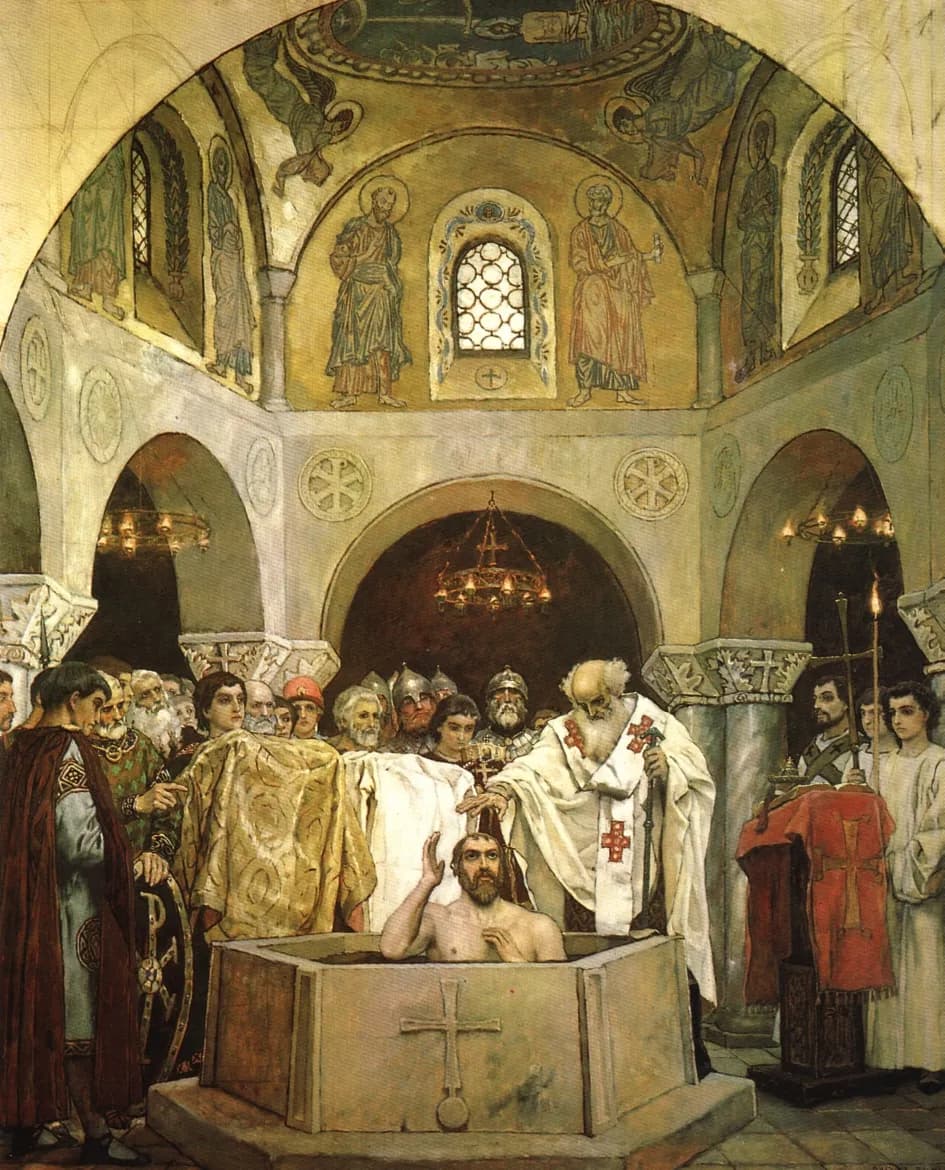
What followed was a negotiation. In 988 Vladimir took the Byzantine city of Kherson, in the Crimea, by cutting off its water, and then asked the emperor Basil II for the hand of his sister Anna, with a threat to march on Constantinople if he was refused. 1 The emperor answered that a Christian could not marry a pagan. Vladimir replied that he had already studied the Christian teaching and was ready to be baptized. 1 Anna came to Kherson with clergy, and there, the encyclopedia says, he was baptized by the Metropolitan Michael and took the name Basil. 1
The encyclopedia adds what it calls a "current legend" that he had gone blind before Anna arrived and recovered his sight at the font. 1 It also records a Russian historian's suggestion that he could have been baptized quietly in Kiev long before, and preferred to receive the faith from the emperor's envoys as something that would impress his people. 1
John Paul II reads the same event from the other side. Vladimir, he writes, "accepted the Christian faith and brought about the permanent and definitive conversion of the people of Rus'." 2 The Pope does not deny the politics. He says Vladimir "also saw in this a decisive element for the civil and human progress" of his nation. 2
Kiev in the Dnieper
He married Anna, put away his other wives, gave Kherson back to the Greeks, and returned to Kiev. 1 There he had the idols thrown down, hacked apart and burned. The statue of Perun was dragged through the mud and thrown into the Dnieper. 1
The people were told to follow their prince, and by the encyclopedia's account they did so willingly, "even wading into the river that they might the sooner be reached by the priest for baptism." 1 One historian it cites took that readiness as a sign that Christian teaching had already spread quietly in the city. 1 John Paul II's letter opens with the same scene, giving thanks for what happened "on the banks of the Dnieper, at Kiev, capital of Rus'." 2
The rest of his reign was spent building. He founded churches and monasteries in Kiev and in a string of other cities, raised the Church of Saint Mary, called the Cathedral of the Tithes, in 989, and the Church of the Transfiguration in 996. 1 He set up schools and church courts. The encyclopedia says he "gave up his warlike career" and "became known for his mildness." 1
Constantinople and Rome
The new church took its liturgy, theology and art from Constantinople. 2 It prayed in Old Slavonic, the liturgical language introduced by Saints Cyril and Methodius, and John Paul II credits Vladimir with accepting it "in the place of Greek," a choice he says was "moved by solicitude for the good of the Church and of his people." 2
The Pope lays weight on the date. The baptism of Rus' came, he writes, "at the end of the first millennium, when the Church was undivided," while Constantinople and Rome were still in full communion. 2 He cites the Chronicle of Nikon for an exchange of legations between Vladimir and the popes of his day, and he notes that the missionary bishop Bruno of Querfurt visited Vladimir about 1007. 2 Catholics and Orthodox alike are his heirs, and the letter speaks of "all the spiritual sons and daughters of Saint Vladimir." 2 In his message to Ukrainian Catholics the Pope calls their Church one "which has sprung from the thousand-year old inheritance of Saint Vladimir." 3
His last years
Anna died in 1011. 1 The encyclopedia says she had borne him two sons, Boris and Gleb, who are honored as saints; John Paul II recalls "the innocent death of Boris and Gleb, Vladimir's sons, killed by their brother Svyatopolk." 12
His older children gave him trouble. He had divided his realm among them, following the custom of his ancestors, and his son Yaroslav, ruling Novgorod, refused him service and tribute. In 1014 Vladimir prepared to march north against him. He fell ill on the way and died at Berestova on July 15, 1015. 1
What is Saint Vladimir of Kiev the patron saint of?
None of the sources consulted for this page names Saint Vladimir as patron saint of a particular country, trade or need. 123 What they give him are titles. His feast calls him "equal to the Apostles." 1 John Paul II says his baptism earned him the name "of Saint and of Father of the Nations which took their origin from that principality." 2 A Ukrainian Greek Catholic bishop, preaching at a liturgy in his honor in 2011, called him the Baptizer and the Enlightener of the nation. 6
Saint Vladimir of Kiev's feast day
His feast is July 15, the day of his death. The encyclopedia gives that date for both the Russian Orthodox and the "Ruthenian Greek Catholic" calendars, and a 2026 report from the Ukrainian Greek Catholic Church describes July 15 as "the feast day of St. Volodymyr the Equal-to-the-Apostles." 14 By the Julian reckoning the day falls later in the civil year: in 2023 that Church announced his day for July 28 "according to the Julian calendar." 5 None of the sources consulted lists him in the general Roman calendar.
Praying with Saint Vladimir of Kiev
Nobody reading the first half of his life would pick him for a saint. He made war on his brother for a throne, the brother was killed, and he filled his capital with idols. 1 Even his baptism, as the encyclopedia tells it, was bargained for with an army camped outside a captured city. 1
The same source says he came home different. He dismissed his other wives, tore down what he had built, and governed for the rest of his life with a mildness nobody had seen in him before. 1 The Ukrainian bishop Bohdan Dzyurakh, preaching in Kyiv, put it this way: for Volodymyr "the life of a Christian did not mean something superficial or purely ritualistic but an internal change of one's life." 6
He did not keep the faith to himself, and his sources disagree about how gently he shared it. The encyclopedia has him ordering and the people complying gladly. 1 John Paul II describes him "inviting the Church's missionaries to inscribe this name on the hearts of the Slavs." 2
His end was not peaceful. He died on campaign against a rebellious son, and two of his other sons were murdered by a third. 12 The Pope suggests that the memory of Boris and Gleb helped give the Eastern Slavs their devotion to the Passion of Christ. 2
Saint Vladimir of Kiev, pray for us.
Sources
- 1.Andrew Shipman, "St. Vladimir the Great," The Catholic Encyclopedia, vol. 15 (New York: Robert Appleton Company, 1912).
- 2.John Paul II, Apostolic Letter Euntes in Mundum, on the Millennium of the Baptism of Kievan Rus', January 25, 1988. English text in the Catholic Culture document library.
- 3.John Paul II, Message to Ukrainian Catholics Magnum Baptismi Donum, February 14, 1988. English text in the Catholic Culture document library.
- 4."God Transformed the Waters of the Dnipro River into the Waters of Our People's Rebirth," Ukrainian Greek Catholic Church, July 15, 2026.
- 5."His Beatitude Sviatoslav Urges Ukrainians to Renew Baptismal Vows on the 1035th Anniversary of the Baptism of Rus-Ukraine," Ukrainian Greek Catholic Church, July 27, 2023.
- 6."Volodymyr the Great - Saint Baptizer and Enlightener," Bishop Bohdan Dzyurakh, Information Resource of the Ukrainian Greek-Catholic Church, July 30, 2011.
Saints to turn to next
Others in this collection who are turned to for some of the same things.