Saint Vitus
Unknown; martyred in southern Italy, venerated by the fifth century
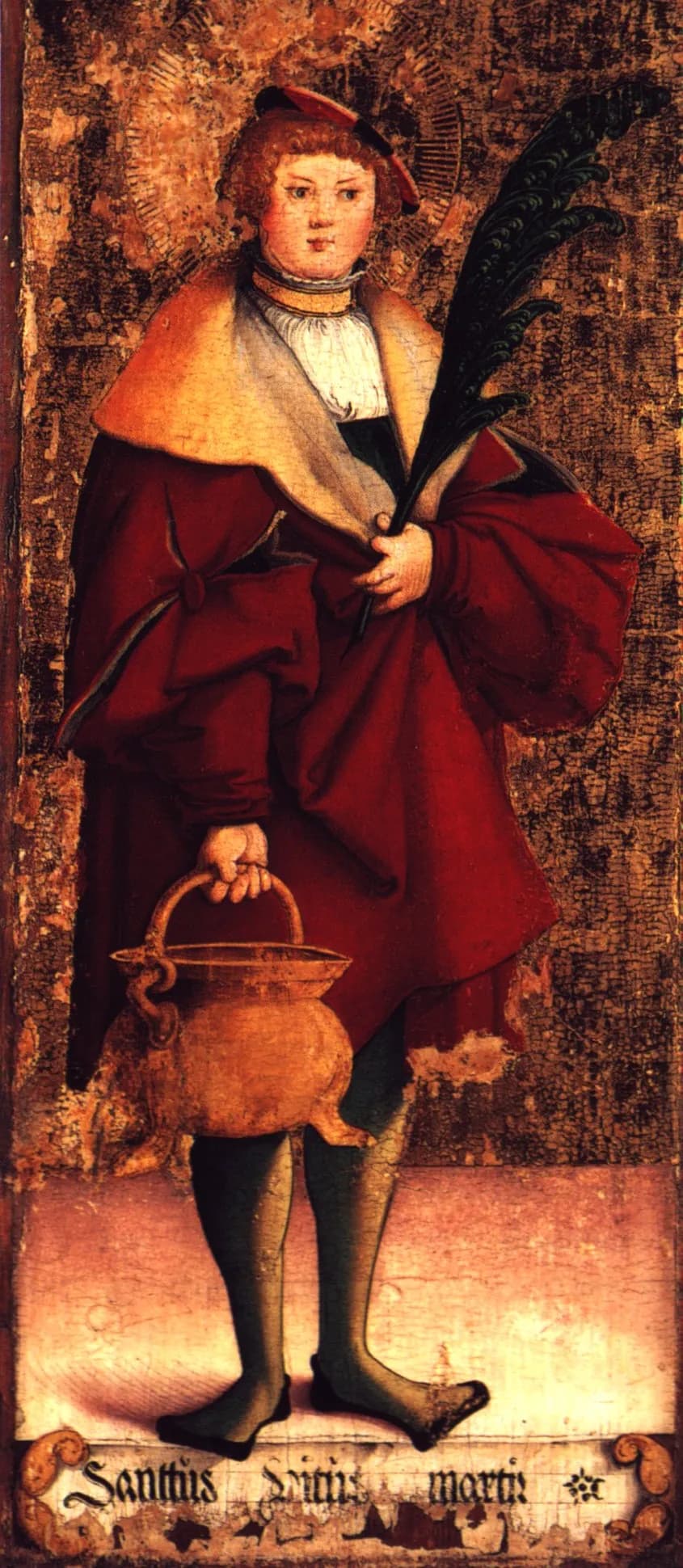
- Patron saint of
- Those with epilepsy 1245 and chorea, called St. Vitus' dance 45; dancers and actors 45; Prague and its cathedral 45. Rabenstein's list adds oversleeping, storms, lightning, dogs and domestic animals, comedians, coppersmiths and young people 5
- Feast day
- June 15, with Saints Modestus and Crescentia 125; removed from the General Roman Calendar in 1969, by one account 4
- Historical record
- Venerated as a martyr by the fifth century; the story of his martyrdom is a later legend with "no historical value" 1
Saint Vitus was a boy martyr of southern Italy whose death is certain and whose story is not. The 1912 Catholic Encyclopedia says his listing with Modestus and Crescentia in a fifth-century martyrology "proves positively that they are historical martyrs," and then that there are "no historical accounts of them, nor of the time or the details of their martyrdom." 1 Vatican News puts it more briefly: "Little is definitively known about St Vitus, apart from the fact of his martyrdom in Lucania." 2 What grew from that small fact was enormous. He became one of the Fourteen Holy Helpers, the saint invoked against epilepsy and the shaking illness still called St. Vitus' dance, and the patron of the cathedral of Prague. 145
What the record holds
Johann Peter Kirsch, writing the encyclopedia article, starts from the oldest witness. The Martyrologium Hieronymianum, in a note found in all three of its most important manuscripts and so going back to a fifth-century original, reads "In Sicilia, Viti, Modesti et Crescentiae." 1 On the same day the same martyrology puts another Vitus at the head of a list of nine martyrs "In Lucania," the Roman province in the far south of Italy between the Tuscan Sea and the Gulf of Taranto. 1 Since only a region is named in each case, Kirsch thinks it "easily possible" that both entries mean the same martyr. 1 Katherine Rabenstein, in an excerpt published by Catholic Culture, reads it the other way: there may be two groups, Vitus alone in Lucania, whose cult is older, and Vitus, Modestus and Crescentia in Sicily. 5
Either way, the public veneration is early and well attested. Pope Gelasius, who reigned from 492 to 496, mentions a shrine dedicated to Vitus, and Gregory the Great mentions a monastery named for him in Sicily. 1 In the seventh century a chapel of one of Rome's deaconries was dedicated to him. 1 Rabenstein adds that he appears alone in the Gelasian Sacramentary and in an early South Italian Gospel book, which gives his feast the reading of a cure from possession and sickness. 5
The legend of the boy and the emperor
In the sixth and seventh centuries, Kirsch writes, a "purely legendary narrative" of the martyrdom appeared, built from other legends and "ornamented with accounts of fantastic miracles." 1 He summarizes it this way. Vitus is a boy of seven, or twelve in other versions, the son of a pagan senator of Lucania. In the reign of Diocletian his father tries everything, torture included, to make him give up his faith, and he holds firm. 1 He flees by boat with his tutor Modestus, and is later taken to Rome to drive out a demon that has seized a son of Diocletian. He does it, and because he still will not give up Christ, he is tortured with Modestus and with his nurse Crescentia. 1 An angel carries the three back to Lucania, where they die of what they have suffered, and three days later Vitus appears to a matron named Florentia, who finds the bodies and buries them. 1
Kirsch draws a plain conclusion: "the author of the legend has connected in his invention three saints who apparently suffered death in Lucania, and were first venerated there." 1
The versions disagree with one another freely. Rabenstein's, which she introduces as "unreliable legend," makes the father Hylas, a senator in Sicily, and has the boy converted by the servants who looked after him. 5 In her telling the torments include a cauldron of molten lead and a hungry lion that only licks him, and one version lets the three go free after a storm destroys the temples. 5 A life from the Orthodox tradition, also reprinted by Catholic Culture, names the father Gelas and has a lion lie down at the Sign of the Cross; it dates the deaths to 303. 6 Francis Weiser, writing in 1956, has the boy freeing Diocletian's daughter rather than his son. 4
From Corvey to Prague
The relics are what carried him north. In the eighth century, it is said, Abbot Fulrad brought relics of Vitus to the monastery of Saint-Denis, and they were later given to Abbot Warin of Corvey, who moved them to his abbey in 836. 1 Rabenstein places Corvey in Saxony. 5 From Corvey, Kirsch says, devotion spread through Westphalia and across eastern and northern Germany. 1 Weiser adds that Corvey was a missionary center and that its monks took the veneration of Vitus to Germanic and Slavic peoples; by the thirteenth century he was honored across France, Germany, England, Scandinavia and eastern Europe. 4
Of all the churches built in his honor, Weiser names Saint Vitus' Cathedral in Prague as the most famous. 4 The Orthodox life says the Czech prince Wenceslaus built a church to Saint Vitus there and was later buried in it. 6 When Benedict XVI prayed Vespers in that cathedral in 2009, he named the martyrs of the Czech Church, Wenceslaus, Adalbert and John Nepomuk, and added "the example of the young Saint Vitus, who preferred to die a martyr's death rather than betray Christ." 3
Why it is called St. Vitus' dance
Kirsch says simply that Vitus is appealed to "above all, against epilepsy, which is called St. Vitus's Dance." 1 Vatican News says he was known for healing miracles and is invoked "especially against epilepsy and other neurological disorders." 2 Rabenstein records that his relics were said to have healing power, "especially when epileptics prayed before them." 5
Weiser gives a longer history. The patronage covered epilepsy, chorea and "all other diseases connected with nervous shaking and muscular spasms," because medieval people believed such illnesses came from the Devil, and in the legend Vitus had freed the emperor's child from the Evil One. 4 He quotes a twelfth-century text, which he identifies as the annals of the Holy Roman Empire: "Saint Vitus was a little boy; in his torture he prayed to God; whoever has the falling sickness goes to him for help." 4
During the outbreaks of dancing mania that swept western Europe between the fourteenth and sixteenth centuries, Weiser continues, the afflicted were brought to his shrines and led three times around his altar or statue in the hope of relief. 4 Later the patronage passed from the illness to the art, and Vitus became the patron of dancers and actors. 4 Weiser also explains the rooster that often stands beside him in paintings: in the Middle Ages people brought roosters, hens and eggs as offerings to his shrines. 4
What is Saint Vitus the patron saint of?
Epilepsy above all. Kirsch, Vatican News, Weiser and Rabenstein all name it, and Weiser and Rabenstein add chorea, the illness that carries his name. 1245 Kirsch also counts him among the Fourteen Holy Helpers, "the Fourteen Martyrs who give aid in times of trouble." 1
Prague is his. Catholic Culture says he is the patron of Prague and that its cathedral is under his patronage, and Rabenstein's list includes Czechoslovakia. 5 Dancers and actors come from the history Weiser tells. 4
Rabenstein's full list is much longer: actors, comedians, mummers, coppersmiths, dogs and domestic animals, young people, and protection against lightning, storms, snakebite, wild beasts and oversleeping. 5 None of the other sources explains those, and they are given here as her list gives them.
Saint Vitus's feast day
His feast is June 15, kept together with Modestus and Crescentia. Kirsch records that the feast of the three passed into the historical martyrologies of the early Middle Ages and stands in the Roman Martyrology on June 15. 1 Vatican News lists "St Vitus, Martyr in Lucania" on that day, alongside Saint Germaine Cousin and Saint Bernard of Menthon. 2
Weiser, writing for Catholic Culture's reprint, says the feast "has been suppressed since the reform of the Calendar in 1969." 4 Catholic Culture's calendar still lists Vitus on June 15 as a commemoration from the Roman Martyrology, and notes that in the 1962 Missal the day is the feast of Saints Vitus, Modestus and Crescentia. 5 The Orthodox life adds that the three are remembered on May 16 as well. 6
Praying with Saint Vitus
The record of this saint is a name in a list. By the fifth century churches in Sicily and southern Italy were keeping a Vitus as a martyr, and nothing survives about when he died or how. 1 The story told of him afterward is a legend, and Kirsch says so without softening it. 1 A page about him has to hold both facts, and the devotion of fifteen centuries rests mostly on the first.
The legend centers on a child who will not give way, first to his father and then to the emperor. 1 Benedict XVI drew that one thread out of it in Prague: a young saint "who preferred to die a martyr's death rather than betray Christ," set beside the bishops, priests and lay people who held out under Communist persecution in the twentieth century. 3
Many who came to him, in the history Weiser tells, were asking for healing. He writes of the many children suffering from "Vitus' dance," of the falling sickness named in the old annals, and of the sick led three times around an altar or a statue in the hope of relief. 4 The sources record the asking; none of them claims to know how often it was answered.
Weiser presents the idea that such illnesses came from the Devil as a medieval belief, and the page leaves it there. 4 The devotion itself has a traceable path: a shrine known to Pope Gelasius in the 490s, a monastery in Sicily, relics carried to Corvey in 836, and a cathedral in Prague where a pope stood in 2009 and spoke his name. 134
Saint Vitus, pray for us.
Sources
- 1.Johann Peter Kirsch, "Sts. Vitus, Modestus, and Crescentia," The Catholic Encyclopedia, Vol. 15 (New York: Robert Appleton Company, 1912).
- 2."St Vitus, Martyr in Lucania," Saint of the Day, 15 June, Vatican News.
- 3.Pope Benedict XVI, Address at Vespers with priests, religious, seminarians and lay movements, Cathedral of Saints Vitus, Wenceslaus and Adalbert, Prague, September 26, 2009.
- 4."St. Vitus, June 15," Catholic Activity, Catholic Culture (Trinity Communications), with text from Francis X. Weiser, S.J., The Holyday Book (New York: Harcourt, Brace and Company, 1956).
- 5."June 15," Liturgical Calendar, Catholic Culture (Trinity Communications), with text excerpted from Katherine Rabenstein, Saints of the Day.
- 6."Holy Martyrs Vitus, Modestus, and Crescentia," Catholic Activity, Catholic Culture (Trinity Communications), from Feasts and Saints of the Orthodox Church.
Saints to turn to next
Others in this collection who are turned to for some of the same things.