Saint Vitalis of Ravenna
Martyred at Ravenna, date uncertain
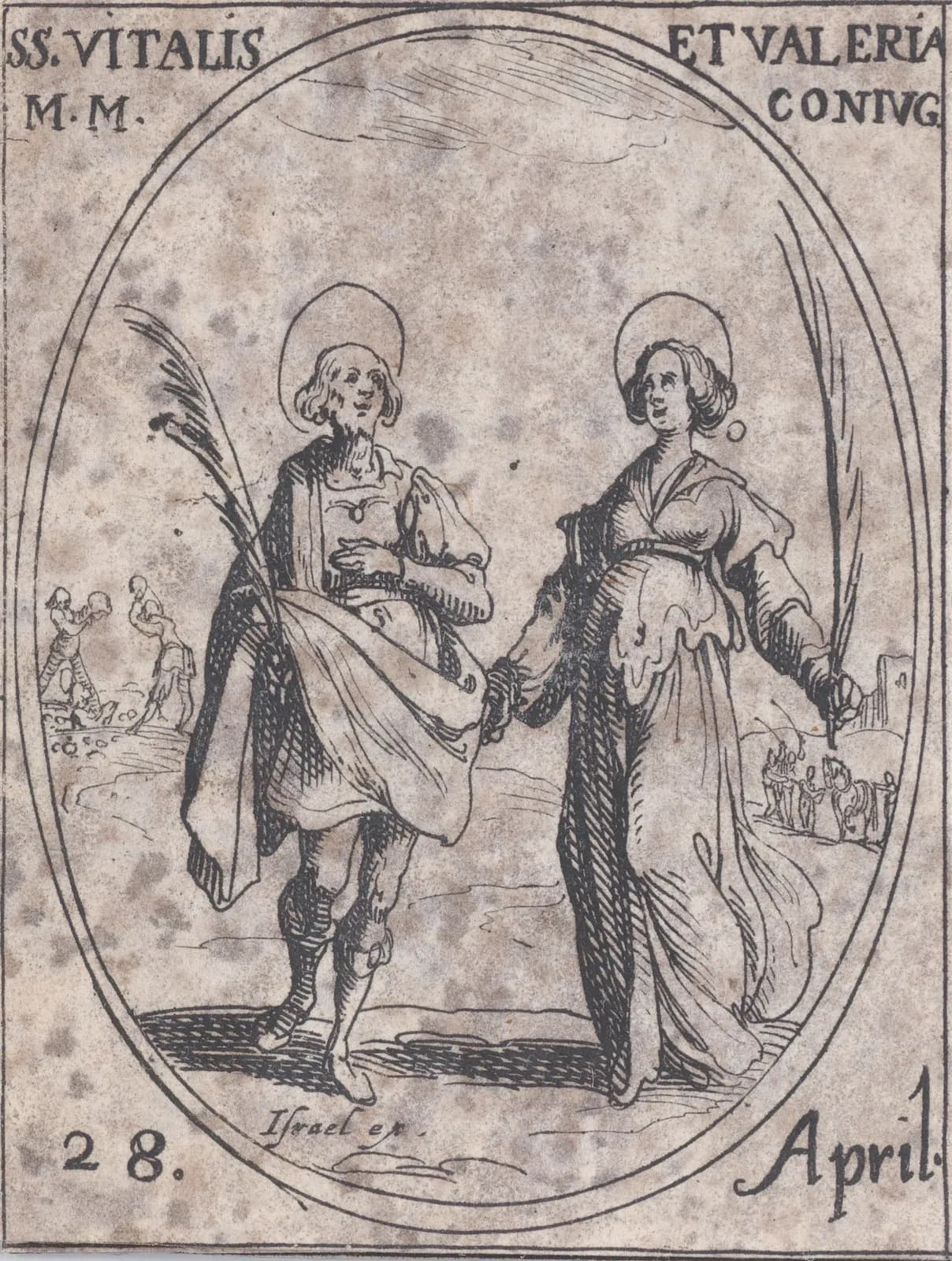
- Also called
- San Vitale, in Italian 3
Saint Vitalis is a martyr of Ravenna, remembered in the old martyrologies for one act: he urged a condemned Christian who was losing his nerve to die well, and then buried him. 24 For that he was racked and buried alive. 24 Legend made him the husband of Saint Valeria and the father of the Milanese martyrs Gervasius and Protasius, and his name is carried by San Vitale in Ravenna, one of the great churches of the sixth century. 256
Ursicinus and the judge Paulinus
The fullest telling among the sources read is the entry for April 28 in the martyrology printed among the works of Bede. 4 It calls Vitalis a soldier of consular rank, who came into Ravenna in the train of his judge, Paulinus. 4 There he watched a Christian named Ursicinus, a physician from Liguria, sentenced to death after long torture, and saw him falter at the last. 4
Vitalis called out to him. In the martyrology's Latin he reminds the physician that he has spent his life healing others and should not now wound himself with eternal death, and that after so much suffering he has come within reach of the palm and should not lose the crown the Lord has prepared for him. 4 Ursicinus knelt, told the executioner to strike, and died repenting his fear. 4 Vitalis took the body and buried it inside the city, and would not go on with the judge. 4
Paulinus had him seized, chiefly, the entry says, for having strengthened Ursicinus. 4 After the rack he was taken to a place called Palma, where Christians were put to death and which was named for the palm trees that grew there. A pit was dug until it reached water, and he was laid in it on his back and covered over with earth and stones. 4 The Catholic Encyclopedia gives the same story in brief: he was martyred on the order of a judge named Paulinus for encouraging Ursicinus and burying him, "racked and then buried alive." 2
A father for Gervase and Protase
In 386 Saint Ambrose found the bodies of two martyrs at Milan, and wrote to his sister about it. 57 His letter tells of "two men of marvellous stature" and the healing of a blind man; it does not say who their parents were. 7 The library's page on Saints Gervase and Protase tells that story.
The parents come from the Acts of Gervasius and Protasius. Francis Mershman, in the Catholic Encyclopedia, says they were perhaps compiled from a letter "falsely ascribed to St. Ambrose," and that their age cannot be established. 5 According to these Acts the brothers were twins, children of martyrs: "Their father Vitalis, a man of consular dignity, suffered martyrdom at Ravenna under Nero (?). The mother Valeria died for her faith at Milan." 5 Webster's article on Vitalis repeats that he was Valeria's husband and "father of the more famous Sts. Gervasius and Protasius." 2
Rome kept the family together in another way. Mershman records that Pope Innocent I (402-417) dedicated a church to Gervasius and Protasius in Rome, and that "Later, the name of St. Vitalis, their father, was added to the title." 5 katolsk.no says that in art he is sometimes shown seated between his two sons, each of them holding a stone, with stones in his own lap. 1
How much of it is history
Webster opens his article by calling the legend "of little historical value." 2 The Norwegian bishops' saints database (katolsk.no) calls the story as now known rather improbable, though it allows that Vitalis may have been a martyr of the second century. 1
The date moves with the teller. The legend sets it under Nero; Webster reports that Baronius put it in 171, under Marcus Aurelius, and says the question was argued by the Bollandist Papebroch and by Tillemont. 2 katolsk.no gives 171 for the legend and mentions a third version that places it under Decius, in the middle of the third century. 1
There is a question of identity as well. katolsk.no says Vitalis of Ravenna is most often taken to be the same man as Saint Vitalis of Bologna, the companion of Saint Agricola. 1 Umberto Benigni, in the encyclopedia's article on Ravenna, lists Vitalis among the city's martyrs and notes that he is "not the St. Vitalis of Rome." 6
San Vitale
Webster names churches dedicated to Vitalis at Rome, Faenza, Rimini, Como, Ferrara, Venice, Verona and Jadera in Dalmatia, "but the most famous church bearing his name is the octagonal San Vitale at Ravenna, the place of his martyrdom." 2 He dates it to 541-46 and says an inscription attests its dedication in 547. 2 Benigni credits it to Archbishop Ecclesius (526-534) and the architect Julianus Argentarius, and describes an octagon nearly 114 feet across. 6
Benigni describes the apse mosaic: a young Christ seated on the globe of the world between two angels, with Saint Vitalis on one side and Archbishop Ecclesius on the other. 6 Below them are the Empress Theodora and the Emperor Justinian with their courts, and with Justinian the Archbishop Maximianus (546-556), in whose time the mosaics were made. 6 Both encyclopedia writers note the restoration of 1898; katolsk.no adds that San Vitale was the first domed church built on a central plan in the West, and the model for Charlemagne's palace chapel at Aachen. 126
Valeria
Of Valeria the sources say little. The encyclopedia records only that she was martyred at Milan. 25 katolsk.no says she is known only from legend, and that a reliquary which once held relics said to be hers is now in the British Museum. 1
The current Roman Martyrology does not give her a separate entry on April 28, but it names her: Vitalis, it says, has been venerated from time immemorial together with the holy martyrs Valeria, Gervasius, Protasius and Ursicinus for a fearless faith firmly defended. 3
What is Saint Vitalis the patron saint of?
None of the sources consulted names a patronage for Saint Vitalis. 123 katolsk.no says he is named in the canon of the Ambrosian Mass, the rite of Milan, and that he is shown as a warrior on a white horse holding the banner of victory, or beside an open grave, and sometimes being buried alive or stoned. 1
Saint Vitalis's feast day
Saint Vitalis's feast day is April 28. 123 The current Roman Martyrology keeps a commemoration of him at Ravenna on that day, which it gives as the day, by tradition, on which the famous basilica there was dedicated under his name. 3 katolsk.no explains the date differently, as the dedication of his church in Rome. 1
katolsk.no adds that the cult of Vitalis and Valeria has now ceased, and that the feast of Vitalis and Agricola of Bologna was left to local calendars in 1969. 1 The current Martyrology nonetheless still commemorates Vitalis on April 28. 3
Praying with Saint Vitalis
The martyrology gives Vitalis one scene, and in it the frightened man is someone else. 4 Ursicinus had already been tortured, and he lost his courage only at the end, which is where Vitalis found him. 4
What Vitalis said to him was practical. The martyrology has him remind a doctor of what he had spent his life doing, and remind a tortured man how near he was to the end of it. 4 Then Vitalis buried him, at a time when doing so marked him out. 4
He paid for both. The martyrology says plainly that he was seized chiefly for strengthening Ursicinus, and that he died in a pit at the place called Palma. 4
The sources treat most of what followed as legend: the wife, the twin sons, the date under Nero. 25 The scene with Ursicinus is the part the martyrology tells at length, and it happened at Ravenna, where his church now stands. 24
Saint Vitalis of Ravenna, pray for us.
Sources
- 1."De hellige Vitalis og Valeria av Ravenna ( -171)," Den katolske kirke (katolsk.no), Catholic Diocese of Oslo (in Norwegian).
- 2.Douglas Raymund Webster, "St. Vitalis," The Catholic Encyclopedia, Vol. 15 (New York: Robert Appleton Company, 1912).
- 3.Roman Martyrology, entry for April 28, "San Vitale," as printed in "Santo del giorno," Conferenza Episcopale Italiana (in Italian).
- 4.Martyrologium, printed among the works of Bede (author uncertain), entry for April 28 (IV Kal. Maii), from J.-P. Migne, Patrologia Latina 94, Latin text via Latin Wikisource (in Latin).
- 5.Francis Mershman, "Sts. Gervasius and Protasius," The Catholic Encyclopedia, Vol. 6 (New York: Robert Appleton Company, 1909).
- 6.Umberto Benigni, "Ravenna," The Catholic Encyclopedia, Vol. 12 (New York: Robert Appleton Company, 1911).
- 7.Ambrose of Milan, Letter 22, to his sister Marcellina, trans. H. de Romestin, E. de Romestin and H. T. F. Duckworth, Nicene and Post-Nicene Fathers, Second Series, Vol. 10 (Buffalo: Christian Literature Publishing Co., 1896), via New Advent.
Saints to turn to next
Others in this collection who are turned to for some of the same things.
- Saint Adelaide931 - December 16, 999Marriage and familyCourage
- Saint Adrian of Nicomediad. c. 304-306CourageMarriage and family
- Saints Chrysanthus and Dariad. about 283CourageMarriage and family
- Saint EustaceMartyred at Rome, in 118 by tradition; other accounts give 140 or 188CourageMarriage and family