Saints Chrysanthus and Daria
d. about 283
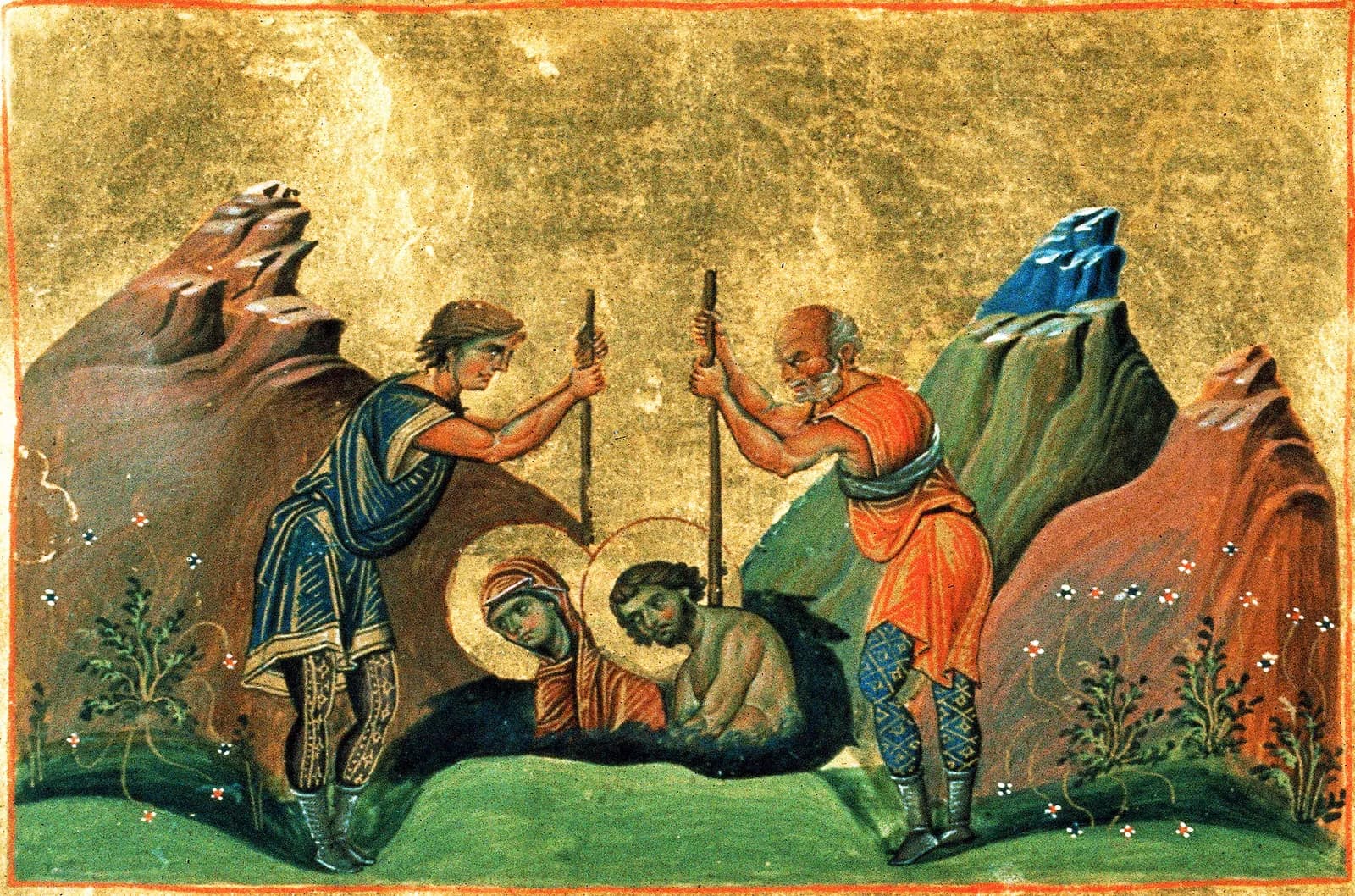
Saints Chrysanthus and Daria were martyrs buried in a sandpit on the Via Salaria Nova outside Rome, and Christians were praying at their tomb in the fourth century. 1 Everything else about them comes from Acts written at least a hundred years later, which tell a romance: a young convert from Alexandria, a pagan priestess sent to seduce him, a chaste marriage, and death together under the stones. 12 The 1908 Catholic Encyclopedia calls those Acts "without historical value." 1 The tomb, the cult and the long journey of the relics are another matter, and they are well documented. 12
What the legend says
The story survives in two versions, a longer one written first in Greek and later put into Latin, and a shorter one in Latin. 1 katolsk.no adds that it was said to be the work of two priests named Varinus and Armenius. 2 In it Chrysanthus is the son of Polemius, a nobleman of Alexandria, who brought him to Rome. 12 The young man studied philosophy, grew disgusted with the excesses of the city, found a copy of the New Testament and began with the Acts of the Apostles. 2 A priest named Carpophorus, who was hiding from the persecution, taught and baptized him. 12
His father tried everything to win him back. 1 katolsk.no says he had his son shut up with five women hired to seduce him, and that when this failed he married him to Daria, whom Kirsch's article calls "a beautiful and very intelligent Vestal" and katolsk.no a Greek priestess of Minerva. 12 Daria was converted by the man she had been sent to bring back, and the two agreed to live together in a virginal marriage. 12 Many Romans followed them into the Church, among them the tribune Claudius, his wife Hilaria and their sons Maurus and Jason. 1 All of that family except the mother were martyred. 1
Then came the trials. ACI Prensa's version has Chrysanthus sewn into the hide of an ox and left in the burning sun, Daria taken to a brothel and defended there by a lion, and the two of them thrown into a fire and walking out unharmed. 5 In the end both were led to a sandpit on the Via Salaria. 12 Kirsch says they were stoned to death there. 1 katolsk.no says they were stoned and then buried alive, and ACI Prensa that they were buried alive under a heap of stones. 25
How much of it can be trusted
Very little, according to Kirsch. The Acts, he writes, "did not originate until the fifth century," and the notices about the pair in the later martyrologies of the West and the Greek synaxaries all go back to this same legend. 1 katolsk.no is blunter, calling it nothing but a romantic myth. 2
What the legend does preserve, Kirsch thinks, is a cluster of real names. It is "evidently connected" with other Roman martyrs whose tombs were venerated in the catacombs of the Via Salaria near those of Chrysanthus and Daria. 1 Even the date is uncertain. The Acts place the martyrdom under the emperor Numerian (283-84), but he was never in Rome, and some historians, among them Paul Allard, have read Valerian instead. 1 katolsk.no reports that others put it about 304, under Diocletian, and that Regino of Prüm, writing about 900, named Numerian's father Carus. 2 Kirsch leaves the question open: perhaps Numerian should be kept, he says, with the date traced to the legend of an Eastern martyr of that name. 1 katolsk.no judges the original dating the likeliest. 2
Of the martyrdom itself there is no doubt. Their names stand in the "Martyrologium Hieronymianum," which Kirsch takes as proof that they were honored in Rome in the fourth century, and the seventh-century pilgrim guides to the Roman martyrs' tombs list their grave as a place of public veneration. 12
The tomb on the Via Salaria
The grave was in a disused sandpit near the catacomb of Thraso, beside the church of Saint Saturninus. 1 A church was later built over it. 12 The Roman Martyrology, as the Italian bishops print it, still places the pair in the cemetery of Thraso on the new Via Salaria and notes that Pope Saint Damasus praised them. 3
The end of the Acts tells of a second massacre at the same spot. While many Christians were gathered at the tomb for the anniversary of the martyrs' death, the persecutors filled the underground crypt with stones and earth and buried them all alive. 1 katolsk.no names a priest, Diodorus, and a deacon, Marianus, among the dead. 2 When the tomb was found again, the bones were discovered together with the silver vessels they had used for the Eucharist. 1 Everything was left where it lay, and a wall was built with a window in it, so that pilgrims could look through at the tomb and at the bones of those who had died there. 1
Damasus, pope from 366 to 384, adorned the shrine with verses in honor of the martyrs. 12 Gregory of Tours described it in his book on the glory of the martyrs. 12 The Goths desecrated it, and it was restored afterward, as a metrical inscription of the time records; Kirsch says that inscription was falsely attributed to Damasus. 1 katolsk.no dates the restoration to 539 and adds that about the year 600 oil from the lamps at the tomb was sent to Queen Theodelinda of the Lombards. 2
Relics in Rome, the Eifel and Reggio
The bones did not stay put. katolsk.no follows them through a series of popes: moved to San Silvestro in Capite under Paul I in 761, to Santa Prassede under Paschal I in 817, and in part to the Lateran in 886. 2 Paschal had eight scenes from their legend painted at Santa Prassede, among them Daria guarded by lions and the stoning of the two, and the frescoes are now partly lost. 2
In 844 Markward, abbot of Prüm, came home from Rome with relics of Chrysanthus and Daria given him by Pope Sergius II. 2 Four years later he brought them to the daughter house he had founded in the Eifel, and the town that grew up around its walls became Münstereifel, now Bad Münstereifel. 2 Kirsch, writing in 1908, says they were "still greatly venerated" there. 1 Other relics went to Reggio Emilia in the tenth century and rest in the crypt of its cathedral, and there were further gifts to Salzburg, Oria, Naples and Vienna. 2
In art the pair appear as a young married couple holding martyrs' palms, sometimes with a lion, and in Germany Chrysanthus is often shown as a knight. 2 The oldest surviving image is in the procession of martyrs in the mosaics of Sant'Apollinare Nuovo in Ravenna, from about 560. 2 Calderón de la Barca wrote a religious drama about them in 1640. 2
What are Saints Chrysanthus and Daria the patron saints of?
Saints Chrysanthus and Daria's feast day
Their feast is October 25, the day on which the Roman Martyrology names them and which already appears in some martyrologies of the seventh century. 13 ACI Prensa keeps the same day. 5 The older "Martyrologium Hieronymianum" mentioned them on August 12 and November 29. 1 katolsk.no adds that the feast was removed from the universal calendar in 1969 and left to local calendars, that the Orthodox keep them on March 19, and that the Armenians remember them on October 17. 2 Kirsch also gives March 19 for the Greeks. 1
Praying with Saints Chrysanthus and Daria
In the story Daria is sent to undo a conversion and is converted herself, and the marriage arranged to pull Chrysanthus away from Christ becomes the place where the two of them live for him. 12 Whatever its history, the legend is about a plan that turned the other way.
The firmer ground is the tomb. Christians kept coming to it on the anniversary even after the crypt had been sealed with their own people inside, and for centuries afterward pilgrims looked through a window in a wall at the bones and the silver vessels of the Mass. 1 The martyrs were honored in the place where the faithful had died praying beside them.
Kirsch is plain that the Acts cannot be trusted, and this page has kept to his judgment. 1 What remains is two names on a fourth-century list and a grave that people would not stop visiting. 1
Saints Chrysanthus and Daria, pray for us.
Sources
- 1.Johann Peter Kirsch, "Sts. Chrysanthus and Daria," The Catholic Encyclopedia, Vol. 3 (New York: Robert Appleton Company, 1908).
- 2."De hellige Chrysanthus og Daria av Roma (d. ~283)," Den katolske kirke (katolsk.no), Catholic Diocese of Oslo (in Norwegian).
- 3.Roman Martyrology, entry for October 25, "Santi Crisanto e Daria, martiri," as printed in "Santo del giorno," Conferenza Episcopale Italiana (in Italian).
- 4."Santos del día, 25 de octubre: ss. Crisanto y Daria, mártires en la via Salaria nueva," Vatican News (in Spanish).
- 5."San Crisanto y Santa Daría," Santoral, ACI Prensa (in Spanish).
Saints to turn to next
Others in this collection who are turned to for some of the same things.
- Saint Adelaide931 - December 16, 999Marriage and familyCourage
- Saint Adrian of Nicomediad. c. 304-306CourageMarriage and family
- Saint EustaceMartyred at Rome, in 118 by tradition; other accounts give 140 or 188CourageMarriage and family
- Saint Gianna Beretta MollaOctober 4, 1922 - April 28, 1962Marriage and familyCourage