Saint Virgil of Salzburg
c. 700 - 784
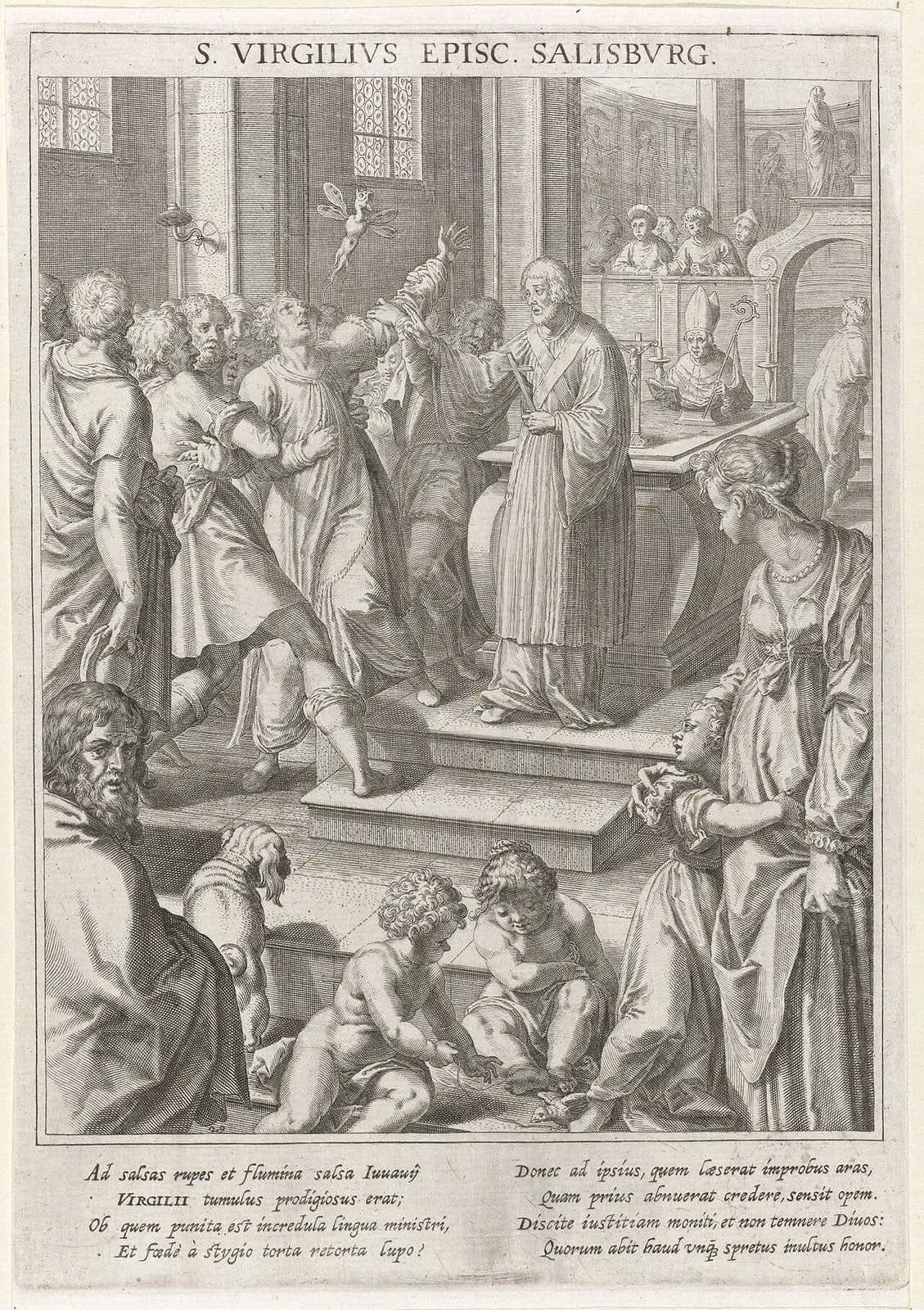
- Bishop of Salzburg
- In charge from 745; consecrated in 765 or 767 1
- Patron saint of
- Women in difficult childbirth 1
Saint Virgil of Salzburg was an Irish monk who became bishop of Salzburg in the eighth century, built its first cathedral and sent the missionaries who brought the faith to Carinthia, in what is now southern Austria and Slovenia. 12 He was one of the most learned men of his age, nicknamed the Geometer. 1 He is also the bishop whom Saint Boniface reported to the pope for teaching that there was another world beneath this one, with other people and another sun and moon. 13 What happened next depends on which source you read.
From Ireland to Bavaria
Virgil was born in Ireland around the year 700, probably of a noble family. 15 His name may be a Latin form of the Irish Feargal. 1 The Irish annals identify him with Feirgil, abbot of Aghaboe, but katolsk.no, the website of the Catholic Church in Norway, calls the identification disputed. 1 Vatican News says he had been a monk at home and had risen to be abbot of an important monastery. 5
Like many Irish monks of the eighth century he left home as a pilgrim, and around 742 he arrived in the kingdom of the Franks. 1 There he became a friend of Pippin the Short, then mayor of the palace and later king, who kept him at court for two years. 1 In 743 Pippin sent him to Bavaria to make peace with Duke Odilo, his brother-in-law, who had led a failed revolt; two years later Odilo entrusted him with the diocese of Salzburg, vacant since the death of its founder, Saint Rupert. 1 The Martyrology says he was put in charge of the Church of Salzburg with the favor of King Pippin. 2
For years he refused the title of bishop. katolsk.no says he was at first only abbot of St. Peter's, the monastery Rupert had founded, and that he left episcopal functions to an Irish wandering bishop who traveled with him, Dub Dá Chrich, until he was finally consecrated in 765 or 767. 1 The 1912 Catholic Encyclopedia calls him the "abbot-bishop" of St. Peter's. 4
Boniface
Saint Boniface, the Apostle of Germany, was archbishop and papal legate, and he did not trust Virgil. 13 katolsk.no suggests Virgil was of a somewhat difficult temperament, and that Boniface suspected him, as he suspected other Irish missionaries in the region, of unorthodox opinions. 1 Vatican News gives a more political reason: Pippin had made Virgil a bishop without consulting the representative of the Holy See, and the papal legate did not consent. 5
Boniface complained of him to Pope Zachary twice. 1 The first time, a priest who knew almost no Latin had garbled the formula of baptism, saying "Baptizo te in nomine patria et filia et spiritus sancti," and Virgil held that the baptism was still valid. 1 He went to Rome to explain himself, and the pope cleared him. 1
Another world beneath this one
The second complaint was about the shape of the world. The only document to survive is Zachary's reply to Boniface, dated May 1, 748. 3 Among Virgil's alleged errors it lists the teaching "that beneath the earth there was another world and other men, another sun and moon." 3 The pope told Boniface to call a council and, "if it be made clear" that Virgil held this "perverse teaching," to "expel him from the Church, deprived of his priestly dignity." 3
What Virgil actually taught is far from clear. 1 katolsk.no thinks it certain that he taught that the earth was a sphere, which was widely accepted at the time, and uncertain whether he meant people living on the far side of it, or, as Boniface may have feared, the otherworld of Irish folklore. 1 The pope's concern, the 1907 Catholic Encyclopedia argues, was the unity of the human race: whether these "other men" were descended from Adam and redeemed by Christ. 3
Here the sources part company. The encyclopedia says that the idea that Virgil "was ever really tried, condemned, or forced to retract, is an assumption without any foundation in history," and that he most likely convinced his censors he meant nothing heretical. 3 katolsk.no agrees that there is no evidence he was tried, still less condemned, and points out that he was consecrated bishop only after Boniface's death in 755, which tells against any charge of heresy. 1 Vatican News tells it differently: Zachary ordered him severely to drop the theories on pain of canonical penalties, and Virgil obeyed, set theological disputes aside and gave himself to his diocese. 5
The encyclopedia closes its article by calling him "the Irish monk who suffered the penalty of being several centuries in advance of his age." 3
Salzburg and Carinthia
Whatever the truth of the dispute, his great work lay elsewhere. The Slavic duke of Carinthia, Chitomar, had become a Christian while a captive in Bavaria and asked Virgil for priests for his still pagan people. 1 Virgil sent Modestus, an Irish missionary bishop, with other clergy, and brought the region into the diocese of Salzburg. 14 The encyclopedia calls Modestus the apostle of Carinthia; katolsk.no gives the title to Virgil himself, as Apostle of the Slovenes and of Carinthia. 14 The Martyrology says he worked hard to spread the faith among the people of Carinthia, and Vatican News says his missions reached Styria and Pannonia. 25
At home he built Salzburg's first cathedral and dedicated it to Saint Rupert, whose relics he moved into it on September 24, 774. 125 The encyclopedia notes that the valuable confraternity book of St. Peter's, the Liber confraternitatum, was begun under him. 4 Vatican News adds that he was tireless in teaching the faith and caring for the poor. 5
Death, a lost grave and canonization
Virgil died at Salzburg on November 27, 784, having just come home from a visitation, and was buried in his cathedral. 15 He was long forgotten. When the cathedral burned in 1167 and was rebuilt, his grave was found, with an inscription saying that Bishop Virgil had built the church. 1 His relics were raised, and in 1233 Pope Gregory IX canonized him. 15 His name was entered in the Roman Martyrology in 1740. 1 The most reliable witness to his life, katolsk.no says, is an epitaph written for him by Alcuin. 1
What is Saint Virgil the patron saint of?
Saint Virgil's feast day
Saint Virgil's feast day is November 27, the day he died. The Roman Martyrology enters him on that day, and Vatican News and katolsk.no give the same date. 125 It is kept throughout Ireland, katolsk.no says, and above all in the Diocese of Ossory. 1 In the German-speaking lands he is celebrated together with his predecessor, Saint Rupert, on September 24, the anniversary of the translation of Rupert's relics, and in the Austrian Diocese of Gurk-Klagenfurt together with Modestus on November 24. 1
Praying with Saint Virgil
He was a scholar whose curiosity got him reported to Rome. The sources do not agree whether he was made to retract, and the honest thing is to leave that open. 35 What the encyclopedia makes clear is that the pope's question was not about geography. It was whether every human being, wherever he lives, is a child of Adam and redeemed by Christ. 3 Virgil, as far as anyone can tell, never denied it.
He also spent years declining to be called a bishop while doing a bishop's work, and the work he chose was sending others out. 1 The conversion of Carinthia went in his name, but it was Modestus and the clergy with him who walked there. 14
And his memory nearly disappeared. For almost four centuries no one in Salzburg knew where the man who built their first cathedral was buried, until a fire uncovered his grave and its inscription. 1 What identified him in the end was neither his learning nor his quarrels, but a line on a tomb saying that he had built the church.
Saint Virgil of Salzburg, pray for us.
Sources
- 1.Per Einar Odden, "Den hellige Virgilius av Salzburg," Den katolske kirke (the Catholic Church in Norway), katolsk.no (in Norwegian).
- 2.Roman Martyrology, entry for November 27, "San Virgilio, vescovo," as printed in "Santo del giorno," Conferenza Episcopale Italiana (in Italian).
- 3.James Loughlin, "Antipodes," The Catholic Encyclopedia, Vol. 1 (New York: Robert Appleton Company, 1907).
- 4.Cölestin Wolfsgrüber, "Salzburg," The Catholic Encyclopedia, Vol. 13 (New York: Robert Appleton Company, 1912).
- 5."S. Virgilio, obispo de Salisburgo," Santo del día, Vatican News (in Spanish).
Saints to turn to next
Others in this collection who are turned to for some of the same things.
- Saint Godehard of Hildesheimc. 960 - May 1038Work and vocationStudy and teaching
- Saint Aelred of Rievaulx1109 - January 12, 1166 (or 1167)Work and vocationStudy and teaching
- Saint Albert the Greatc. 1206 - November 15, 1280Study and teachingWork and vocation
- Saint Alexander Sauli1533 or 1534 - October 11, 1592Work and vocationStudy and teaching