Saint Godehard of Hildesheim
c. 960 - May 1038
- Patron saint of
- The Diocese of Hildesheim and masons; invoked in difficult births and against gout, lightning and hail 2
Saint Godehard of Hildesheim, also called Gotthard, was the son of poor Bavarian farmers who became abbot of Niederaltaich, reformed three other monasteries, and at about sixty was made bishop of Hildesheim in Saxony. 12 There he built churches and schools and a hospice for the poor, and with his predecessor Bernward he is remembered by the diocese as the bishop of its first great age. 23 He was canonized in 1131, and his feast is May 5. 14
A farmer's son at Niederaltaich
He was born about 960 in Bavaria. The Catholic Encyclopedia, which spells his name Godard, places his birth in "a village of Upper Bavaria, near the Abbey of Altaich, in the Diocese of Passau." 1 The Catholic Church in Norway's biography names the village as Reichersdorf and says the family were poor farmers; his father, Ratmund, worked for the monastery of Niederaltaich nearby. 2
The monks soon saw that the boy was better suited to books than to farming, and he was educated in the monastery school. 2 The Archbishop of Salzburg, a frequent guest of the house, took the promising young man back with him for three more years of teaching. 2 Court life did not satisfy him, the Norwegian account says, and he returned to Niederaltaich. 2
Niederaltaich was at that time a house of canons. With the support of the bishops of Passau and Regensburg and of Duke Henry of Bavaria, the future emperor Saint Henry II, it was made a Benedictine monastery again in 990, and Godehard took vows as a monk along with several of the other canons. 2 The encyclopedia says he "received the Benedictine habit in 991." 1 The Norwegian biography adds that he was ordained a priest in 993 by Saint Wolfgang, Bishop of Regensburg. 2
Abbot and reformer
He rose quickly. In the encyclopedia's words, "his learning and sanctity speedily procured his elevation to the dignity of prior, and afterwards that of abbot." 1 The Norwegian account dates his election as abbot to 996 and says Henry attended his installation. 2
What he did at Niederaltaich made him useful elsewhere. The encyclopedia says that as abbot he "went far towards enforcing rigorous observance of rule among those placed under his care," and that this led to his being chosen to reform three more abbeys: Hersfeld in Hesse, Tegernsee in the Diocese of Freising, and Kremsmünster in the Diocese of Passau. 1 The Norwegian biography dates the work at Hersfeld to 1005 and lists him among the abbots of Kremsmünster from 1007 to 1012. 2 It describes him as a champion of the reform that came from Cluny, who brought discipline and learning to the houses under him. 2
It was hard work with many disappointments, the same account says, since laxity had spread in the monasteries for years. Over twenty-five years he trained nine abbots for different houses. 2 The Roman Martyrology also remembers this first: he was abbot of Niederaltaich, and he visited and established other monasteries. 4
Bishop of Hildesheim at sixty
When the Bishop of Hildesheim died, Emperor Henry II named Godehard to succeed him. 2 The encyclopedia calls the dead bishop "St. Bernard" and dates his death 1021; the Diocese of Hildesheim, the Norwegian biography and the encyclopedia's own article on Hildesheim all name him as Bernward, whose episcopate ended in 1022. 1235
Godehard did not want the office. His modesty, the encyclopedia says, "yielded only to the urgent admonitions of Emperor St. Henry II." 1 The cathedral chapter formally elected him on November 30, 1022, and he was consecrated on December 2. 2 He was about sixty, and by the Norwegian account he set to work like a young man. 2
He ran the diocese the way he had run his abbeys. The encyclopedia says that monastic observance "was established, as far as possible, in his cathedral chapter," that he "built schools for the education of youth in which he always manifested an active interest," kept a close personal watch over his seminary, and "fostered a strict observance of the liturgy." 1 The Norwegian biography says the cathedral school of Hildesheim became a center of learning under him and that he founded a school of writing and painting. 2 The Martyrology says he restored religious discipline among the clergy and opened schools. 4
He was a builder as well. The Norwegian account credits him with about thirty new churches and with finishing Saint Michael's church in Hildesheim. 2 The diocese, in its own history, puts the weight elsewhere: Godehard worked to bring the Church into line with the Gospel, through the building of many churches and through more intensive pastoral care, including regular preaching by the parish priests in their own places. 3
The poor had a claim on him. The encyclopedia says he "exercised a paternal care for the material needs of his people." 1 By the Norwegian account he founded a hospice for the poor and the sick on a marshy piece of ground at the edge of Hildesheim. He had great love for those truly in need and less sympathy for able-bodied professional wanderers, whom he let stay no more than two or three nights. 2
What was told of him
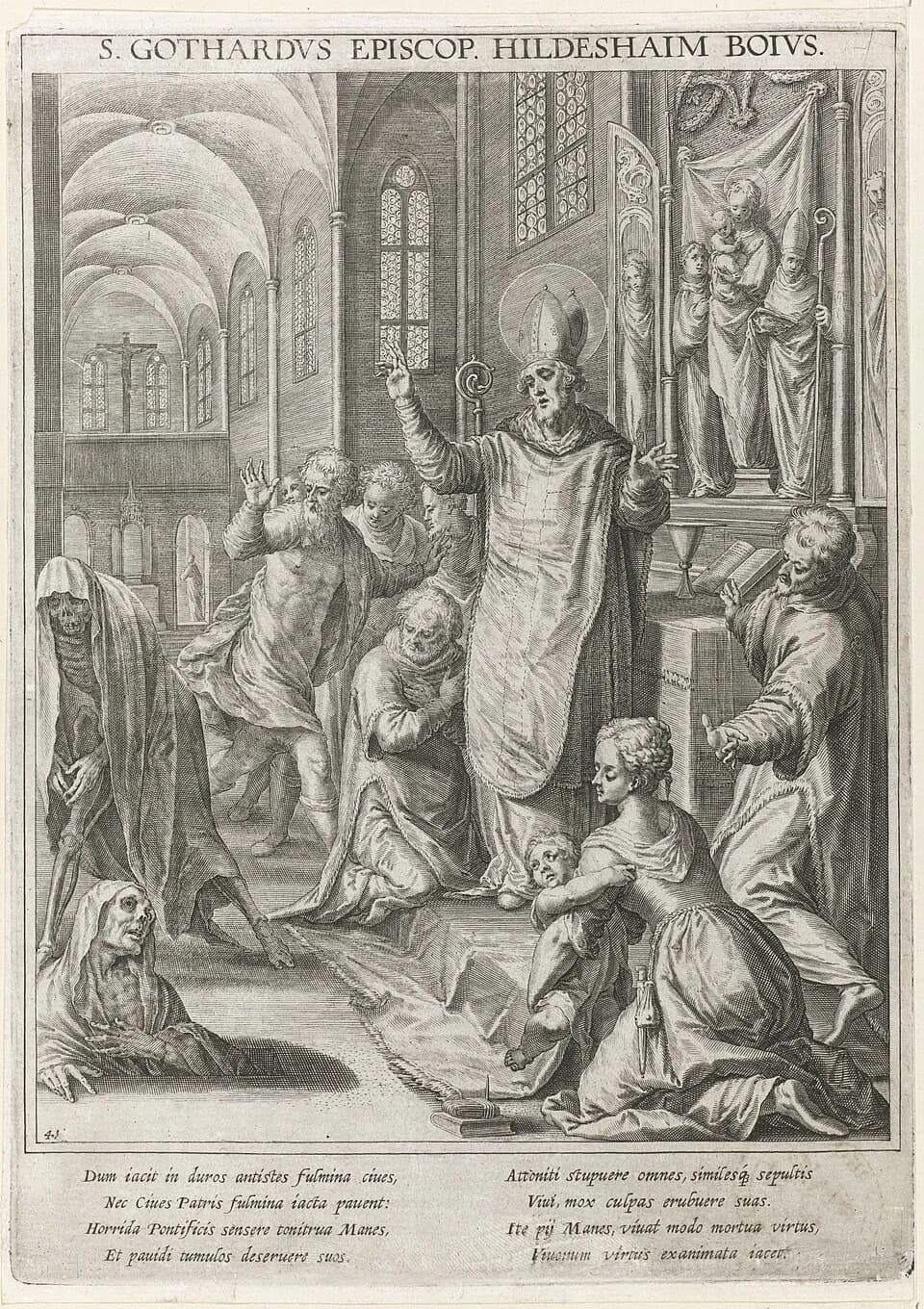
Even in his lifetime, the Norwegian biography reports, he was said to have worked many miracles. At a synod in Mainz he is said to have healed a possessed person and even to have raised the dead, so that they could make the last confession that death had not left them time for. 2 The 1615 engraving on this page shows that scene. The same account says he was known for his kindness and his skill as a mediator, and that he settled the long quarrel with Mainz over the convent of Gandersheim. 2
The encyclopedia mentions no miracles. It notes that his letters "which have come down to us exhibit a lofty spiritual tone throughout." 1
His death and canonization
Godehard died at Hildesheim in May 1038. The encyclopedia gives the day as May 4; the Norwegian biography gives May 5 and says he was seventy-eight. 12 He was buried in his cathedral. 12
Pope Innocent II canonized him in 1131. 1 The Norwegian account dates the canonization October 31 of that year and calls him the first Bavarian to be formally canonized. 2 In 1132, the encyclopedia says, "the year following his canonization and the translation of his relics," a Benedictine monastery under his patronage was begun and two altars were dedicated to him in the cathedral. 1
His cult traveled. "Many churches in Germany honour Godard as patron and several bear his name," the encyclopedia says. 1 The Norwegian biography says he is honored from Sweden to Italy, and that the Saint Gotthard Pass in the Swiss Alps was named for him, with a chapel built at its summit by the dukes of Bavaria. It adds that other sources say the pass is named for a Swiss nobleman who lived there as a penitent. 2
What is Saint Godehard of Hildesheim the patron saint of?
The Catholic Church in Norway lists Saint Godehard of Hildesheim as patron of the Diocese of Hildesheim and of masons, and as a saint invoked against gout, rheumatism, kidney stones and children's illnesses, in difficult births, and against lightning and hail. 2 It explains the masons: some pictures show him with a man holding a hammer, line and square. 2 The other sources used here name no patronage beyond the churches dedicated to him. 1
Saint Godehard of Hildesheim's feast day
Praying with Saint Godehard of Hildesheim
Godehard spent most of his life putting other people's houses in order. He was sent to one slack monastery after another, and the Norwegian biography does not pretend it went smoothly: the work was hard and full of disappointments. 2 What he had to show for twenty-five years of it was nine men trained to be abbots. 2
He did not seek promotion. He left the archbishop's court for his monastery, and he accepted Hildesheim only when the emperor pressed him. 12 Once there he did the things a reformer of monasteries would think of first, which were schools, the liturgy, and the common life of his clergy. 1
His charity had an edge to it. He built the hospice and he also limited the stay of the able-bodied who made a living of wandering. 2 The encyclopedia's phrase for him is "paternal care," which covers both. 1
Saint Godehard of Hildesheim, pray for us.
Sources
- 1.Patrick MacAuley, "St. Godard," The Catholic Encyclopedia, vol. 6 (New York: Robert Appleton Company, 1909).
- 2.Per Einar Odden, "Den hellige Godehard (Gotthard) av Hildesheim (~960 - 1038)," Den katolske kirke (the Catholic Church in Norway), katolsk.no, updated February 1, 2000 (in Norwegian).
- 3."Geschichte des Bistums Hildesheim," Bistum Hildesheim (in German).
- 4.Roman Martyrology, entry for May 5, "San Gottardo, vescovo," as printed in "Santo del giorno," Conferenza Episcopale Italiana (in Italian).
- 5.Johann Märing, "Hildesheim," The Catholic Encyclopedia, vol. 7 (New York: Robert Appleton Company, 1910).
Saints to turn to next
Others in this collection who are turned to for some of the same things.
- Saint Virgil of Salzburgc. 700 - 784Study and teachingWork and vocation
- Saint Aelred of Rievaulx1109 - January 12, 1166 (or 1167)Work and vocationStudy and teaching
- Saint Albert the Greatc. 1206 - November 15, 1280Study and teachingWork and vocation
- Saint Alexander Sauli1533 or 1534 - October 11, 1592Work and vocationStudy and teaching