Saint Victor of Marseille
d. c. 290-303
- Died
- At Marseille, in 290 or 303, under Maximian 1; about 292, according to the Spanish Martyrology 3
- Historical record
- His tomb was one of the great pilgrim shrines of Gaul by the sixth century; his passio is judged a fiction 1
- Patron saint of
- Millers and sickly children; invoked against lightning 1
Saint Victor of Marseille was, by the oldest tradition, a Christian officer in the Roman army at Marseille who was put to death under the emperor Maximian at the end of the third century. 15 His tomb became one of the most visited pilgrim shrines in Gaul, and John Cassian built a monastery over it that grew into the great Abbey of Saint-Victor. 14 The story of his tortures is another matter: the Norwegian bishops' saints database calls his passio pure fiction, though it adds that the archaeology under the abbey suggests the tradition is not empty. 1
What is known
Very little, and the sources say so. The Norwegian bishops' saints database (katolsk.no), which gathers the older scholarship, says that little that is historical is known of him, and that it is unclear which elements of his legend, if any, rest on fact. 1 It notes that the origins of Christianity in Marseille are obscure and seem to have been fairly late, for all the port's trade with Italy and the eastern Mediterranean. 1
What is certain is the cult. The writings of Gregory of Tours and Venantius Fortunatus in the sixth century show that his tomb at Marseille was one of the most popular pilgrim destinations in Gaul. 1 He may be one of several martyrs named Victor in the Martyrologium Hieronymianum, but the first full mention of him is in the martyrology of Lyon, from 806. 1 katolsk.no finds it strange that so popular a cult left no inscriptions. 1
He may have been of senatorial rank, or a Christian officer. Marseille was under siege in 287, and katolsk.no suggests the persecution there may have begun when Christians refused either to fight or to sacrifice and acknowledge the emperor as a god. 1 For the year of his death it gives 290 or 303, since Maximian was in Marseille for a time in those years; the Spanish text of the Roman Martyrology gives about 292. 13
The story in the passio
In the legend, Victor is an officer stationed at Marseille when Maximian arrives to enforce the persecution. He goes from house to house at night, urging the Christians to stand firm if they have to die for their faith. 13 He is caught and brought before the prefects Asterius and Eutychius, who hand him on to the emperor because of what he has been saying. 13
Maximian has him bound and dragged through the streets. He comes back bruised and bloody and still refuses to worship the gods, so he is racked and tortured, and during the torture he has a vision of Christ. 1 In prison at midnight he is visited by angels whose light fills the cell. Three frightened guards, Alexander, Felician and Longinus, ask his forgiveness, and he sends for priests who baptize them. 13 The emperor, furious, has all four brought to the marketplace. The three soldiers hold to their new faith and are beheaded; Victor is beaten and taken back to prison. 13
Catholic.net, giving the legend in Spanish, tells the end. Three days later Victor is ordered to worship a statue of Jupiter set on an altar, and kicks the altar over instead. Maximian has his foot cut off and has him put under a millstone; when the mill breaks down on its first turn, he is taken out and beheaded. His body and the bodies of the three soldiers are thrown into the sea, and Christians find them on the shore and bury them. 3
katolsk.no is blunt about all of this. The passio is fiction; it even makes Victor bishop of Marseille, a title Rabanus Maurus also gave him. 1 Some have proposed that Cassian wrote it to give the new monastery an account of its patron, perhaps drawing on oral tradition; others think it much later and built from the little the martyrologies say. 1 One more theory, that Cassian adopted an Eastern martyr and moved him to Marseille, runs into the fact that Victor is a Latin name and not a Greek one. 1
The tomb under the abbey
The encyclopedia article on John Cassian says: "About 415 he was at Marseilles where he founded two monasteries, one for men, over the tomb of St. Victor, a martyr of the last Christian persecution under Maximian (286-305), and the other for women." 5 The article on Marseilles says the same: "About 415, Cassian founded the two monasteries of St. Victor." 4 katolsk.no places Cassian's foundations in the fourth century, and says the men's house became the famous Benedictine abbey. 1
In 1963 excavations in the crypt of Saint-Victor uncovered a rock-cut burial ground with several graves and an altar beneath the remains of a fifth-century chapel. 1 Under five or six graves laid one above another were two marble tombs holding the remains of two men, along with the remains of an early Christian structure of the kind often built over martyrs who had first been buried in pagan cemeteries. 1 katolsk.no dates the structure to the early fifth century and the grave to the early fourth, and concludes that a cult at least that old is proved. 1 It is likely, it says, that the tomb holds two martyrs, perhaps Victor and a companion, though Victor, a Latin name meaning conqueror, may also have been a symbolic name given to a martyr nobody could name. 13
The abbey became one of the great houses of southern France. The encyclopedia records that the church of Saint-Victor was dedicated by Benedict IX in 1040, that the abbey was rebuilt in the eleventh century after the Saracen raids, and that from the middle of that century "appeals were sent to the abbots of this church to restore the religious life in decadent monasteries." 4 Blessed William de Grimoard was its abbot when he was elected pope in 1362 as Urban V. 4 The encyclopedia lists among the saints who belong to Marseille "the soldier St. Victor, martyr under Maximian." 4
Beyond Marseille
He was one of the most celebrated martyrs of Gaul and was honored in many parts of Western Europe, including England from the ninth century. 1 In Paris another abbey took his name, Saint-Victor, where a foot said to be his was venerated as a precious relic and the feast of its translation was kept every July 23. 1 Most of his relics have since been lost, apart from a few remains. 1
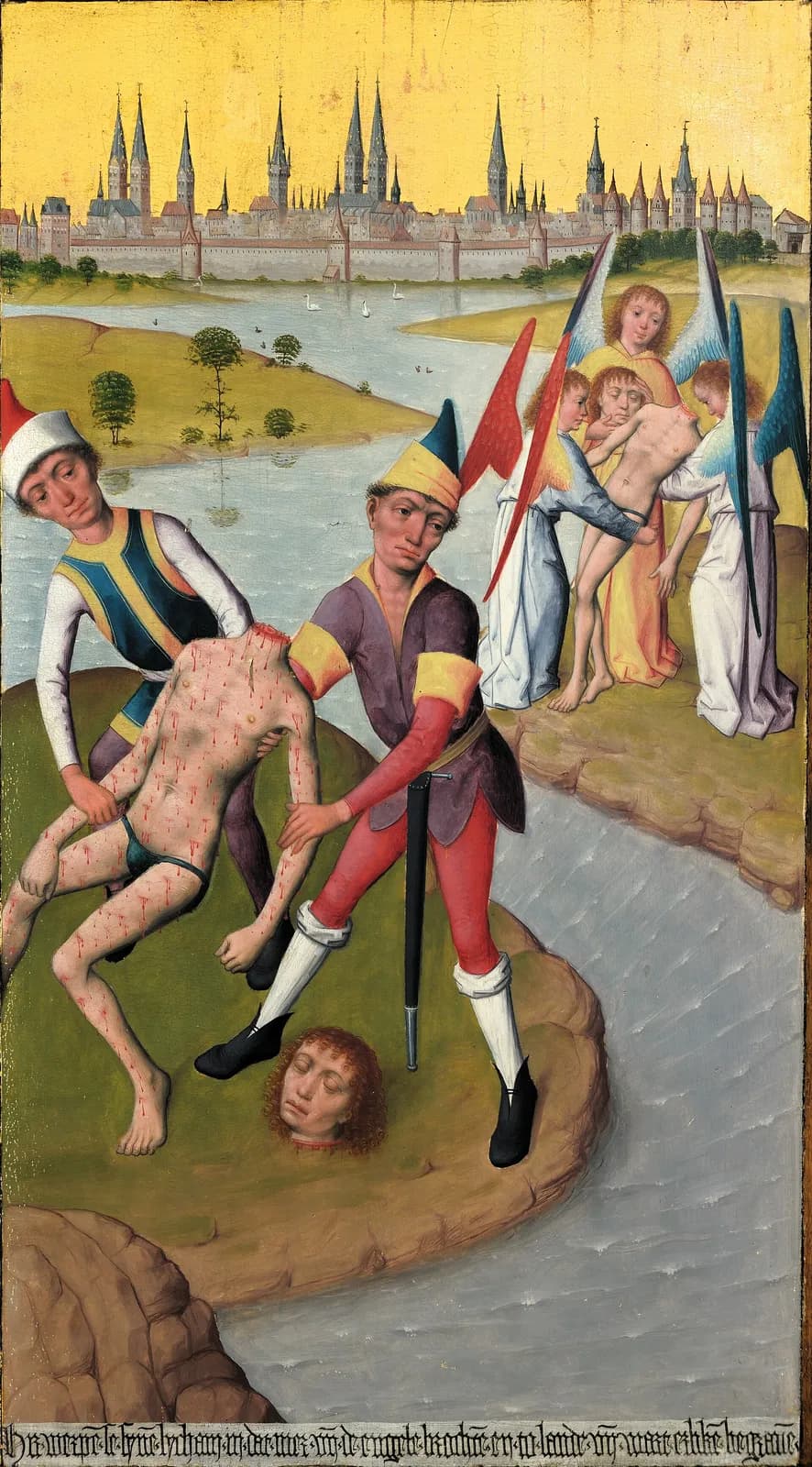
Artists show Victor and his companions as Roman soldiers, and Victor often with a millstone or a windmill. 1 He is also shown overturning the statue of Jupiter, surrounded by angels in prison, or crushed under a millstone, and sometimes beheaded with his body thrown into a river and rescued by angels. 1 That last scene is the panel at the top of this page, from Hermen Rode's altarpiece of 1481 in Tallinn, with the city of Lübeck behind the river.
What is Saint Victor the patron saint of?
Saint Victor's feast day
Saint Victor's feast day is July 21. The Roman Martyrology commemorates him on that day, at Marseille in Provence, without further detail. 23 katolsk.no gives July 21 as the day kept for him together with Alexander, Felician and Longinus, and notes that July 1 is also found. 1 The translation of his relic at Saint-Victor in Paris was kept on July 23. 1
Praying with Saint Victor
The passio gives Victor a career of night visits, angels, an overturned idol and a broken mill, and the sources do not believe a word of it. 1 What they do believe is a grave. Two men were buried in marble under a hill outside a Roman port in the early fourth century, and people kept coming to pray there, and eventually built a church, then a monastery, then one of the great abbeys of France on top of them. 14
In the legend his first act is not defiance of the emperor. It is going from door to door at night to keep other people from losing heart. 13 Whether or not it happened, it is what the people who told the story thought a martyr ought to be doing before his own turn came.
His name may be the only true thing we have, and it may not even be his. 1 The Martyrology still enters him on July 21 with no story attached at all: a city, a name and the word martyr. 2
Saint Victor of Marseille, pray for us.
Sources
- 1."Den hellige Viktor av Marseille og tre ledsagere (d. ~290)," Den katolske kirke (katolsk.no), Catholic Diocese of Oslo (in Norwegian).
- 2.Roman Martyrology, entry for July 21, "San Vittore, martire," as printed in "Santo del giorno," Conferenza Episcopale Italiana (in Italian).
- 3."Víctor, San," with the Roman Martyrology entry for July 21, Catholic.net (in Spanish).
- 4.Georges Goyau, "Marseilles," The Catholic Encyclopedia, Vol. 9 (New York: Robert Appleton Company, 1910).
- 5.Maurice Hassett, "John Cassian," The Catholic Encyclopedia, Vol. 3 (New York: Robert Appleton Company, 1908).
Saints to turn to next
Others in this collection who are turned to for some of the same things.