Saint Titus
First century
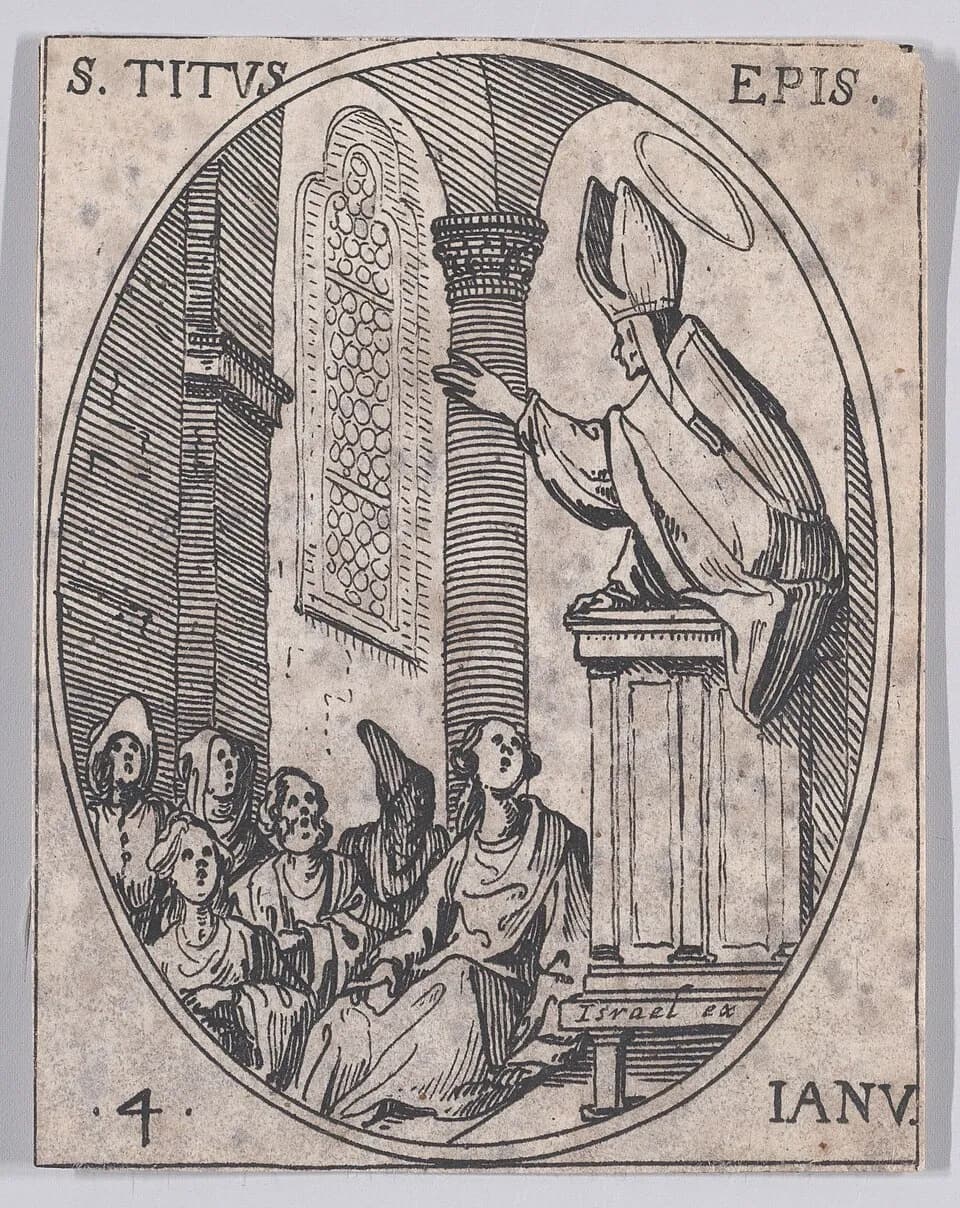
- Patron saint of
- Relief from stomach disorders, with Saint Timothy, according to Franciscan Media; Crete, according to Catholic Culture 56
- Feast day
- January 26, with Saint Timothy 456; February 6 in the 1962 Missal, according to Catholic Culture 6
- Relics
- His skull is venerated in the Church of Saint Titus, Heraklion, Crete 6
Saint Titus was a Greek convert whom Saint Paul took to Jerusalem as living proof that a Gentile could be a Christian without circumcision, and then sent to Corinth to mend a quarrel Paul could not mend himself. 17 Paul called him "my partner and co-worker," and the New Testament letter that bears his name shows him organizing the church on Crete. 1011 The Church keeps his memorial on January 26, together with Saint Timothy. 4
A Greek in Jerusalem
The Acts of the Apostles never mentions him, as a note to Galatians in the Bible on the United States bishops' site points out. 7 Everything about Titus comes from Paul's letters. Benedict XVI, who devoted half a general audience to him in 2006, begins with the name, which is Latin, and the man, who "was Greek by birth, that is, a pagan." 1 Vatican News says he was converted by Paul on one of his journeys and became his collaborator, companion and brother in mission. 3 Franciscan Media adds that he was "apparently from Antioch." 5
His first appearance is at a decisive moment. "I again went up to Jerusalem with Barnabas, taking Titus along also," Paul writes to the Galatians. 7 Benedict XVI identifies the visit with what is usually called the Apostolic Council, where the preaching of the Gospel to the Gentiles without the obligations of the Mosaic Law was accepted. 1 Some there wanted Titus circumcised. Paul reports the outcome with satisfaction: "not even Titus, who was with me, although he was a Greek, was compelled to be circumcised." 7
Vatican News draws the conclusion that Titus became "a living symbol of the universality of Christianity, without distinction of nationality, race or culture." 3 Paul had Timothy, whose mother was Jewish, circumcised, and refused it for Titus. Between the two of them, Vatican News says, he united "the men of circumcision and the men of non-circumcision." 3
The mission to Corinth
After Timothy had left Corinth, Benedict XVI says, Paul sent Titus there "with the task of bringing that unmanageable community to obedience." 1 Franciscan Media describes him as "the bearer of Paul's severe letter." 5
Paul waited badly. He went to Troas to preach and found an open door there, but, he says, "I had no relief in my spirit because I did not find my brother Titus," and he left for Macedonia to look for him. 8 There the news reached him. "But God, who encourages the downcast, encouraged us by the arrival of Titus," he writes, and by the report Titus brought "of your yearning, your lament, your zeal for me." 9
The mission had gone well enough that Titus came back fond of the people he had been sent to correct. Paul tells the Corinthians that "his heart goes out to you all the more, as he remembers the obedience of all of you, when you received him with fear and trembling," and that he himself rejoices "because of the joy of Titus, since his spirit has been refreshed by all of you." 9 Benedict XVI puts it in a phrase: Titus restored peace between the church of Corinth and the Apostle. 1
The collection
Paul then sent him straight back. He was organizing a collection among his churches for the Christians of Jerusalem, and he asked Titus to finish at Corinth what he had already begun there. 110 Titus did not need persuading. "He has gone to you of his own accord," Paul writes, thanking God for putting the same concern into his heart. 10
It is in this passage that Paul gives his own summary of the man: "As for Titus, he is my partner and co-worker for you." 10 Franciscan Media, reading the same letter, calls him "a peacemaker, administrator, great friend." 5
Crete
The Letter to Titus, one of three letters that Benedict XVI calls "traditionally attributed to Paul," finds him on Crete. 1 It opens by addressing him as "my true child in our common faith," and states his assignment in a sentence: "I left you in Crete so that you might set right what remains to be done and appoint presbyters in every town." 11
It was not an easy posting. The letter quotes a Cretan poet's harsh verdict on his own countrymen and tells Titus to admonish them sharply. 11 Catholic Culture calls it "a difficult charge because of the character of the inhabitants and the spread of erroneous doctrines on that island." 6 Franciscan Media summarizes his task as organizing the community, correcting abuses and appointing presbyter-bishops. 5
Benedict XVI says the Pastoral Letters describe Titus as Bishop of Crete, and Catholic Culture says he is revered as the island's first bishop. 16 The letter does not expect him to stay put. "Try to join me at Nicopolis, where I have decided to spend the winter," Paul writes near the end. 12 Benedict places this Nicopolis in Epirus. 1 The last mention of him in the New Testament is three words in the Second Letter to Timothy, in a list of companions who have gone elsewhere: "Titus to Dalmatia." 13
What tradition adds
After Dalmatia the record stops. "We lack any further information on the subsequent movements of Titus or on his death," Benedict XVI says. 1
Tradition fills the silence modestly. Cornelius Aherne, in the Catholic Encyclopedia, reports that "according to early tradition Titus continued after St. Paul's death as Archbishop of Crete, and died there when he was over ninety." 2 Catholic Culture gives the tradition a number, a natural death at the age of ninety-four. 6 It also notes that not all of his relics are accounted for, but that his skull was returned in 1966 and is venerated in the Church of Saint Titus at Heraklion. 6
What is Saint Titus the patron saint of?
Franciscan Media lists Saints Timothy and Titus together as patron saints of relief from stomach disorders. 5 It gives no reason. The same page quotes Paul's advice to Timothy to take a little wine for his stomach, which concerns Timothy and not Titus. 5
Catholic Culture lists a patronage for Titus alone: Crete, the island where Paul left him. 6
Saint Titus's feast day
Saint Titus is honored on January 26, in a single memorial with Saint Timothy. 456 Vatican News describes them as Paul's closest collaborators and says, "Their liturgical memory is kept on January 26th." 4
Before the two were joined, each had his own day. According to Catholic Culture, in the 1962 Missal, the Extraordinary Form of the Roman Rite, Saint Titus is celebrated on February 6 and Saint Timothy on January 24. 6
Praying with Saint Titus
Titus was given the awkward jobs. He was the test case in Jerusalem, the envoy to a congregation that had turned on its founder, the collector of money, and the man left behind on an island to put things in order. 1711 Benedict XVI says of him and Timothy that they were ready to represent Paul "in circumstances far from easy." 1
The second letter to the Corinthians shows how he went about it. He walked into a hostile church and came away with affection for it, and Paul could boast about the Corinthians to him without being embarrassed afterward. 9 He went back a second time without being pushed. 10
It also shows what he meant to Paul. An apostle with an open door in front of him at Troas could not settle to the work because his brother Titus had not arrived, and when Titus came, Paul wrote that God had encouraged him by it. 89 Benedict XVI observes that Paul "did not do everything on his own but relied on trustworthy people." 1
Benedict ended his audience with the charge the letter gives to Titus: to insist that those who believe in God "be careful to devote themselves to good works." 112 Of how Titus himself ended, Scripture says nothing. 1
Saint Titus, pray for us.
Sources
- 1.Pope Benedict XVI, General Audience of 13 December 2006: Timothy and Titus. The Holy See.
- 2.Cornelius Aherne, "Epistles to Timothy and Titus," The Catholic Encyclopedia, Vol. 14 (New York: Robert Appleton Company, 1912).
- 3."Sts. Timothy and Titus, Bishops, Disciples of St. Paul," Saint of the Day, Vatican News.
- 4."26 January," Saint of the Day, Vatican News.
- 5."Saints Timothy and Titus," Saint of the Day, Franciscan Media.
- 6."Memorial of Sts. Timothy and Titus, bishops," Liturgical Year, Catholic Culture.
- 7.Galatians 2. Bible, United States Conference of Catholic Bishops.
- 8.2 Corinthians 2. Bible, United States Conference of Catholic Bishops.
- 9.2 Corinthians 7. Bible, United States Conference of Catholic Bishops.
- 10.2 Corinthians 8. Bible, United States Conference of Catholic Bishops.
- 11.Titus 1. Bible, United States Conference of Catholic Bishops.
- 12.Titus 3. Bible, United States Conference of Catholic Bishops.
- 13.2 Timothy 4. Bible, United States Conference of Catholic Bishops.
Saints to turn to next
Others in this collection who are turned to for some of the same things.