Saint Timothy
First century
- Patron saint of
- Relief from stomach disorders, with Saint Titus, according to Franciscan Media 5
- Feast day
- January 26, with Saint Titus 456; January 24 in the 1962 Missal, according to Catholic Culture 6
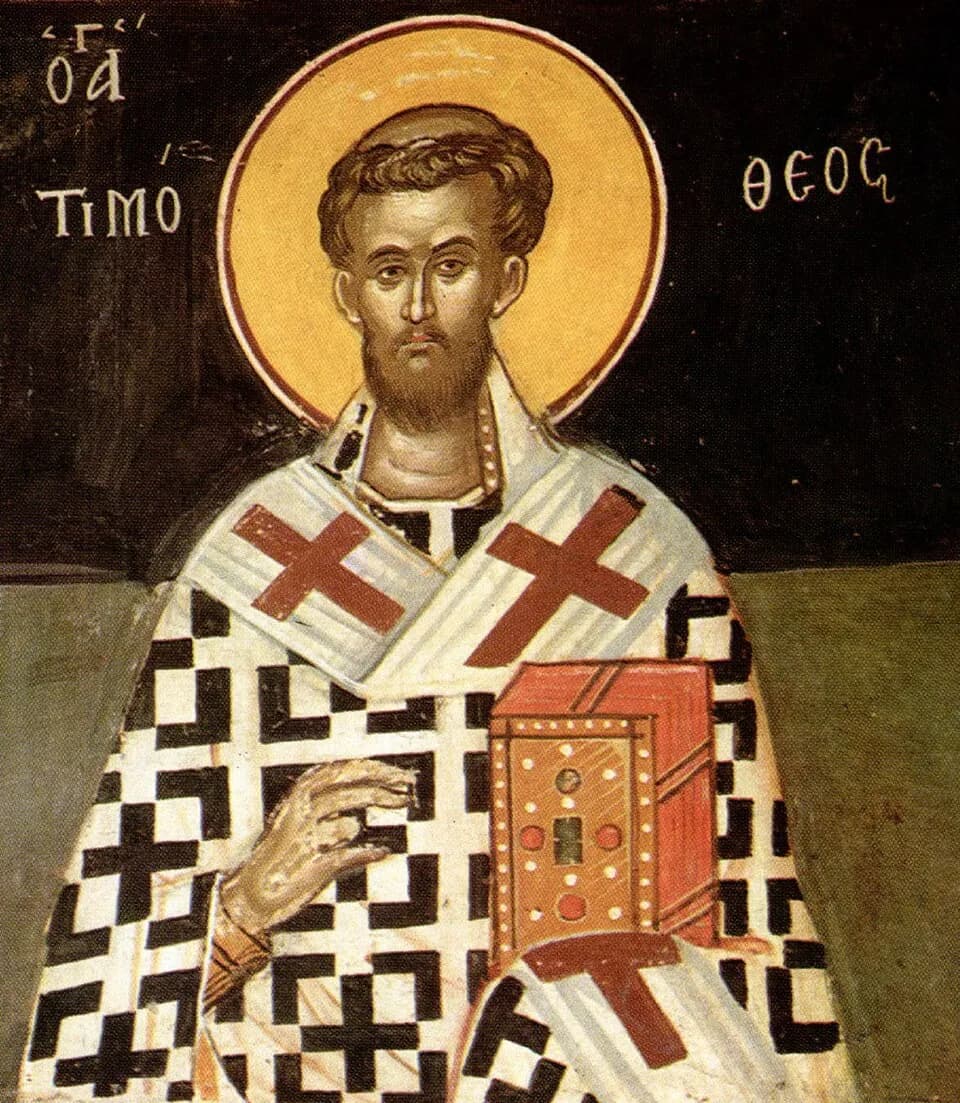
Saint Timothy was the young man from Lystra whom Paul took on as a traveling companion and came to trust above almost anyone, the disciple he sent where he could not go himself. Paul names him in his letters at least seventeen times, and Benedict XVI says the Apostle saw him "almost as an alter ego." 1 Two of the New Testament letters are addressed to him, and the later tradition of the Church remembers him as the first bishop of Ephesus. 12
A family in two worlds
Acts introduces him without ceremony: at Lystra "there was a disciple named Timothy, the son of a Jewish woman who was a believer, but his father was a Greek." 7 Benedict XVI places Lystra about 200 kilometers northwest of Tarsus, and notes that the name Timothy is Greek and means "one who honours God." 1
Benedict reads something into the household. A mother who married outside her people and did not have her son circumcised suggests a family "that was not strictly observant," he says, and yet Timothy was said to have known the Scriptures from childhood. 1 The Second Letter to Timothy names the women behind that faith, which "first lived in your grandmother Lois and in your mother Eunice." 11 Franciscan Media adds that Lois was the first of the family to become a Christian, and that a child of a mixed marriage would have been considered illegitimate by the Jews. 5
Chosen at Lystra
Paul came through Lystra at the start of his second missionary journey. 1 The brothers there and in Iconium "spoke highly of him," and Paul wanted Timothy to come along. 7 Then Acts records a decision that has puzzled readers since: "On account of the Jews of that region, Paul had him circumcised, for they all knew that his father was a Greek." 7 Vatican News sets it beside Paul's refusal to circumcise Titus, and concludes that in his two collaborators Paul "unites the men of circumcision and the men of non-circumcision." 3
Franciscan Media dates his conversion by Paul to around the year 47, and says he went on to work with Paul for about fifteen years, becoming one of his most faithful and trusted friends. 5
The one Paul sent
With Paul and Silas he crossed Asia Minor and went over into Macedonia. 17 At Philippi, where Paul and Silas were beaten and jailed, Benedict notes that Timothy "was spared." 1 When Paul moved on to Athens, Timothy joined him there and was sent back to the young church at Thessalonica to bring news and strengthen it in the faith. He rejoined Paul at Corinth with good news and helped him preach in that city. 1
The pattern held for years. During the third journey Timothy was at Ephesus, and from there Paul sent him to Macedonia and then to Corinth, carrying a letter that asked the Corinthians to receive him well. 1 His name stands beside Paul's at the head of the Second Letter to the Corinthians and the letters to the Philippians and Philemon, and his greetings close the Letter to the Romans. 1 Aherne's list in the 1912 Catholic Encyclopedia adds Colossians and both letters to the Thessalonians. 2
Paul's own praise of him is in Philippians. "I have no one comparable to him for genuine interest in whatever concerns you," he writes; the others "all seek their own interests," but "you know his worth, how as a child with a father he served along with me in the cause of the gospel." 8 Benedict observes that Luke mentions Timothy six times in Acts while Paul mentions him at least seventeen, and draws the obvious conclusion: Paul held him in high esteem, "even if Luke did not consider it worth telling us all about him." 1
Franciscan Media says the missions were often hard ones, into churches Paul had founded that were in turmoil, and that Timothy was with Paul in Rome during his house arrest. 5 The Letter to the Hebrews records that Timothy himself had been in prison: "our brother Timothy has been released." 1 After the end of the third journey, Benedict says, the ancient sources tell us nothing further about him except that line. 1
Young, often ill, and told not to be afraid
The two letters addressed to him are, as Vatican News points out, unusual in the New Testament for being written to a person and not a community. 3 They are full of personal detail. "Let no one have contempt for your youth," the first says, "but set an example for those who believe." 9 It tells him not to neglect the gift conferred on him "with the imposition of hands of the presbyterate." 9 And in a line Franciscan Media calls one of Paul's most frequently quoted, it says: "Stop drinking only water, but have a little wine for the sake of your stomach and your frequent illnesses." 510
The second letter opens with Paul remembering his tears and longing to see him. 11 "I remind you to stir into flame the gift of God that you have through the imposition of my hands," he writes. "For God did not give us a spirit of cowardice but rather of power and love and self-control." 11 Franciscan Media reads the letters as showing a man comparatively young for his work, and says several references "seem to indicate that he was timid." 5 Near its end the letter asks him to come quickly: "Try to join me soon," and again, "Try to get here before winter." 12
Bishop of Ephesus
Franciscan Media says Paul installed Timothy as his representative at the church of Ephesus. 5 Benedict XVI and Vatican News both report that, according to the later Ecclesiastical History of Eusebius, he was the first bishop of Ephesus. 13 Aherne adds that the ancient Roman Martyrology has him die bishop there, and that some have identified him with the "angel of the church of Ephesus" in the Book of Revelation. 2
How he died is known only from tradition, and the traditions differ. Aherne reports a life ascribed to Polycrates, an early bishop of Ephesus, which says Saint John came to Ephesus and lived with Timothy, and that Timothy, "who was unmarried, continued Bishop of Ephesus until, when he was over eighty years of age, he was mortally beaten by the pagans." 2 Catholic Culture gives a different account, in which he was stoned to death thirty years after Paul's martyrdom for denouncing the worship of the goddess Diana. 6 Neither appears in Scripture.
Benedict XVI says that some of his relics, brought from Constantinople, were found in Italy in 1239 in the Cathedral of Termoli, in the Molise. 1 Vatican News also has them arriving from Constantinople in 1239. 3 Catholic Culture adds that they had been moved from Ephesus to Constantinople in the fourth century, were buried at Termoli and forgotten, and were rediscovered during restoration work in 1945. 6
What is Saint Timothy the patron saint of?
Franciscan Media lists Saints Timothy and Titus together as patron saints of relief from stomach disorders. 5 It does not say why, though the same page quotes the advice in First Timothy to take a little wine "for the sake of your stomach and your frequent illnesses." 510 No other patronage is stated in the sources used here.
Saint Timothy's feast day
Saint Timothy is honored on January 26, in a single memorial with Saint Titus. 456 Vatican News describes the two as Paul's closest collaborators, Timothy leading the church at Ephesus and Titus the church of Crete. 4
The joint memorial is the newer arrangement. According to Catholic Culture, in the 1962 Missal, the Extraordinary Form of the Roman Rite, Saint Timothy's feast falls on January 24 and Saint Titus's on February 6. 6 Aherne notes that the Bollandists printed the early lives of Timothy under January 24. 2
Praying with Saint Timothy
Most of what we know about Timothy is what Paul asked of him. Go to Thessalonica and find out how they are. Take this letter to Corinth. Stand in for me at Ephesus. Come before winter. 1512 Benedict XVI takes from Timothy and Titus that Paul "did not do everything on his own but relied on trustworthy people," and that their lives show a readiness to represent him "in circumstances far from easy." 1
His faith came to him through his grandmother and his mother before it came through Paul. 11 The letters name both women, and the second letter traces that faith from Lois to Eunice and on to Timothy. 11 Paul also reminds him that he had known the sacred Scriptures from childhood. 1
The letters do not describe a man without difficulties. He was young enough for others to look down on, he was often ill, and Paul had to tell him to stir up his gift and not to give way to a spirit of cowardice. 91011 He was trusted with a great deal anyway, and Paul wrote of him that he had no one else like him. 8
Of the end of his life, Scripture says nothing, and the traditions that do speak of it disagree. 126 What is certain is the long record of errands in between, which Benedict XVI summed up as serving the Gospel with generosity. 1
Saint Timothy, pray for us.
Sources
- 1.Pope Benedict XVI, General Audience of 13 December 2006: Timothy and Titus. The Holy See.
- 2.Cornelius Aherne, "Epistles to Timothy and Titus," The Catholic Encyclopedia, Vol. 14 (New York: Robert Appleton Company, 1912).
- 3."Sts. Timothy and Titus, Bishops, Disciples of St. Paul," Saint of the Day, Vatican News.
- 4."26 January," Saint of the Day, Vatican News.
- 5."Saints Timothy and Titus," Saint of the Day, Franciscan Media.
- 6."Memorial of Sts. Timothy and Titus, bishops," Liturgical Year, Catholic Culture.
- 7.Acts of the Apostles 16, New American Bible. The Holy See.
- 8.Philippians 2, New American Bible. The Holy See.
- 9.1 Timothy 4, New American Bible. The Holy See.
- 10.1 Timothy 5, New American Bible. The Holy See.
- 11.2 Timothy 1, New American Bible. The Holy See.
- 12.2 Timothy 4, New American Bible. The Holy See.
Saints to turn to next
Others in this collection who are turned to for some of the same things.
- Saint Marianne CopeJanuary 23, 1838 - August 9, 1918CourageSuffering and illnessWork and vocation
- Saint Andrew Kim TaegonAugust 21, 1821 - September 16, 1846CourageSuffering and illnessWork and vocation
- Saint Damien of MolokaiJanuary 3, 1840 - April 15, 1889Suffering and illnessCourageWork and vocation
- Saint Gianna Beretta MollaOctober 4, 1922 - April 28, 1962Work and vocationCourageSuffering and illness