Saint Damien of Molokai
January 3, 1840 - April 15, 1889
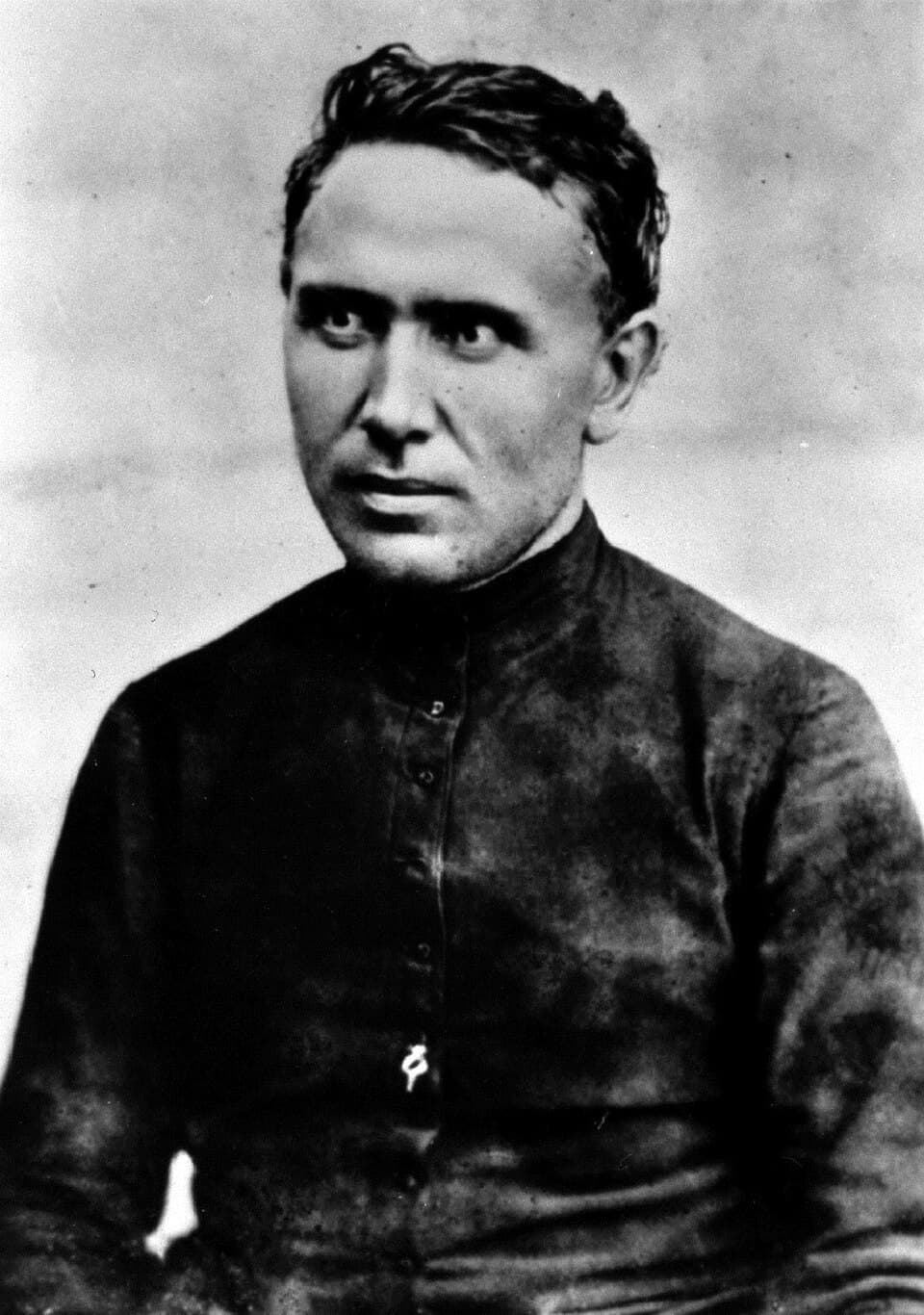
- Beatified
- June 4, 1995, in Brussels, by John Paul II 2
- US Capitol
- One of Hawaii's two statues in the National Statuary Hall, chosen in 1959 4
Saint Damien of Molokai was a Belgian priest who went in 1873 to the settlement on Molokai where the Hawaiian government sent everyone with leprosy, stayed for the rest of his life, caught the disease and died of it in 1889. 23 Benedict XVI, canonizing him in 2009, said he became "a leper with the lepers." 1 Franciscan Media puts his reach plainly: when he was born few people in Europe had any firsthand knowledge of leprosy, Hansen's disease, and by the time he died people all over the world knew about it because of him. 4
A farmer's son from Tremelo
He was born Jozef De Veuster at Tremelo, in Belgium, on January 3, 1840. 2 The 1913 Catholic Encyclopedia calls his father a small farmer. 3 The sources tell his schooling differently. Franciscan Media says he was forced to quit school at 13 to work on the family farm; the encyclopedia says his father sent him to a college at Braine-le-Comte to prepare him for a commercial career. 34
What turned him, according to the encyclopedia, was a mission preached by the Redemptorists in 1858, after which he decided to become a religious. 3 He began his novitiate with the Congregation of the Sacred Hearts of Jesus and Mary, the Picpus Fathers, at the beginning of 1859, and took the name Damien. 2 Franciscan Media notes the name belonged to a fourth-century physician and martyr. 4 The encyclopedia dates his profession to October 7, 1860. 3
The Holy See biography records one habit from those years. He prayed every day before a picture of Saint Francis Xavier, patron of missionaries, asking to be sent on a mission. 2
His brother's place
The mission came to him by accident. In 1863 his brother, who was due to sail for the Hawaiian Islands, fell ill. 2 Franciscan Media names him as Pamphile, a priest of the same congregation. 4 The passage was already arranged, so Damien asked the superior general for permission to go instead, and got it. 2 He was 23, and Benedict XVI marks the moment: "he left Flanders, the land of his birth, to proclaim the Gospel on the other side of the world in the Hawaiian Islands." 1
He landed at Honolulu on March 19, 1864, still in minor orders. 23 He was ordained a priest there that May: on May 21 by the Holy See biography's date, on May 24 by the encyclopedia's. 23 He was assigned to the island of Hawaii, where the encyclopedia says he had charge of several districts. 34 It credits his robust constitution and says he built several chapels with his own hands, there and later on Molokai. 3
Molokai
The Hawaiian government had decided on quarantine: everyone infected with what was then thought an incurable disease was deported to the island of Molokai. 2 Franciscan Media says the settlement had been set up seven years before Damien arrived. 4 The encyclopedia says the board of health supplied food and clothing but, at first, neither resident doctors nor nurses. 3 It quotes the superintendent of the board writing to the bishop: "As long as the lepers can care for themselves, they are comparatively comfortable, but as soon as the dreadful disease renders them helpless, it would seem that even demons themselves would pity their condition and hasten their death." 3
Bishop Louis Maigret believed the sick needed priests but would not send anyone "in the name of obedience," the Holy See biography says, because he knew such an assignment was a potential death sentence. 2 Four brothers volunteered, and Damien was the first to leave, on May 10, 1873, for Kalaupapa. 2 Franciscan Media describes the arrangement as a team of four chaplains each taking three months of the year, from which Damien soon volunteered to stay for good. 4 The Holy See biography says he remained at his own request and at the request of the sick themselves. 2 The encyclopedia counts 600 of them when he came. 3
Benedict XVI did not make it sound easy. Damien went, he said, "not without fear and repugnance," to serve people "abandoned by all," and in doing so "he was exposed to the disease from which they suffered. He felt at home with them." 1
Priest, builder, gravedigger
For a long time, the encyclopedia says, he was the only one bringing help. Besides the sacraments, he gave what medical care and comfort he could: he dressed their ulcers, helped them put up their cottages, and dug their graves and made their coffins. 3 Franciscan Media adds that he became their most effective advocate for the government support they had been promised. 4 Soon there were new houses, a new church, a school and an orphanage, and morale improved considerably. 4
He did not run it as a sectarian enterprise. The Holy See biography lists among his best friends Meyer, a Lutheran and the superintendent of the settlement; Clifford, an Anglican; Moritz, a free-thinker who was the doctor on Molokai; and Dr. Masanao Goto, a Japanese Buddhist and leprologist. 2 It says he respected the religious convictions of others and received their help with joy. 2
A few years on, Franciscan Media says, he succeeded in bringing the Franciscan Sisters of Syracuse, led by Mother Marianne Cope, to help staff the settlement at Kalaupapa. 4 Benedict XVI, canonizing her in 2012, said that she "looked after Father Damien, already famous for his heroic work among the lepers, nursed him as he died and took over his work among male lepers." 6
A leper with the lepers
The sources date the illness a year apart. The Holy See biography speaks of the announcement of his leprosy in 1884; the encyclopedia says he discovered the first symptoms in 1885, after twelve years on the island. 23 He kept working, with two other priests and two lay brothers helping him by then. 3 On March 28, 1889, he became helpless, and he died on April 15, at 49. 234 The Holy See biography reckons sixteen years among the sick; the encyclopedia says he died closing his fifteenth. 23
He was buried in the settlement cemetery, the Holy See biography says, under the same pandanus tree where he had slept on his first night there. 2 In 1936 the Belgian government had his remains exhumed and taken to a crypt in his congregation's church at Louvain. 24 After his beatification in 1995, part of his body was returned to Hawaii. 4
He had his accusers. The encyclopedia says remarks about his morality provoked Robert Louis Stevenson's well-known reply to the Rev. Dr. Hyde, and that letters printed in the Pacific Commercial Advertiser on June 20, 1905, showed Hyde's insinuations rested on misunderstandings. 3 Franciscan Media records the split more simply: some people thought him a hero for going to Molokai, and others thought him crazy. 4
John Paul II beatified him in Brussels on June 4, 1995. 2 When Hawaii became a state in 1959, it chose him as one of its two figures in the National Statuary Hall at the US Capitol. 4 Benedict XVI canonized him in Rome on October 11, 2009. 14
What is Saint Damien of Molokai the patron saint of?
None of the sources consulted for this profile names a patronage for Saint Damien, so this page does not claim one. 1234 What Benedict XVI did say in his canonization homily points past the disease itself: Damien, he said, "invites us to open our eyes to the forms of leprosy that disfigure the humanity of our brethren and still today call for the charity of our presence as servants, beyond that of our generosity." 1 That is an invitation, not a formal patronage, and it is reported here as what it is.
Saint Damien of Molokai's feast day
In the United States his feast is May 10. The bishops' proper calendar lists "Saint Damien de Veuster, Priest" on that day as an optional memorial, and Franciscan Media keeps him as its Saint of the Day for May 10. 45 It is the date the Holy See biography and the 1913 encyclopedia give for his arrival on Molokai in 1873. 23
He died on April 15, 1889. 23 No source consulted here prints April 15 as a feast, so this page gives it only as the day he died.
Praying with Saint Damien of Molokai
He went to Molokai, Benedict XVI said, "not without fear and repugnance." 1 It is worth keeping that phrase in front of the rest. The bishop would not order anyone to go, and the ones who went did not go because they found it easy. 2 What the sources describe is a man who went anyway and then found, as the homily says, that he "felt at home with them." 1
Most of what he did there was physical. He built houses, dressed sores, made coffins and dug graves, and he argued with a government for supplies it had promised. 34 The holiness the sources describe is largely carpentry, nursing and persistence, carried on in the same place for years.
He also had friends who did not share his faith: a Lutheran, an Anglican, a free-thinking doctor, a Buddhist physician. 2 The same biography calls him "above all a Catholic missionary," and in the same passage says he respected the religious convictions of others and received their help with joy. 2 It does not treat the two as being in tension.
And he died of the disease he went to serve. The sources do not soften that or turn it into a reward. Benedict XVI calls him a "suffering servant" for his last four years, and the encyclopedia simply records the day he became helpless and the day, less than three weeks later, he died. 13
Saint Damien of Molokai, pray for us.
Sources
- 1.Benedict XVI, Homily for the Canonization of Zygmunt Szczęsny Feliński, Francisco Coll y Guitart, Jozef Damiaan de Veuster, Rafael Arnáiz Barón and Marie de la Croix (Jeanne) Jugan, Vatican Basilica, October 11, 2009.
- 2."St Jozef Damien De Veuster (1840-1889)," biography published by the Holy See for the canonization of October 11, 2009.
- 3.Libert Boeynaems, "Father Damien (Joseph de Veuster)," The Catholic Encyclopedia, vol. 4 (New York: Robert Appleton Company, 1908).
- 4."Saint Damien de Veuster of Moloka'i," Saint of the Day, Franciscan Media.
- 5.Liturgical Calendar for the Dioceses of the United States of America 2025, Committee on Divine Worship, United States Conference of Catholic Bishops (Proper Calendar, and May 10).
- 6.Benedict XVI, Homily for the Canonization of Blesseds James Berthieu, Pedro Calungsod, John Baptist Piamarta, Maria Carmen Salles y Barangueras, Marianne Cope, Kateri Tekakwitha and Anna Schaffer, St Peter's Square, October 21, 2012.
Saints to turn to next
Others in this collection who are turned to for some of the same things.
- Saint Andrew Kim TaegonAugust 21, 1821 - September 16, 1846CourageSuffering and illnessWork and vocation
- Saint Gianna Beretta MollaOctober 4, 1922 - April 28, 1962Work and vocationCourageSuffering and illness
- Saint Junípero SerraNovember 24, 1713 - August 28, 1784CourageWork and vocationSuffering and illness
- Saint Marianne CopeJanuary 23, 1838 - August 9, 1918CourageSuffering and illnessWork and vocation