Saint Junípero Serra
November 24, 1713 - August 28, 1784
- Religious order
- Franciscan; entered September 14, 1730 4
- Missions
- San Diego (1769) to San Buenaventura (1782); nine by Franciscan Media's count, twenty-one by Francis's 257
- Buried
- Mission San Carlos Borromeo, Carmel 5
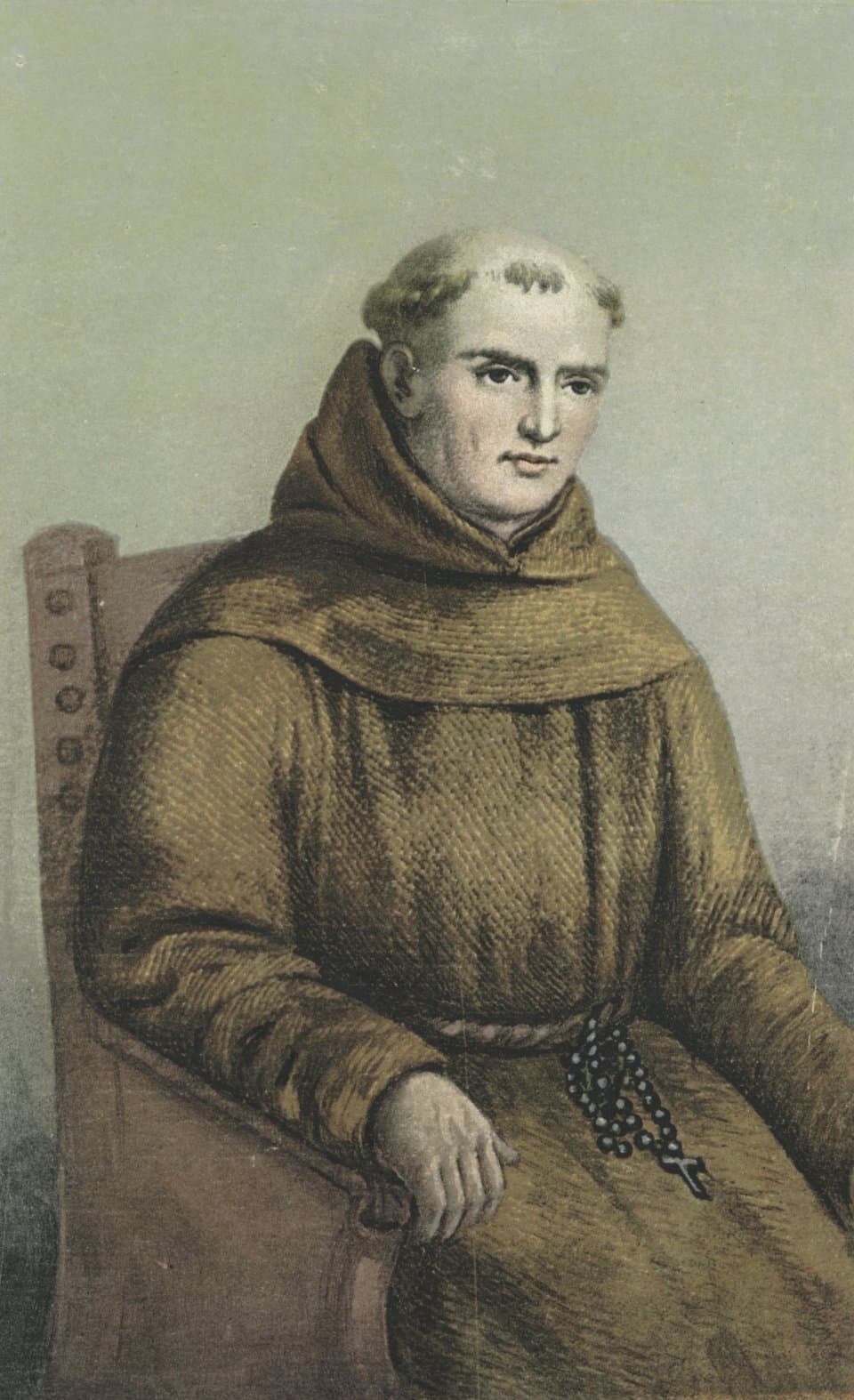
Saint Junípero Serra was a Franciscan from Majorca who gave up a chair of philosophy to walk the missions of Mexico and then founded the first of the California missions at San Diego in 1769. 45 Pope Francis canonized him in Washington, D.C., on September 23, 2015, calling him "the embodiment of 'a Church which goes forth'" and also naming the "mistreatment and wrongs which today still trouble us". 1 He is also a disputed figure, criticized as a symbol of colonialism, and the Catholic sources that honor him say so. 56
A professor in Majorca
He was born at Petra, on the island of Majorca, on November 24, 1713, and entered the Franciscan Order on September 14, 1730. 45 Franciscan Media says he took his religious name from Brother Juniper, the childlike companion of Saint Francis. 5 The name did not predict the career. He was good enough at his studies to be made lector of philosophy before he was ordained, took a doctorate in theology at the Lullian University in Palma, and held its Duns Scotus chair of philosophy. 4 Franciscan Media says that until he was 35 he spent most of his time in the classroom, and that he was also known as a preacher. 5
Then he left. Franciscan Media traces the turn to a desire that had begun years earlier, when he heard about Saint Francis Solano's missionary work in South America. 5 Francis, preaching on him in Rome in May 2015, asked what it was that made him leave "his home and country, his family, university chair and Franciscan community in Mallorca to go to the ends of the earth," and answered that it was the desire to proclaim the Gospel to those farthest away. 2 In 1749 he joined the missionary college of San Fernando in Mexico. 4
Mexico on foot
He landed at Vera Cruz and walked to Mexico City, about 250 miles by Franciscan Media's reckoning. 45 The road left him lame for life, though the sources describe the injury differently. The 1912 encyclopedia says he hurt his leg on the walk and suffered from it ever after, yet kept traveling on foot whenever he could. 4 Franciscan Media says his left leg was infected by an insect bite and remained a cross, sometimes life-threatening, for the rest of his life. 5
At his own request he was sent to the Sierra Gorda missions north of Querétaro. The encyclopedia says he served there nine years, partly as superior, learned the language of the Pame people and translated the catechism into it. 4 Recalled to the capital, he became famous as a preacher of missions. 4 The encyclopedia does not soften what that preaching looked like: he would pound his breast with a stone in the pulpit, scourge himself, or hold a lighted torch to his bare chest to move his hearers to penance. 4 Franciscan Media sums up the whole Mexican period as 18 years in central Mexico and the Baja Peninsula, where he became president of the missions. 5 In 1767 he was named superior of fifteen Franciscans sent to the missions of Lower California. 4
The California missions
Franciscan Media puts the next move down to politics: Charles III of Spain feared a Russian advance south from Alaska and ordered an expedition to claim the coast first. 5 Early in 1769 Serra went north with Portolá's land expedition, founding a mission at Velicatá on the way, and reached San Diego on July 1. 4 On July 16 he founded Mission San Diego. 4 Supplies nearly ran out that first year. Franciscan Media tells how Serra and another friar, resolved to stay, began a novena before the feast of Saint Joseph, the day set for abandoning the effort, and the relief ship arrived on that day. 5
Other foundations followed: San Carlos at Monterey and Carmel in 1770, San Antonio and San Gabriel in 1771, San Luis Obispo in 1772, San Francisco and San Juan Capistrano in 1776, Santa Clara in 1777, and San Buenaventura on Easter Sunday, March 31, 1782. 457 The sources count them differently. Franciscan Media says nine missions were founded under his direction and twelve more after his death, and Vatican News calls San Buenaventura the ninth and last he founded. 57 Francis, in May 2015, spoke of "the 21 missions that Friar Junípero founded along the coast of California". 2 The encyclopedia gives twenty-one as the total of the California missions and lists nine as founded by him or during his administration. 4
He fought the colonial authorities more than once. The encyclopedia says that trouble with the military commander Pedro Fages sent him to Mexico City in 1773, where he drew up a "Representación" in thirty-two articles for the viceroy, and that all but two minor points were settled the way he asked. 4 Franciscan Media says he arrived at the point of death, and that the result was the "Regulation" protecting the Indians and the missions, which it calls the basis of the first significant legislation in California and a "Bill of Rights" for Native Americans. 5 Later Governor Neve stopped him from administering confirmation for nearly two years, until the viceroy ruled he was within his rights. 4
In his last three years he walked the missions again, six hundred miles from San Diego to San Francisco, to confirm everyone who had been baptized, suffering badly from his leg and his chest and refusing remedies. 4 The encyclopedia counts 5,309 confirmations; Franciscan Media says he baptized over 6,000 people and confirmed 5,000. 45 Franciscan Media adds that he prayed each night, often from midnight until dawn. 5 He died at Monterey on August 28, 1784, and is buried at Mission San Carlos Borromeo in Carmel. 45
The controversy over the missions
Serra is not remembered calmly, and the Catholic sources do not pretend he is. Franciscan Media explains that the friars were made the legal guardians of the Native peoples, and that converts were kept at the mission after baptism "lest they be corrupted in their former haunts—a move that has brought cries of 'injustice' from some moderns." 5 Vatican News reports that some have called him a symbol of European colonialism, and that in June and July 2020 demonstrators tore down statues of him in San Francisco, Los Angeles and Sacramento. 6
The Bishop of Sacramento, Jaime Soto, answered without denying the history. "There is no question that California's indigenous people endured great suffering during the colonial period and then later faced the horror of government-sanctioned genocide under the nascent State of California," he said. 6 Serra, in his view, worked within the colonial system but "denounced its evils and worked to protect the dignity of native peoples," and "his holiness as a missionary should not be measured by his own failures to stop the exploitation or even his own personal faults." 6
Francis took up the question himself. In Rome he placed Serra among the missionaries who "defended the indigenous peoples against abuses by the colonizers," and allowed that when we look at such men we examine "their strengths and, above all, their weaknesses and their shortcomings." 2 At the canonization he said Serra "sought to defend the dignity of the native community, to protect it from those who had mistreated and abused it," and called those wrongs ones "which today still trouble us, especially because of the hurt which they cause in the lives of many people." 1 Two months earlier, in Bolivia, he had said that "many grave sins were committed against the native peoples of America in the name of God" and asked forgiveness for the offenses of the Church and for crimes committed during "the so-called conquest of America." 3 That apology was about the conquest of America as a whole and did not mention Serra, so it should not be read as a verdict on him in particular. 3
What is Saint Junípero Serra the patron saint of?
Saint Junípero Serra's feast day
Saint Junípero Serra is kept on July 1 in the proper calendar for the dioceses of the United States, approved by the United States Conference of Catholic Bishops and confirmed by the Apostolic See, which lists him as "Saint Junípero Serra, Priest." 8 Franciscan Media also keeps him on July 1. 5 It is not the day he died, which was August 28, 1784. 45 The encyclopedia does record that July 1 was the day in 1769 that he arrived at San Diego. 4
Praying with Saint Junípero Serra
Francis built his canonization homily around Serra's motto, "siempre adelante! Keep moving forward!" 1 Franciscan Media renders it "Always forward, never back." 5 It is a fitting phrase for a man on a bad leg who walked six hundred miles at the end of his life to confirm converts, and who would not take remedies for the pain. 4 The encyclopedia names his "insatiable zeal" and "absolute confidence in God"; Franciscan Media chooses the single word zeal. 45
Before he left for California, Francis said, Serra consecrated his life to Our Lady of Guadalupe and asked her to open the hearts "of the colonizers and indigenous peoples" alike. 2 That prayer names both parties to what followed. A reader praying with him cannot leave either one out, and the Church, through Francis and Bishop Soto, has not. 16
The sources disagree about how his work landed, and the disagreement is part of the record. Franciscan Media says he won the love of the people he served, witnessed by their grief at his death. 5 Vatican News reports that, more than two centuries later, statues of him were burned and broken by people who see in him the beginning of a long injury. 6 Francis declared him a saint knowing both, and spoke of the wrongs in the same homily as the holiness. 1
The sources describe a missionary who worked inside a colonial system under which, in Bishop Soto's words, California's indigenous people "endured great suffering," and who fought that system's officials on their behalf more than once. 456 The same Francis who canonized him had asked forgiveness, that summer, for the sins committed against the native peoples of America in the name of God. 3 Praying with Serra on July 1 can carry both.
Saint Junípero Serra, pray for us.
Sources
- 1.Francis, Homily at the Holy Mass and Canonization of Blessed Fr. Junípero Serra, National Shrine of the Immaculate Conception, Washington, D.C., September 23, 2015.
- 2.Francis, Homily at the Holy Mass at the Pontifical North American College, Rome, May 2, 2015.
- 3.Francis, Address at the Second World Meeting of Popular Movements, Santa Cruz de la Sierra, Bolivia, July 9, 2015.
- 4.Zephyrin Engelhardt, "Junípero Serra," The Catholic Encyclopedia, vol. 13 (New York: Robert Appleton Company, 1912).
- 5."Saint Junipero Serra," Saint of the Day, Franciscan Media.
- 6.Devin Watkins, "US Bishop decries destruction of St. Junipero Serra statue," Vatican News, July 6, 2020.
- 7."Pope Francis declares Mission San Buenaventura a Basilica," Vatican News, July 16, 2020.
- 8."Proper Calendar for the Dioceses of the United States of America," United States Conference of Catholic Bishops, last updated September 23, 2015.
Saints to turn to next
Others in this collection who are turned to for some of the same things.
- Saint Andrew Kim TaegonAugust 21, 1821 - September 16, 1846CourageSuffering and illnessWork and vocation
- Saint Damien of MolokaiJanuary 3, 1840 - April 15, 1889Suffering and illnessCourageWork and vocation
- Saint Gianna Beretta MollaOctober 4, 1922 - April 28, 1962Work and vocationCourageSuffering and illness
- Saint Marianne CopeJanuary 23, 1838 - August 9, 1918CourageSuffering and illnessWork and vocation