Saint Pantaleon
Died at Nicomedia about 305
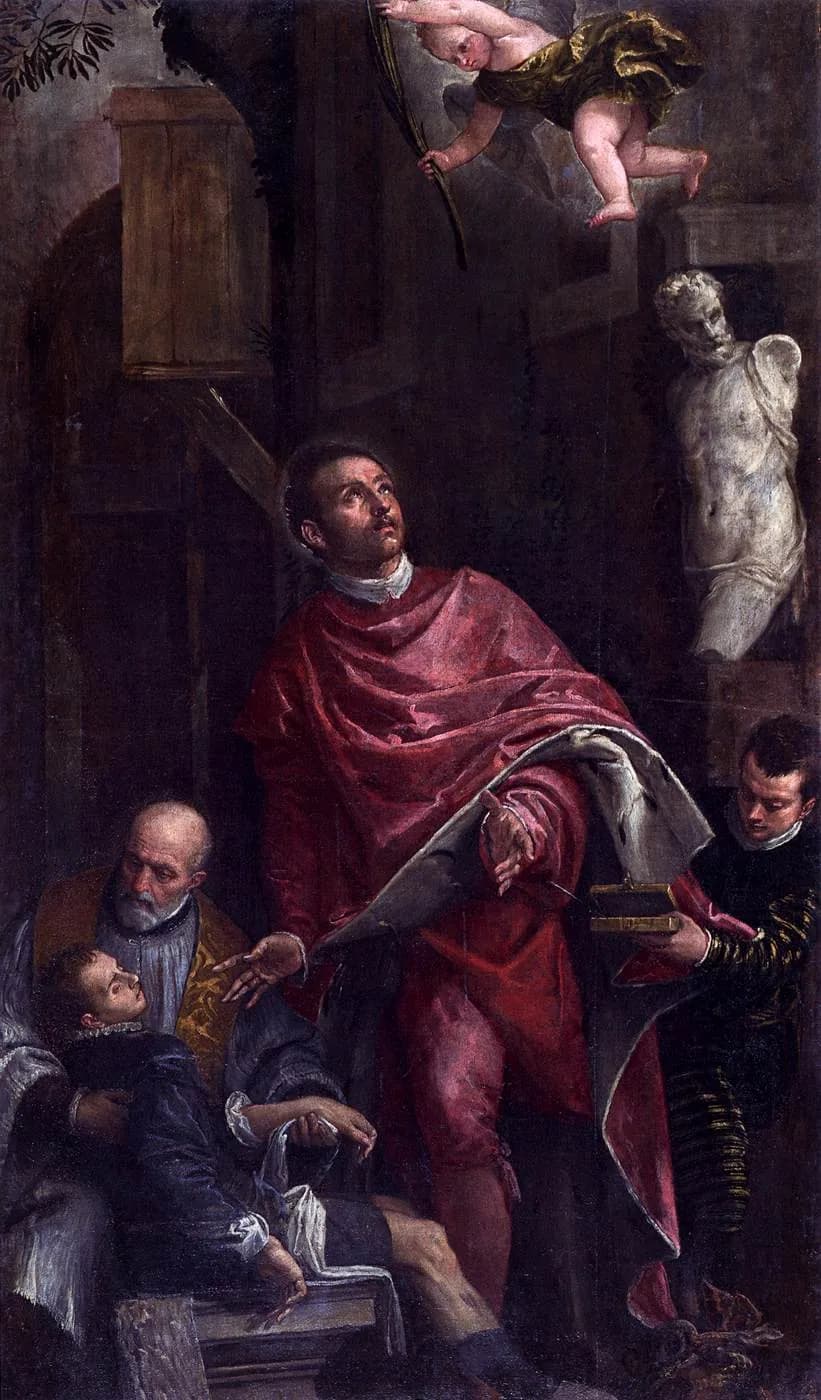
- Patron saint of
- Physicians and midwives 13; Catholic Culture adds doctors, bachelors, torture victims, people with consumption or tuberculosis, and the protection of domestic animals 34
- Also called
- Panteleemon, "the all-compassionate" 1
- Died
- About 305 according to the 1911 Catholic Encyclopedia 1; 305 or about 303 in Catholic Culture 34
- Relics
- At Saint-Denis in Paris; his head at Lyons 1
- Historical record
- The 1911 Catholic Encyclopedia calls the legendary lives "all late in date and valueless," but holds the martyrdom itself proved by early veneration 1
Saint Pantaleon was a physician of Nicomedia, in what is now northwestern Turkey, who was put to death for his faith around the year 305. 13 The Church has long counted him among the Fourteen Holy Helpers and the patrons of physicians and midwives, and the East honors him as a great martyr and wonderworker. 13 Almost every detail of his story, though, comes from Acts that the 1911 Catholic Encyclopedia calls "all late in date and valueless." 1 What survives as history is the fact of his martyrdom, attested by veneration that goes back to the early Church. 1
What is known, and what is legend
Klemens Löffler, who wrote the encyclopedia article, is blunt about the stories. He tells them in full, prefaced "according to legend," and then sets them aside as worthless for history. 1 He does not, however, set aside the man. "Yet the fact of the martyrdom itself seems to be proved," he writes, by early testimony to the veneration of Pantaleon: the fifth-century bishop Theodoret mentions him, as do the historian Procopius of Caesarea and the ancient martyrology attributed to Saint Jerome. 1
Catholic Culture adds what the cult looked like on the ground. It was centered on Bithynia, the province around Nicomedia, where the emperor Justinian rebuilt Pantaleon's church, and churches were dedicated to him in Constantinople and Rome. 3 In the East he is still known as the Great Martyr and Wonder Worker. 13
Even his name has a story attached. Pantaleon is the form used in the West, and the encyclopedia explains the Greek Panteleemon, "the all-compassionate," as a name he received for praying that his executioners be forgiven. 1 The rest of this page tells the legend as the sources tell it, and marks it as legend.
A physician at the emperor's court
In the legend, Pantaleon is the son of a rich pagan, Eustorgius of Nicomedia, and of a Christian mother, Eubula, who taught him the faith. 1 He drifted away from it as he grew up, studied medicine, and rose to become physician to the emperor. 1 The encyclopedia names that emperor as Maximinianus. 1 Pius Parsch, whose account Catholic Culture excerpts, says he "is said to have strayed from the faith because of the voluptuous life at the court." 3
He was brought back by a priest named Hermolaus. 1 Parsch says Hermolaus did it "by pointing out the example of his virtuous mother." 3 When his father died, Pantaleon inherited a large fortune. 1 According to Parsch, he gave his goods to the poor and turned his skill to "the most wretched and poor among the sick," and Catholic Culture calls him a celebrated "fee-less physician" who practiced without payment. 3
That generosity, in the encyclopedia's telling, is what brought him down. Envious colleagues denounced him to the emperor during the persecution under Diocletian. 1 The emperor wanted to save him and pressed him to give up his faith. Pantaleon instead confessed it openly and, as proof that Christ is the true God, healed a paralyzed man in front of him. The emperor took the cure for magic and condemned him. 1
The martyrdom in the legend
What follows in the encyclopedia's summary is a series of executions that fail. His flesh was burned with torches, and Christ appeared to everyone present in the form of Hermolaus to strengthen and heal him, and the torches went out. A bath of molten lead was prepared, and Christ, again in the form of Hermolaus, stepped into the cauldron with him; the fire died and the lead went cold. 1
He was thrown into the sea weighted with a stone, and the stone floated. He was given to wild beasts, which fawned on him and would not leave until he had blessed them. He was bound to a wheel, and the ropes snapped and the wheel broke. When the executioners tried to behead him, the sword bent, and they were converted. 1 Pantaleon prayed for their forgiveness, and only when he himself consented could he be beheaded. 1
The shorter accounts differ. Parsch says Pantaleon was seized by order of the emperor Maximian, tied to the rack and scorched with torches, that Christ appeared and gave him strength, and that "finally a stroke of the sword ended his sufferings." 3 Catholic Culture's page on the Fourteen Holy Helpers says he was nailed to a tree and then beheaded at Nicomedia, around 303, under Diocletian, and that he is pictured with his hands nailed together. 4
His blood and his relics
The encyclopedia reports that a phial of his blood has been kept at Constantinople "from early times," and that on his feast day the blood "is said to become fluid and to bubble." 1 Catholic Culture describes a reputed relic of his blood at Ravello, in southern Italy, which it says liquefies on his feast in the manner of the blood of Saint Januarius. 3 Both sources use the language of report, and this page does the same; neither says the two relics are connected.
Other relics, according to the encyclopedia, are kept at the abbey of Saint-Denis near Paris, and his head is venerated at Lyons. 1
One of the Fourteen Holy Helpers
In the Middle Ages, the encyclopedia says, Pantaleon became one of the "fourteen guardian martyrs," the group better known in English as the Fourteen Holy Helpers. 1 Catholic Culture explains that devotion to the group as a whole grew up mainly during the Black Death of 1346 to 1349, when people turned to these saints to be spared or cured, and that all fourteen except Giles were martyrs. 4 The group had a shared feast on August 8 until the 1969 reform of the Roman calendar, which dropped it; each saint keeps his or her own day. 4 Pantaleon keeps company there with George, Christopher, Barbara and Catherine of Alexandria, and with Blaise, who Catholic Culture says is thought to have been a physician as well. 4
What is Saint Pantaleon the patron saint of?
Saint Pantaleon is the patron saint of physicians and midwives. The encyclopedia says he came to be regarded that way in the Middle Ages, and Catholic Culture gives the same two patronages. 134 Catholic Culture's fuller list adds doctors, bachelors, torture victims, people suffering from consumption or tuberculosis, and the protection of domestic animals. 3 Its Holy Helpers page says he is invoked against consumption and for the protection of domestic animals. 4
In art, Catholic Culture lists a budding olive branch or olive tree, vials of medicine, a lion, a club, and a sword and vase among his symbols. 3
Saint Pantaleon's feast day
Saint Pantaleon's feast day is July 27. 234 Vatican News lists "St. Pantaleon, Physician, Martyr" among the saints of that day. 2 Catholic Culture lists him for July 27 as a commemoration from the Roman Martyrology rather than as a memorial of the general calendar. 3 The 1911 encyclopedia gives July 27 and adds that he is also kept on July 28 and on February 18. 1
Praying with Saint Pantaleon
The Church's own historians have said for more than a century that the miracles of his execution cannot be relied on. 1 What remains is thinner and harder to dismiss: a physician of Nicomedia who died for his faith, and whose memory Christians kept from very early on, in the East and the West alike. 13
The part of the story Parsch dwells on is ordinary work. A doctor with a court practice and an inheritance, as the legend has it, gave away his money and spent his skill on the poorest of the sick, without charging them. 3 The patronage of physicians and midwives that grew up around him in the Middle Ages keeps that picture of him in view. 1
The legend also brings him back to the faith through a priest who reminded him of his mother. 3 Whatever its value as history, that is a story about the faith being handed on and recovered rather than held without a break.
In the encyclopedia's telling, his last recorded act was to ask forgiveness for the men sent to kill him, and the name the East gave him, the all-compassionate, comes from that prayer. 1 Nothing here has been added to make the devotion easier, and the stories that do not hold up are labeled as legend.
Saint Pantaleon, pray for us.
Sources
- 1.Klemens Löffler, "St. Pantaleon," The Catholic Encyclopedia, Vol. 11 (New York: Robert Appleton Company, 1911).
- 2."27 July," Saint of the Day, Vatican News.
- 3."Monday of the Seventeenth Week in Ordinary Time - July 27, 2026," Liturgical Year, Catholic Culture (Trinity Communications), with an excerpt from Pius Parsch, The Church's Year of Grace.
- 4."Fourteen Holy Helpers," Catholic Activity, Liturgical Year, Catholic Culture (Trinity Communications).
Saints to turn to next
Others in this collection who are turned to for some of the same things.
- Saints Cosmas and DamianMartyred c. 287, or in the early fourth centuryWork and vocationSuffering and illnessCourage
- Saint Gianna Beretta MollaOctober 4, 1922 - April 28, 1962Work and vocationCourageSuffering and illness
- Saint Marianne CopeJanuary 23, 1838 - August 9, 1918CourageSuffering and illnessWork and vocation
- Saint TimothyFirst centuryWork and vocationCourageSuffering and illness