Saints Cosmas and Damian
Martyred c. 287, or in the early fourth century
- Patron saints of
- Physicians and surgeons 12; doctors 4; the Catholic Apostolate Center adds pharmacists, chemistry and barbers 6
- In the Eastern churches
- July 1, October 17 and November 1, according to the 1908 Catholic Encyclopedia 1
Saints Cosmas and Damian were Christian physicians who treated the sick without charging them, and for that they were called anargyroi, "the silverless". 12 Under Diocletian they were arrested and beheaded, and although the sources agree that little about their lives is certain, their names have been said in the Canon of the Mass for centuries. 146
Two doctors who would not take payment
The 1908 Catholic Encyclopedia gives the traditional account in a few lines. They "were twins, born in Arabia, and practised the art of healing in the seaport Ægea, now Ayash (Ajass), on the Gulf of Iskanderun in Cilicia, Asia Minor, and attained a great reputation." 1 The page of the Vatican City State Governorate is less sure where they were from: they "appear to have been natives of Cilicia," it says, although in their Passio they declare, "We are from a city of Arabia." 2
Whether they were twins is not settled either. Catholic Culture says that "tradition holds they were twin brothers," and the Vatican City State page allows that they may have been "brothers or perhaps friends." 24 It also names their mother, from a text called the Life and Miracles: Theodote, who raised them in the faith and taught them to read from the Bible, "particularly the Psalms." 2
The one thing every account repeats is the money. "They accepted no pay for their services and were, therefore, called anargyroi, 'the silverless'. In this way they brought many to the Catholic Faith." 1 The Vatican City State page says the same, and adds that they worked first at Aegeae and later in the Roman province of Syria. 2 It describes them as "complete physicians" who cared for "the sufferings of the soul and mind" as well as the body, and says their healing extended to livestock. 2
The leg, and the other stories
The best-known story about them is a transplant. "One of the most famous miracles attributed to Cosmas and Damian, according to tradition, was the replacement of a patient's diseased, ulcerated leg with a healthy limb taken from the body of a recently deceased Ethiopian." 2 It is a tradition, and that is how the Vatican City State page presents it.
The encyclopedia is blunt about how such stories gathered: "At a later date a number of fables grew up about them, connected in part with their relics." 1 The excerpt from Clifford Stevens that Catholic Culture prints is just as plain: "Little is known of their true history, but the legend that has come down to us is of very early origin." 4 Neither source tries to sort the stories into true and false, and this page does not either.
Arrest and martyrdom
When the persecution of Diocletian began, the encyclopedia says, "the Prefect Lysias had Cosmas and Damian arrested, and ordered them to recant." 1 The Stevens excerpt calls Lysias the governor of Cilicia and says the brothers, "since they were prominent Christians," were among the first taken. 4
The account the encyclopedia summarizes is full of wonders. "They remained constant under torture, in a miraculous manner suffered no injury from water, fire, air, nor on the cross, and were finally beheaded with the sword." 1 Three more brothers, Anthimus, Leontius and Euprepius, are said to have died with them. 1
The sources do not agree on the date or the place. The encyclopedia puts the execution on 27 September, "probably in the year 287." 1 Catholic Culture gives 303 and says they died in Syria. 4 The Vatican City State page places their martyrdom at Cyrrhus, in northern Syria, "in the early 4th century." 2 The Stevens excerpt has them beheaded under the governor of Cilicia and their bodies "carried to Syria and buried at Cyrrhus." 4
Churches in Constantinople and Rome
Whatever the uncertainty about their lives, there is none about how quickly they were honored. The encyclopedia says that the Emperor Justinian I, "having been cured of a dangerous illness by the intercession of Cosmas and Damian," rebuilt and adorned their church at Constantinople, which "became a celebrated place of pilgrimage," and restored the city of Cyrus where they were buried. 1
In Rome, according to the encyclopedia, Pope Felix IV (526-530) built a church in their honor, "the mosaics of which are still among the most valuable art remains of the city." 1 The Stevens excerpt gives its dedication as 530. 4 The Vatican City State page says that by the fifth century basilicas had been dedicated to them in Syria, Cappadocia, Constantinople, Ravenna and Rome, and that the Roman mosaic shows them offering their crowns to Christ, led by Saints Peter and Paul. 2
Their names went into the prayer of the Mass itself. The encyclopedia says they are invoked "in the Canon of the Mass and in the Litany of the Saints," and the Catholic Apostolate Center notes that the Canon is the Roman Canon, "commonly known as Eucharistic Prayer 1." 16 The Stevens excerpt takes that as evidence of how old their feast is. 4 The Vatican City State page adds a smaller sign of their fame: Cosmas was a common name in Renaissance Italy, borne even by the Medici. 2
A flask and a jar: how they are painted
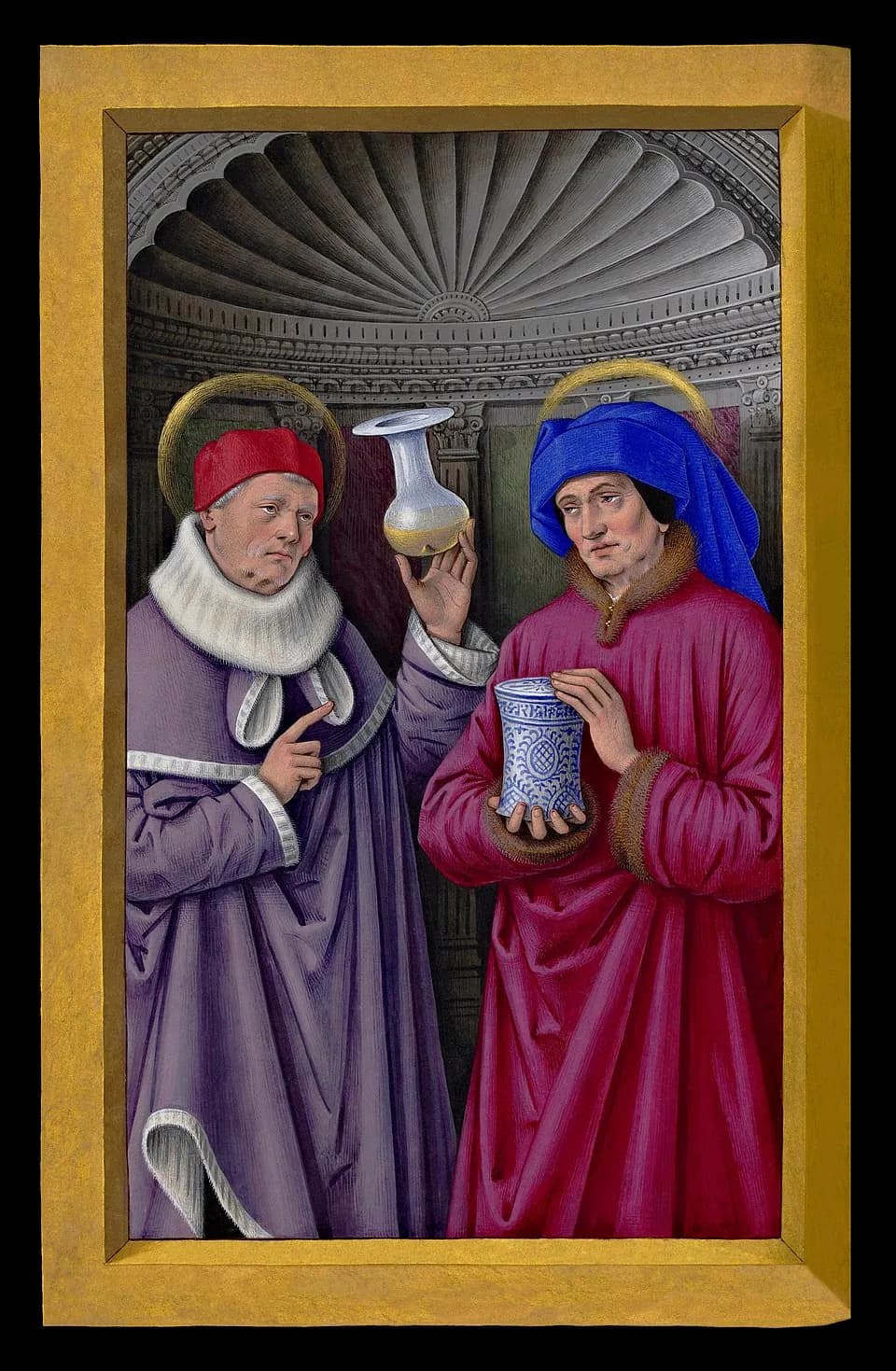
The encyclopedia notes that they "are sometimes represented with medical emblems." 1 Catholic Culture lists what those usually are: a phial, "phials and jars," a box of ointment, a lancet and other surgical instruments, along with the swords, crosses and arrows of their martyrdom. 4 The miniature on this page, painted for Anne of Brittany early in the sixteenth century, shows the first kind. One brother holds a glass flask up to the light and the other carries a lidded jar, and they look less like martyrs than like two well-dressed doctors of the painter's own day.
That is a fair picture of how they were remembered in the West. The Stevens excerpt says that they "were venerated very early and became patrons of medicine, known for their miracles of healing," and that by their practice of medicine without fee they "symbolized God's blessing upon the art of healing and that respect for every form of science, which is an important part of Christian tradition." 4
Remembered in the East and the West
Catholic Culture says they "are honored in both the Eastern and Western Church and highly celebrated in Italian communities." 4 The East keeps more of them than the West does. According to the encyclopedia, the Greek Church venerates "three pairs of saints of the same name and profession," and keeps feasts of Cosmas and Damian on July 1, October 17 and November 1. 1
In the United States the Italian devotion is still visible. Catholic Culture points readers to an annual Italian festival of Saints Cosmas and Damian in Cambridge, Massachusetts, held near their feast every September since 1926. 4 The Stevens excerpt places their practice on the Bay of Alexandretta, "in what is now Turkey," and says they had studied in Syria before they began. 4
What are Saints Cosmas and Damian the patron saints of?
Cosmas and Damian are the patron saints of physicians and surgeons. The 1908 encyclopedia says they "are regarded as the patrons of physicians and surgeons and are sometimes represented with medical emblems," and the Vatican City State page says the same in nearly the same words. 12 The Stevens excerpt puts it more simply: "Along with St. Luke, they are the patron saints of doctors." 4
Other lists go further. The Catholic Apostolate Center calls them patron saints "of Chemistry, Pharmacists, Physicians, and Barbers." 6 Catholic Culture prints a much longer list, from midwives and druggists to people with kidney stones, which this page does not repeat. 4
Saints Cosmas and Damian's feast day
The feast of Saints Cosmas and Damian is September 26. Vatican News lists "Sts. Cosmas and Damian, Martyrs" on that day, and the Vatican City State keeps them there as well. 23 Catholic Culture marks it as an optional memorial, and the Catholic Apostolate Center gives the same date. 46
Older books give September 27. That is the date in the 1908 Catholic Encyclopedia, which calls it the day of their execution, and Catholic Culture says it remains their feast in the 1962 Missal. 15 The encyclopedia also records that the Greek Church keeps them on July 1, October 17 and November 1, and "venerates three pairs of saints of the same name and profession." 1
Praying with Saints Cosmas and Damian
What the sources are surest of is a refusal. Two doctors who could have been paid would not be, and the encyclopedia ties that directly to the people who came to the faith through them. 1 The legends grew around that fact. The fact is what gave them their name.
Their care, as the Vatican City State page describes it, did not stop at the body. It speaks of them tending "the sufferings of the soul and mind" and bringing "peace to the tormented." 2 For anyone who works in medicine, or sits in a waiting room, that is a description of what good care looks like, from people who gave it without sending a bill.
They also died for the faith they practiced. The encyclopedia records that they were ordered to recant and would not, and that they were beheaded. 1 Their skill did not protect them, and the stories of fire and water that could not touch them end, in every version, with the sword.
Basilicas were being built in their name by the fifth century, according to the Vatican City State page, and their names are still said at the altar. 126 A great deal about them is uncertain. That they were remembered, and remembered as healers, is not.
Saints Cosmas and Damian, pray for us.
Sources
- 1.Gabriel Meier, "Sts. Cosmas and Damian," The Catholic Encyclopedia, Vol. 4 (New York: Robert Appleton Company, 1908).
- 2."September 26: Saints Cosmas and Damian, Martyrs," Saint of the Day, Governorate of Vatican City State.
- 3.Saint of the Day, 26 September, Vatican News (Dicastery for Communication).
- 4.Liturgical Year calendar, "Opt Mem of Sts. Cosmas and Damian, Martyrs," September 26, 2026, Catholic Culture (Trinity Communications), with an excerpt from Clifford Stevens, The One Year Book of Saints.
- 5.Liturgical Year calendar, September 27, 2014, Catholic Culture (Trinity Communications).
- 6."Sts. Cosmas and Damian," Catholic Feast Days, Catholic Apostolate Center.
Saints to turn to next
Others in this collection who are turned to for some of the same things.
- Saint Gianna Beretta MollaOctober 4, 1922 - April 28, 1962Work and vocationCourageSuffering and illness
- Saint PantaleonDied at Nicomedia about 305Suffering and illnessWork and vocationCourage
- Saint Andrew Kim TaegonAugust 21, 1821 - September 16, 1846CourageSuffering and illnessWork and vocation
- Saint Damien of MolokaiJanuary 3, 1840 - April 15, 1889Suffering and illnessCourageWork and vocation