Saints Tiburtius, Valerian and Maximus
Martyred at Rome, date unknown
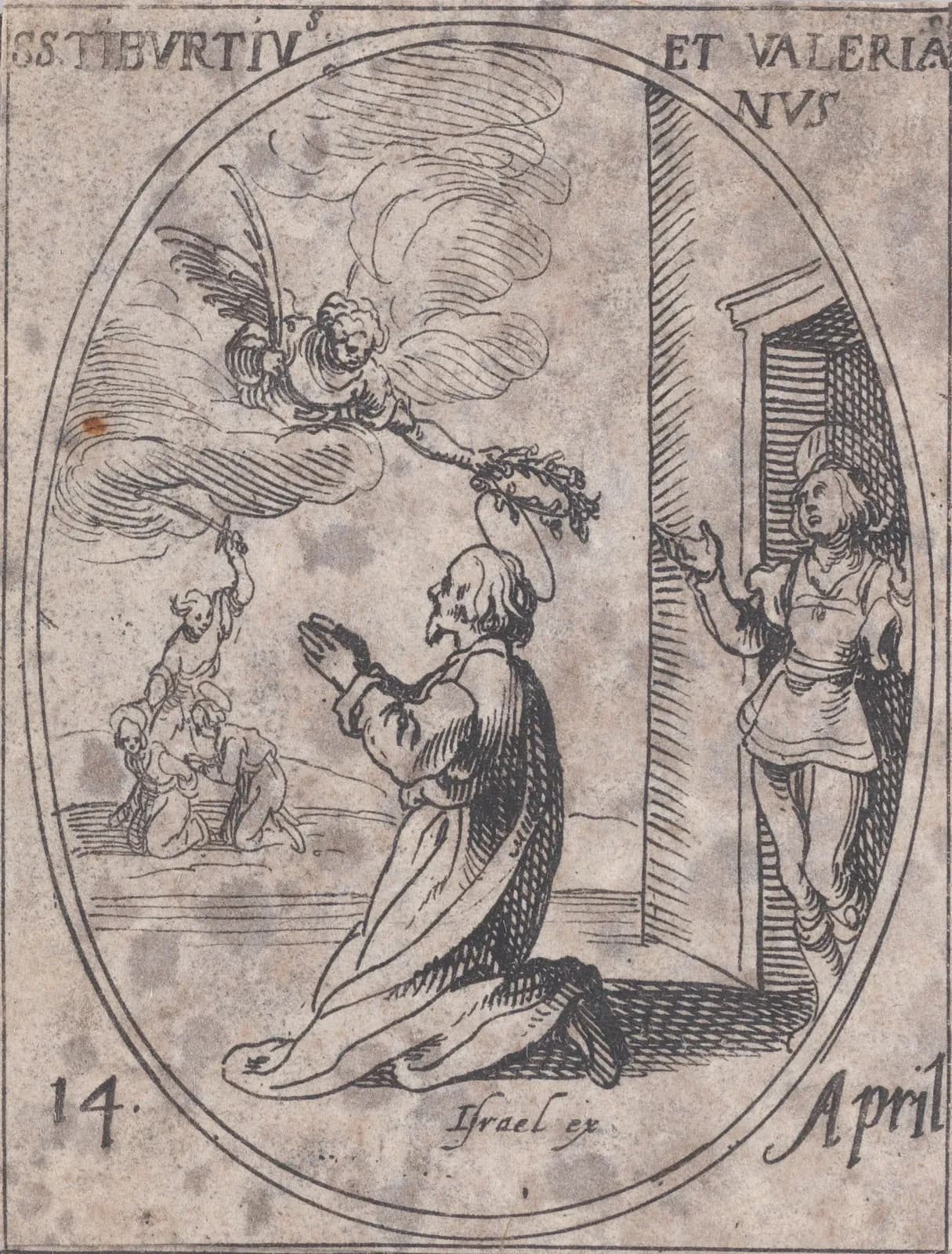
- In the legend
- Valerian, husband of Saint Cecilia; Tiburtius, his brother; Maximus, the officer, soldier or jailer who saw them die 124
- Emblems
- An angel, with whips and instruments of torture 1
- Patrons against
- Storms, says katolsk.no 1
Saints Tiburtius, Valerian and Maximus are three Roman martyrs buried in the catacomb of Praetextatus on the Via Appia, and kept on April 14 since at least the fifth century. 123 They are known chiefly through the legend of Saint Cecilia, in which Valerian is her husband, Tiburtius his brother, and Maximus the officer sent to see them die. 2 The 1908 Catholic Encyclopedia calls that legend "a pious romance," and the martyrs themselves "a historical fact." 2
Three graves on the Via Appia
What can be said of them with some confidence comes from graves and calendars. The Martyrologium Hieronymianum, the oldest Western list of martyrs, sets down their feast on April 14 with the note "Romae via Appia in cimiterio Prætextati," Johann Peter Kirsch writes in the Catholic Encyclopedia, and an octave on April 21 in the catacomb of Callistus. 2 Their tombs in Praetextatus are named in the old pilgrim guides to the graves of the Roman martyrs. 2 The Norwegian bishops' saints database (katolsk.no) adds that the grave was a popular place of pilgrimage in the Middle Ages. 1
The current Roman Martyrology keeps them in the same place: at Rome, in the cemetery of Praetextatus on the Via Appia, on April 14. 3 It says nothing more about them.
The two April dates have puzzled scholars. katolsk.no says it is unclear whether the three died and were buried on April 14 in Praetextatus and were moved to Callistus on April 21, or the other way around. 1 Kirsch reports the view of the scholar Duchesne that the octave was kept in Callistus because Cecilia lay there; if that entry is older than her Acts, Kirsch reasons, the three were linked with her in Rome before the legend was written. 2 One copy of the Hieronymianum names four more companions, Quiriacus, Diocletian, Sophronius and Docimus, of whom nothing else is known, and the Roman Martyrology names only the three. 1
The legend of Cecilia's household
The story most people know comes from the Acts of Saint Cecilia, which Kirsch dates to about the middle of the fifth century. 2 In his summary, Cecilia, a Christian of a senatorial family, was given in marriage by her parents to a noble pagan youth named Valerian, and on their wedding night told him she was betrothed to an angel who guarded her body. 2 Valerian wanted to see the angel. She sent him to the third milestone on the Via Appia to find Bishop Urban, who baptized him, and when he came back a Christian an angel appeared and crowned the two of them with roses and lilies. 2 Vatican News, telling the same story, gives the lilies to him and the roses to her. 4
Then Tiburtius came to the house, and he too was won over. 2 The brothers, in Kirsch's summary of the Acts, "distributed rich alms and buried the bodies of the confessors who had died for Christ." 2 Vatican News has them go out at night with Cecilia to bury the martyrs and to bring food to Christians in hiding, though burying the condemned risked being condemned as their accomplice. 4
The prefect Turcius Almachius sentenced them to death. 2 In katolsk.no's retelling he was ready to give them time to think again, until an adviser warned him that they would use it to give away their fortune before the state could seize it. 1 They were beheaded at a place called Pagus Triopius, about six kilometers outside Rome. 1
Maximus
The third martyr enters the story at its end, and each source places him differently. Kirsch's summary makes him "an officer of the prefect" appointed to carry out the sentence, who was converted and suffered with the brothers. 2 katolsk.no calls him a soldier, or in another version Almachius's secretary, won over by the brothers' courage and flogged to death. 1
Vatican News tells it another way. In its version Maximus was the jailer in charge of them, who took them to a temple to sacrifice and, when they refused, put them to death as the law required. 4 Then he saw the heavens open and angels come down for their souls, and believed, and a few days later he was martyred himself. 4
In every version Cecilia buries them. Kirsch's summary says she laid the three in one tomb. 2 Vatican News has her carry her husband and his brother to Pagus, four miles outside Rome, and bury Maximus separately in the cemetery of Praetextatus. 4 katolsk.no wonders whether the three were in fact executed at different times and buried apart, and their relics gathered together only after the legend had joined their names. 1
How much of it is history
Kirsch is plain about the Acts: "In this shape the whole story has no historical value; it is a pious romance, like so many others compiled in the fifth and sixth century." 2 He holds two things back from that verdict. The martyrs are real, and the tie between Cecilia and the three "has perhaps some historical foundation." 2
Urban is another matter. Kirsch writes that the author of the Acts, "without any authority," took a confessor named Urban who was buried in Praetextatus near the other martyrs and made him the pope. 2 In his article on Pope Urban I he calls the story of the baptisms "purely legendary." 6 katolsk.no thinks the author of the Cecilia legend probably wrote the three martyrs' parts into it. 1
The date is just as open. Vatican News sets the story in 229. 4 katolsk.no places it, if anywhere, under the emperor Alexander Severus, while Urban I was pope (222-230), and notes that no contemporary source supports the story. 1 Kirsch, writing about Cecilia, lists the dates scholars have proposed, from about 177 to 362, and finds none of them established. 2
The other Tiburtius
A second Roman martyr named Tiburtius, kept on August 11, has been confused with this one. 12 His own legend, part of the Acts of Saint Sebastian, makes him the son of the prefect Chromatius, with Sebastian as his godfather; Gabriel Meier writes in the encyclopedia that he walked barefoot over red-hot coals and was beheaded at the third milestone of the Via Labicana in 286. 5
Kirsch thinks the confusion explains why Cecilia's name also appears under August 11 in the old martyrology, an entry he calls "a later and erroneous addition." 2
From the catacomb to Trastevere
Pope Paschal I (817-824) rebuilt Cecilia's church in Trastevere and searched for her body. Kirsch writes that it was found in the catacomb of Praetextatus, and that the pope took up with it the relics of Valerian, Tiburtius and Maximus, and of Popes Urban and Lucius, and buried them all again under the high altar. 2 Vatican News also credits Paschal with bringing the three martyrs to Cecilia's basilica. 4
When the church was restored in 1599, Cardinal Sfondrato had the high altar examined and found beneath it the sarcophagi that Paschal had placed there, with the relics of the saints. 2
What are Saints Tiburtius, Valerian and Maximus the patron saints of?
katolsk.no names the three, together, patrons against storms, because the story tells that a violent storm broke out after their execution. 1 It describes them shown with an angel, and with whips and other instruments of torture beside them. 1 None of the other sources consulted gives them a patronage. 234
Saints Tiburtius, Valerian and Maximus's feast day
The feast day of Saints Tiburtius, Valerian and Maximus is April 14. 13 The current Roman Martyrology keeps them on that day, at the cemetery of Praetextatus. 3 katolsk.no says the Church has kept them on April 14 since about 450, on the evidence of the Martyrologium Hieronymianum, and that the calendar reform of 1969 took the feast off the general calendar and left it to local and particular calendars. 1 The Orthodox and the Copts remember them on November 22, Cecilia's day, and the Armenians on November 27. 1
Praying with Saints Tiburtius, Valerian and Maximus
Nearly everything told about these three reaches us secondhand, inside a story written about someone else, and even their deaths are told three ways. 124 What lasted is smaller and firmer: three names, a grave on the Via Appia, and a day kept for them in Rome for some fifteen hundred years. 123
In the legend the faith passes each time to the person nearest. Valerian receives it from his wife, Tiburtius from his brother, and Maximus from the men he was sent to see put to death. 24
The work the brothers are remembered for is burial. Kirsch's summary has them burying "the bodies of the confessors who had died for Christ," and Vatican News points out that in pagan Rome to bury the condemned was to risk being counted among them. 24 Then Cecilia buries them. 2
Their relics lie with hers under the altar of her church in Trastevere, where Paschal put them in the ninth century and where they were found again in 1599. 2
Saints Tiburtius, Valerian and Maximus, pray for us.
Sources
- 1."Den hellige Valerian av Roma og seks ledsagere (200-t)," Den katolske kirke (katolsk.no), Catholic Diocese of Oslo (in Norwegian).
- 2.Johann Peter Kirsch, "St. Cecilia," The Catholic Encyclopedia, Vol. 3 (New York: Robert Appleton Company, 1908).
- 3.Roman Martyrology, entry for April 14, "Santi Tiburzio, Valeriano e Massimo, martiri," as printed in "Santo del giorno," Conferenza Episcopale Italiana (in Italian).
- 4."Santi Tiburzio, Valeriano e Massimo, martiri, sulla via Appia," Santo del giorno, April 14, Vatican News (in Italian).
- 5.Gabriel Meier, "Sts. Tiburtius and Susanna," The Catholic Encyclopedia, Vol. 14 (New York: Robert Appleton Company, 1912).
- 6.Johann Peter Kirsch, "Pope Urban I," The Catholic Encyclopedia, Vol. 15 (New York: Robert Appleton Company, 1912).
Saints to turn to next
Others in this collection who are turned to for some of the same things.