Saint Thomas More
1477 or 1478 - July 6, 1535
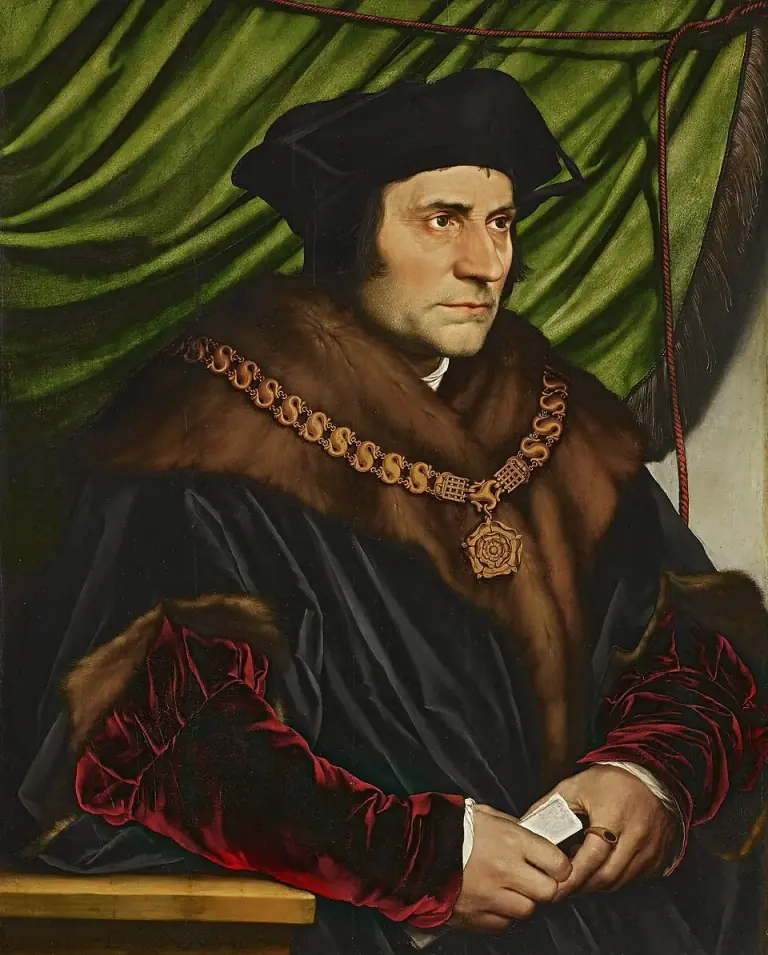
- Patron saint of
- Attorneys, civil servants, court clerks, lawyers, politicians and public servants; John Paul II named him patron of political leaders in 2000 2
- Feast day
- June 22 2
- Office
- Lord Chancellor of England, and author of the Utopia 1
Saint Thomas More was Lord Chancellor of England, a friend of Erasmus, and the author of the Utopia, and he was beheaded on Tower Hill in 1535 for declining to say that his king was head of the Church. 12 What is less well known is that he spent four years living beside the London Charterhouse trying to work out whether to become a monk instead, and wore a hair shirt under the chain of office for the rest of his life. 1
A lawyer who kept reading the Fathers
More was born in London on 7 February - the encyclopedia writes the year as "1477-78" and does not choose; Franciscan Media gives 1478. 12 He went to St Anthony's School in Threadneedle Street, and at thirteen was placed in the household of Cardinal Morton, Archbishop of Canterbury and Lord Chancellor, whose notice he attracted with what the article calls "his merry character and brilliant intellect." Morton sent him to Oxford. 1
His father kept him on an allowance "barely sufficient to supply the necessaries of life," which the encyclopedia notes left him no opportunity for "vain or hurtful amusements." 1 He learned Greek from Thomas Linacre, and a contemporary wrote that "his eloquence is incomparable and twofold, for he speaks with the same facility in Latin as in his own language." He read French, history and mathematics, and learned the flute and the viol. 1
Recalled to London for the law, he was admitted to Lincoln's Inn in 1496 and was soon lecturing on law at Furnival's Inn, so well that the appointment was renewed three years running. 1 The encyclopedia is careful not to oversell his scholarship: he mastered Greek "by an instinct of genius" without ever becoming an exact scholar, and his poetry, Latin and English, is "of good quality, though not particularly striking." He was especially devoted to Pico della Mirandola, and published an English translation of his life. 1 Law never absorbed him entirely. He wrote poetry in Latin and English, translated epigrams from the Greek Anthology with William Lilly, and delivered a course of public lectures on Augustine's City of God at St Lawrence Jewry, prepared for an audience of scholars - of which, the article says regretfully, "not a fragment of them has survived." 1 In 1497 he met Erasmus, and they corresponded until death separated them. 1
The four years he nearly gave it up
Between about 1499 and 1503 More's mind was, in the encyclopedia's words, "occupied almost wholly with religion and the question of his own vocation for the priesthood." 1 He went to live near the London Charterhouse and joined the monks in their spiritual exercises. He wore "a sharp shirt of hair next his skin, which he never left off wholly," and gave himself to prayer and penance. 1
He wavered between the Carthusians and the Observant Franciscans, both of which kept their rule with severity. In the end, apparently with the approval of his confessor Colet, he gave up the hope of being a priest or a religious. 1 The encyclopedia says this part of his life "has caused much misunderstanding among his various biographers," which is a polite way of saying people have wanted it to come out differently.
What he did instead was marry, have four children, and become a lawyer of enormous reputation. The hair shirt stayed.
Utopia, and the rise
In 1510 he was made Under-Sheriff of London. In 1515 Wolsey sent him on an embassy to Flanders to protect the interests of English merchants, and in the six months he was away he made the first sketch of the Utopia, published the following year. 1 It is still the book most people know his name from.
Both Wolsey and the king wanted him at court. He was granted a pension for life in 1516, sent on the embassy to Calais the next year, made a privy councillor, and in 1519 resigned the Under-Sheriffship to attach himself to the court completely. 1 Franciscan Media sums up the range: "a literary scholar, eminent lawyer, gentleman, father of four children, and chancellor of England." 2
The house at Chelsea is where most of that life happened. Erasmus paid several long visits to it, and the friendship that had begun in 1497 lasted until death separated them. 1 Holbein painted More there in 1527 - the portrait on this page - and also painted a large group of the whole household, which has since disappeared; the original sketch for it survives at Basle and a sixteenth-century copy is in private hands. 1 It is a rare thing to be able to say of a saint that we know what his family looked like sitting together in one room.
What he would not say
Franciscan Media puts the whole collision in one line: "Thomas More's belief that no lay ruler has jurisdiction over the Church of Christ cost him his life." 2 He would not approve Henry VIII's divorce from Catherine of Aragon and remarriage to Anne Boleyn, and he would not acknowledge the king as supreme head of the Church in England. 2
He resigned the chancellorship rather than approve either, and that is when the king had to be rid of him. Franciscan Media notes that Henry had tried hard to win him first, "because he knew More was a man whose approval counted, a man whose personal integrity no one questioned." 2 The value of his signature was exactly what made refusing it fatal.
He was committed to the Tower to await trial for treason - for not swearing to the Act of Succession and the Oath of Supremacy. 2 The charge was not that he had said anything. It was that he had declined to say something, which is a difficult thing to build a treason case on and was built anyway.
On conviction he declared that he had "all the councils of Christendom and not just the council of one realm" behind the decision of his conscience. 2 He was beheaded on Tower Hill on 6 July 1535. 12 Franciscan Media records the description that has stuck to him ever since: "a man for all seasons." 2
What is Saint Thomas More the patron saint of?
Franciscan Media lists him as patron of attorneys, civil servants, court clerks, lawyers, politicians and public servants, and records that in 2000 John Paul II named him patron of political leaders. 2 The six labels are really two: the people who practice law, and the people who hold office.
Franciscan Media adds the sentence that explains why the second group got him: "true allegiance to authority is not blind acceptance of everything that authority wants." 2
Saint Thomas More's feast day
Praying with Saint Thomas More
The hair shirt is the detail to keep. He decided against the monastery, took the highest civil office in England, raised four children, wrote a famous book - and never quite left off the shirt he had started wearing while he was living beside the Charterhouse. 1 Whatever he settled, he did not settle it by forgetting the other thing.
He was killed for a refusal rather than an action. He did not denounce the king, publish against him, or organize anything; he declined to swear, and kept declining. Franciscan Media is right that the value of his name was the reason it was wanted, and the reason he could not lend it. 2
What he said at the end was about scale: he had the councils of all Christendom behind his conscience, not the council of one realm. 2 That is not a claim to be uniquely right. It is a claim about where he was standing when everyone around him moved.
He also went on being a lawyer to the end. The councils-of-Christendom line is not a mystic's answer; it is a jurisdictional argument, made by a man who had spent forty years making jurisdictional arguments, about which court had competence over his conscience. 2 Sanctity did not require him to stop thinking in the way he had been trained to think.
John Paul II gave him to political leaders in 2000, four hundred and sixty-five years after England executed him for one. 2 It is not a comfortable patronage, and it was not meant to be.
Saint Thomas More, pray for us.
Sources
Saints to turn to next
Others in this collection who are turned to for some of the same things.