Saint Ivo of Kermartin
October 17, 1253 - May 19, 1303
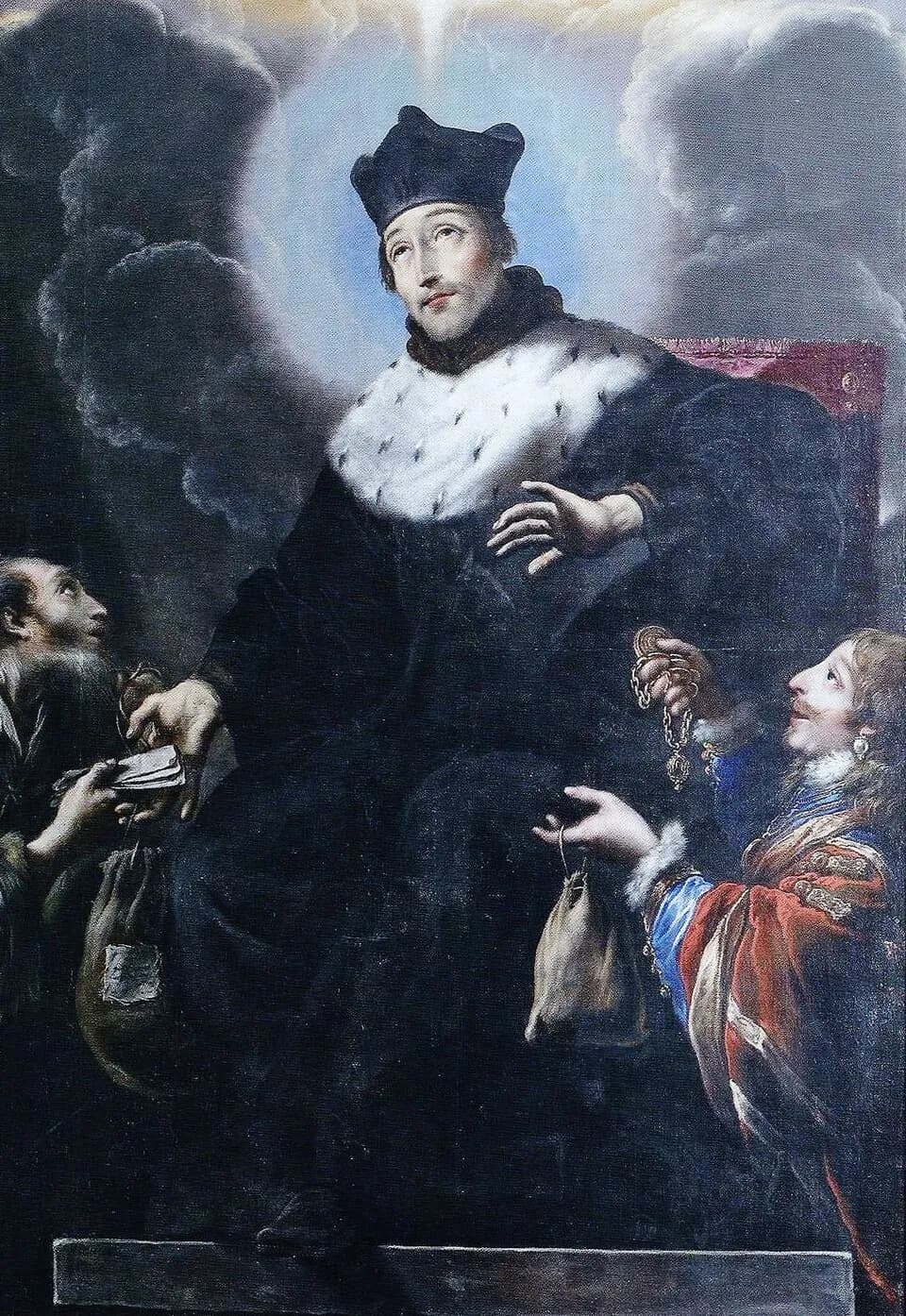
- Born
- October 17, 1253, at Kermartin, near Tréguier, in Brittany 1
- Studied
- Civil law at the University of Paris and canon law at Orléans 1
- Offices
- Ecclesiastical judge at Rennes (1280) and Tréguier (1284); parish priest of Tredrez (1285) and Louannec 1
- Died
- May 19, 1303, at Louannec; buried at Tréguier 1
Saint Ivo of Kermartin was a Breton priest and church judge who trained in civil and canon law and spent it on people who could not pay for it. By his charity, the 1910 Catholic Encyclopedia says, he gained "the title of advocate and patron of the poor." 1 He died at Louannec in 1303, was canonized in 1347, and is the patron saint of lawyers. 12 John Paul II summed up his life as one spent "serving Christ in serving the poor, as a magistrate, lawyer and priest." 2
From Kermartin to Paris and Orléans
He was born on October 17, 1253, at Kermartin, near Tréguier in Brittany, the son of Helori, lord of Kermartin, and of Azo du Kenquis. 1 The encyclopedia calls him Ives and treats Helori as his father's name; John Paul II calls him Ivo Hélory, and Pope Francis uses the French form, Yves. 124 They are the same man. He should not be confused with Saint Ivo of Chartres, a bishop and canonist of two centuries earlier.
In 1267 he was sent to the University of Paris, where he graduated in civil law. 1 Ten years later, in 1277, he went to Orléans to study canon law. 1 When he came home to Brittany, it was as a lawyer that the Church first put him to work. 1
A judge in the Church's courts
Back in Brittany, having received minor orders, he was appointed "official," the encyclopedia's word for an ecclesiastical judge, of the archdeaconry of Rennes in 1280. 1 He studied Scripture during those years as well. 1 The encyclopedia adds that "there are strong reasons for holding" that at some later point he joined the Franciscan Tertiaries at Guingamp, which is as far as it will go. 1
In 1284 the Bishop of Tréguier invited him to be his own official, and he accepted. 1 The encyclopedia credits him with "great zeal and rectitude in the discharge of his duty," and records one conflict by name: he "did not hesitate to resist the unjust taxation of the king, which he considered an encroachment on the rights of the Church." 1 It does not say which king, and neither does any other source used here.
John Paul II, writing seven centuries later, described the same work in terms of principle. "St Ivo was involved in defending the principles of justice and equity," he wrote, and "was careful to guarantee the fundamental rights of the person, respect for his primary and transcendent dignity, and the protection that the law must guarantee him." 2 He also noted that Ivo "took care to defend the family, its members and its property." 2
Parish priest of Tredrez and Louannec
After his ordination to the priesthood he was given the parish of Tredrez in 1285, and eight years later the parish of Louannec, where he stayed until his death. 1 The encyclopedia gives no detail of his years there. John Paul II supplies a picture of them, drawn from the testimony gathered for his canonization. 2
"St Ivo also chose to divest himself of everything, little by little, to be more radically conformed to Christ," the Pope wrote, "desiring to follow him in poverty, to contemplate the face of the Lord in the faces of the lowly with whom he tried to identify." 2 He was a preacher as well as a pastor: "As a servant of God's Word, he meditated upon it," and "he tirelessly travelled through the countryside to bring material and spiritual help to the poor." 2 In his address to Breton pilgrims a few weeks later John Paul II called him "a priest and a tireless preacher of the Word of God." 3
He died at Louannec on May 19, 1303, and was buried at Tréguier. 1
Advocate of the poor
The title by which he is best known did not come from a pope. It came from the people around him. The encyclopedia says that by his charity he "gained the title of advocate and patron of the poor." 1 Vatican News keeps it in the name it gives him on its calendar: "St. Ives, priest, Advocate of the Poor." 5 And John Paul II, quoting what he called popular piety, said the crowds still honor him as "the father of the poor." 2
The people who knew him are the reason he is a saint at all. Clement VI canonized him on May 19, 1347, the forty-fourth anniversary of his death. 12 John Paul II pointed to the evidence gathered for that cause: "The testimony of the small rural community, collected during the cause for his canonization, is certainly the most beautiful tribute that can be paid to someone who devoted his whole life to serving Christ in serving the poor, as a magistrate, lawyer and priest." 2
His devotion did not stay in Brittany. In Rome there is a church of Saint-Yves des Bretons and another, Sant'Ivo alla Sapienza, "St Ivo at the University," and John Paul II took both as witness to "the extraordinary spread of the devotion to him, long practised in Europe." 3 At home he is Zan Erwan in the Breton canticle the Pope quoted: "There is not in all Brittany, there is not a single one, there is no saint like St Ivo." 2
What John Paul II saw in him
The centenary message of 2003 is the longest of the sources used here, and much of it is about law. John Paul II said Ivo "based his duty as judge on the principles of natural law," which a well-formed conscience can discover through reason, and on positive law that takes its principles from natural law and so avoids being "purely arbitrary or a mere act of government." 2 He drew from that a reminder "that law is established for the good of persons and peoples." 2
He had in mind what he called, speaking to the Breton pilgrims that month, "the Europe that is being built." 3 Ivo's "concern to promote impartial justice and to defend the rights of the poorest persons," he wrote, "invites the builders of Europe today to make every effort to ensure that the rights of all, especially the weakest, are recognized and defended." 2 To the pilgrims he called Ivo "a servant of justice" and "this lawyer, a champion of the poor." 3
The 1910 encyclopedia, writing in a lighter register, records a Latin saying about him that has followed him for centuries: "Sanctus Ivo erat Brito, Advocatus et non latro, Res miranda populo." 1 Roughly: Saint Ivo was a Breton, a lawyer and not a thief, a thing for the people to marvel at. The encyclopedia gives it as the reason he is the patron of lawyers "though not, it is said, their model." 1 It is a joke at the profession's expense, and an old one.
What is Saint Ivo of Kermartin the patron saint of?
He is the patron saint of lawyers. The 1910 encyclopedia says so plainly. 1 John Paul II calls him patron of "all who exercise a legal profession" and speaks of the "magistrates, lawyers and jurists" who still go on pilgrimage to him, and for the centenary in 2003 jurists organized colloquiums on "the life and influence of their holy patron." 23 Pope Francis, receiving a delegation of lawyers from the member countries of the Council of Europe in 2023, closed by commending them to "the Blessed Virgin Mary and Saint Yves, patron of lawyers." 4
The phrase "advocate and patron of the poor" is the title his charity earned him in his lifetime, according to the encyclopedia, and it is reported here as that. 1 None of the sources used calls him the patron saint of Brittany, though all of them place him there, and so this page does not.
Saint Ivo of Kermartin's feast day
His feast is May 19. The 1910 Catholic Encyclopedia says that since his canonization in 1347 "his feast being kept on 19 May," and Vatican News lists him under May 19 in its Saint of the Day calendar. 15 It is the day he died, in 1303, and John Paul II notes it was also the day Clement VI canonized him. 12
John Paul II's message for 2003 refers to the anniversary as the "dies natalis," the Church's term for the day a saint dies and is born into heaven, and the address of May 31 that year calls it "the seventh centenary of the death of St Ivo." 23 The heading over the message on vatican.va calls it the 700th anniversary of his birth, but the text and the dates show it was his death that was being kept. 123
Praying with Saint Ivo of Kermartin
Ivo spent his working life inside institutions, first as a judge in the bishop's court and then as a parish priest, and the record of his holiness is the record of how he did those jobs. 1 The encyclopedia names zeal, rectitude and charity, and one fight with a king over taxes. 1
What survived him was a reputation among the poor, and the canonization rested on it. John Paul II placed the testimony of "the small rural community" above everything else that could be said of him. 2 None of the sources used records his own words or a miracle. What they keep is that ordinary people in the country remembered him, and that their memory was what the Church examined. 2
John Paul II also described a slow stripping away: Ivo chose "to divest himself of everything, little by little." 2 The sources do not say what he gave up or when, and it is better not to supply it. They say only that the poverty grew, and that it was deliberate.
Centuries later, two popes have commended lawyers to his care, one of them in a message about natural law and the dignity of the person, the other with a single line at the end of an address. 24 Both treat the law as a form of service, and both point to Ivo as one person who practiced it that way. 24
Saint Ivo of Kermartin, pray for us.
Sources
- 1.Andrew MacErlean, "St. Ives," The Catholic Encyclopedia, vol. 8 (New York: Robert Appleton Company, 1910).
- 2.John Paul II, Message to Bishop Lucien Fruchaud of Saint-Brieuc and Tréguier for the seventh centenary of Saint Ivo Hélory, May 13, 2003.
- 3.John Paul II, Address to the Pilgrims from the Diocese of Saint-Brieuc and Tréguier, May 31, 2003.
- 4.Francis, Address to a Delegation of Lawyers from Council of Europe Member Countries, August 21, 2023.
- 5."19 May," Saint of the Day, Vatican News.
Saints to turn to next
Others in this collection who are turned to for some of the same things.
- Saint BarnabasFirst centuryCourageWork and vocationPoverty and simplicity
- Saint Frances Xavier CabriniJuly 15, 1850 - December 22, 1917CouragePoverty and simplicityWork and vocation
- Saint Katharine DrexelNovember 26, 1858 - March 3, 1955Poverty and simplicityWork and vocationCourage
- Saint Mary MacKillopJanuary 15, 1842 - August 8, 1909CouragePoverty and simplicityWork and vocation