Saint Theodosius of the Caves
c. 1008 or 1029 - May 3, 1074
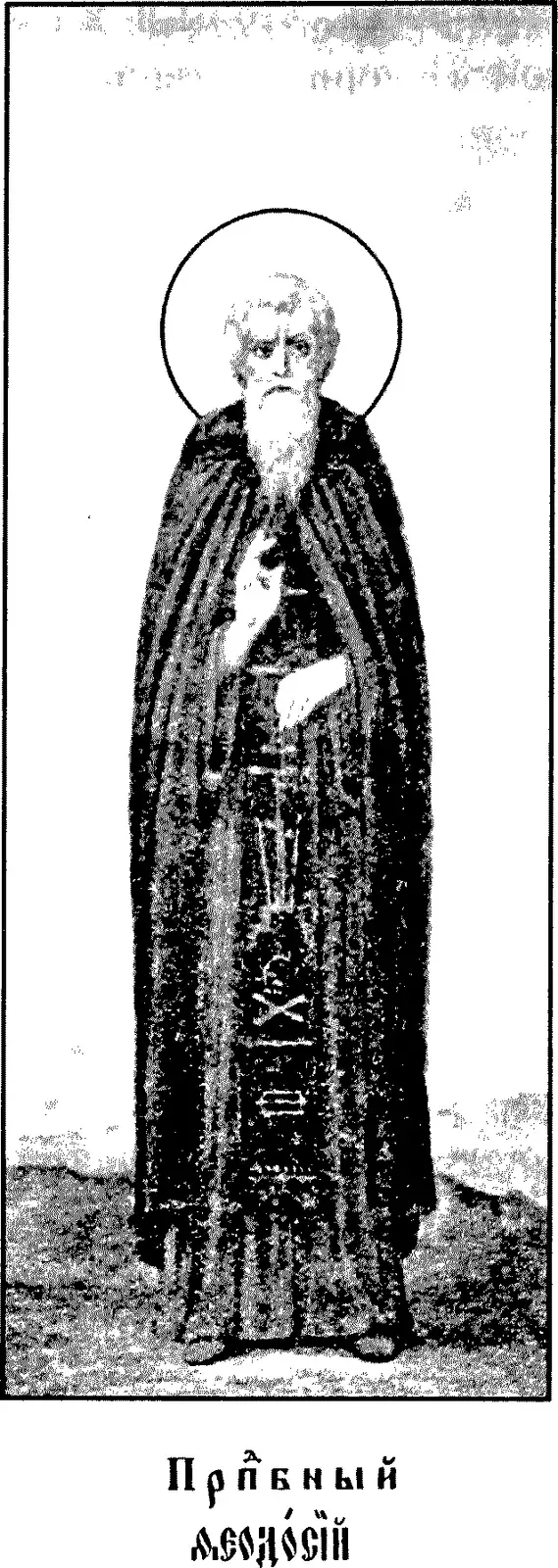
Saint Theodosius was a monk of Kiev who took a handful of hermits living in caves above the Dnieper and made them the Monastery of the Caves, the house that formed the first generations of monks among the Eastern Slavs. 12 He gave it the rule of the monastery of Studios in Constantinople, a hospital and a guesthouse, and a cartload of food for the prisons every Saturday, and he died there on May 3, 1074. 12 His feast is May 3. 5
A boy who would not stay home
He was born near Kiev to a well-off family in the prince's service. The Norwegian bishops' biography places his birth about 1008 at Vasilkov; santiebeati gives 1029, at Vasilev in the Kiev region. 12 The family moved to Kursk, and he grew up there. 1
He wanted no part of the life his family expected. katolsk.no says he cared nothing for games or fine clothes and was always in church. 1 As a boy he slipped away with a band of pilgrims bound for the Holy Land; three days later his mother caught up with him, brought him home, and kept him in chains until he promised not to try it again. 1 santiebeati records the failed pilgrimage too, and says that after his father died he was treated with great severity by his mother. 2
The Norwegian account describes her as "muscular, with a voice like a man's," and says she beat him and locked him up when he dressed like a serf and went out to work in the fields with the laborers. 1 He apprenticed himself to a baker anyway and learned to bake the bread used for the Eucharist. 1
The caves above the Dnieper
At twenty-four, according to katolsk.no, he waited until his mother was away for a few days and ran to Kiev, about 1032, where the hermit Anthony and his disciples lived in a cave by the Dnieper. 1 Nikon, a priest and Anthony's first disciple, gave him the tonsure. 12 santiebeati dates the tonsure to about 1055. 2
Four years later his mother found him and wept for him to come home. He persuaded her instead to stay in Kiev, and she took the veil in the convent of Saint Nicholas, where she ended her life in peace. 1
More men came. They dug caves for themselves and larger ones for a chapel and a refectory. 1 In the community Theodosius worked harder than anyone: he carried water, chopped wood, ground grain and brought each monk his flour, and he was first into church and the last out. 1 He was ordained a priest in 1054. 1
Anthony, who was drawn to the solitary life of the Egyptian hermits, did not stay in charge. He handed the community to Barlaam and dug himself a new cave. 1 When Barlaam was moved to another monastery, the monks chose Theodosius as abbot, with Anthony's blessing: in 1063 by the Norwegian account, in 1062 by santiebeati's. 12 There were already about a hundred monks. 1
Abbot of the Monastery of the Caves
santiebeati calls him the real founder of the great Lavra of Kiev and the man who brought the common life of monks to the Russian Church. 2 He found the caves cramped and gloomy, and he finished and enlarged the wooden buildings that had been begun; the monks no longer lived in the caves. 12 Under him it acquired lands and a stone church of the Dormition of the Virgin, built with masters brought from Constantinople. 2
His decisive change was the rule. He obtained the rule of the monastery of Studios from a Studite monk in Constantinople, had it translated, and introduced it at Kiev; santiebeati says it was the version of Patriarch Alexius the Studite, and that it went on to govern Russian monastic life as a whole. 2 katolsk.no describes the result as neither the extreme asceticism of Palestine nor the politics of Byzantium, but closer to Basil the Great: prayer and fasting, and also works of charity. 1
The house had a hospital for the sick and disabled and a hostel for travelers. 1 The monks were to study the Scriptures and the Fathers, keep strict poverty, and help any lay person who came to them, of whatever class. A cart of food went to the prisoners in the city every Saturday. 1 katolsk.no quotes him: "It is good for us to feed the hungry and the wanderers with the fruit of our labor." 1
He kept his own austerities out of sight. He ate dry bread and boiled vegetables without oil, prayed through the night, and was rarely seen to sleep; in Lent he withdrew alone to a cave near the monastery. 1 He wore a hair shirt, and dressed so poorly that strangers took the old abbot for a beggar. 1 For two years he nursed an old monk who was almost entirely paralyzed. 1
The Norwegian account tells of a night when he was driven home from a visit to Grand Prince Izyaslav. The coachman did not know who he was and grumbled that monks were always on holiday while he was always at work, so Theodosius changed places with him and drove the horses. When the coachman saw nobles along the road bowing to the monk on the box, he grew frightened; Theodosius calmed him and gave him a meal at the monastery. 1
The prince and the poor
The princes of Kiev listened to him and endowed his monastery. 1 That did not stop him from speaking against them. When Svyatoslav drove his brother from the throne of Kiev, Theodosius rebuked him to his face, at the risk of exile, and compared him to Cain. 1 People who had been unjustly condemned found a defender in him, and judges reopened cases when he asked. 1
katolsk.no suggests that the Russian tradition of the starets, the elder to whom lay people bring their troubles, can probably be traced to him. He welcomed the people of Kiev of every age and station, and the account mentions a married couple, John and Mary, whom he loved especially "because they loved God and each other." 1
santiebeati adds a harder side. It describes him as faithful to Byzantine Orthodoxy in his dealings with the powerful, and quotes his second letter to Prince Izyaslav on the faith of the Latins, which tells them they have "rejected the faith of the Apostles and the holy Fathers" and that it is therefore impossible to celebrate the Liturgy or receive Communion with them. 2 It is given here as santiebeati prints it.
Death and memory
He kept Easter of 1074 with the brothers as usual, felt death coming, and died a week later, on May 3, 1074. 12 At his own wish he was buried in one of the original caves. 1 In 1091 his body was found and moved into the Dormition church, and in 1108 he was canonized by the bishops of the province of Kiev; katolsk.no calls him the second saint canonized in Russia. 12
His life was written by a monk of the same house, Saint Nestor the Chronicler. katolsk.no says about thirty years after his death; santiebeati says about ten, around 1084, and adds that Nestor also put notices of him in the Russian Primary Chronicle. 12
The monastery was sacked by the Tatars more than once, and in the twentieth century it was turned into a museum before being given back to monks. 1 John Paul II, writing for the thousandth anniversary of the baptism of Kievan Rus' in 1988, named the Monastery of the Caves, founded by Saints Anthony and Theodosius, as the place where the monastic life that shaped the Eastern Slavs first stood out at Kiev. 3
What is Saint Theodosius the patron saint of?
Saint Theodosius's feast day
Saint Theodosius's feast day is May 3, the day he died. The current Roman Martyrology, in the text published by the Italian bishops, enters him on that day as the abbot who founded the monastery "of the Caves" at Kiev, where by tradition he began the common life of monks in that region. 5 santiebeati and katolsk.no give May 3, and the Byzantine Catholic Menaion keeps his passing on May 3 with its own troparion and kontakion. 124
katolsk.no, last revised in 2010, says that neither Theodosius nor Anthony appears in the 2001 edition of the Roman Martyrology. 1 The text now printed by the Italian bishops does include him on May 3. 5 katolsk.no also records the finding of his relics on August 14 and a commemoration with Anthony on other days in some places. 1
Praying with Saint Theodosius
Most of what is remembered about him is work. He carried the water and the flour, baked the bread for the altar, and drove the coachman home. 1 Becoming abbot did not end it: he still took his share of the ordinary work every day, in the fields or in the house. 1
He was also the man who stood up in front of a usurping prince and called him Cain, and who sent bread to the prisons every week. 1 In his life the two belonged together: the monastery fed people because it was a monastery. 1
He did not escape his own age, and the page does not pretend he did. The letter santiebeati quotes is the voice of a monk who saw the Latins as having left the faith. 2 The same monk is honored today in the Roman Martyrology and in the Byzantine Catholic Churches, and John Paul II named him among the founders of the Christian culture of the Eastern Slavs. 345
The hymn of his feast calls his life in the cave the summit of virtue. 4 His own monks remembered something smaller: the abbot first into church in the morning, standing in the same place until the service ended. 1
Saint Theodosius of the Caves, pray for us.
Sources
- 1.Per Einar Odden, "Den hellige Theodosios Petsjerskij (~1008-1074)," Den katolske kirke (Catholic Diocese of Oslo), last revised 2010 (in Norwegian).
- 2."San Teodosio di Pecersk," with a biography by Cyril Ivanov, Santi, beati e testimoni (santiebeati.it) (in Italian).
- 3.John Paul II, apostolic letter Euntes in mundum, for the millennium of the baptism of Kievan Rus', January 25, 1988, no. 8 (in Italian).
- 4."Menaion - May 3," Metropolitan Cantor Institute, Byzantine Catholic Archeparchy of Pittsburgh.
- 5.Roman Martyrology, entries for May 3, Santo del giorno, Conferenza Episcopale Italiana (in Italian).
Saints to turn to next
Others in this collection who are turned to for some of the same things.
- Saint André BessetteAugust 9, 1845 - January 6, 1937PrayerWork and vocationPoverty and simplicity
- Saint Benedict the Moor1524 or 1526 - April 4, 1589Work and vocationPoverty and simplicityPrayer
- Saint Crispin of ViterboNovember 13, 1668 - May 19, 1750Work and vocationPoverty and simplicityPrayer
- Saint Didacus of Alcalác. 1400 - November 12, 1463Work and vocationPoverty and simplicityPrayer