Saint Crispin of Viterbo
November 13, 1668 - May 19, 1750
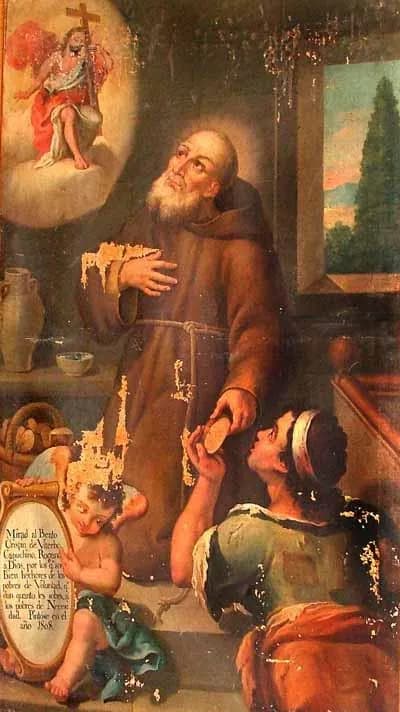
- Canonized
- June 20, 1982, by Pope John Paul II, the first saint of his pontificate 2
Saint Crispin of Viterbo was a shoemaker's apprentice who became a Capuchin lay brother in 1693 and spent most of his life as a cook, a gardener and a beggar for his friars, nearly forty years of it in the streets of Orvieto. 23 He called himself the donkey of the Capuchins, and people repeated his sayings for years. 13 He was the first saint John Paul II canonized, on June 20, 1982, and his feast is May 19. 24
Il Santarello
He was born on November 13, 1668, at Viterbo, north of Rome, and baptized two days later with the name Pietro. 23 CapDox, which draws on the baptismal record, names his parents as Ubaldo Fioretti and Marzia, a widow when Ubaldo married her, and says his father died while Pietro was still small. 3
When he was five his mother took him to a shrine of the Virgin a short way outside Viterbo and gave him to Mary's care. 1 Vatican Radio identifies it as the shrine of Our Lady of the Oak and gives her words to him there: "See, that is also your mother. I have made a gift of you to her." 2 He grew up devout enough that, according to both the encyclopedia and Vatican Radio, the people of Viterbo called him il Santarello, the little saint. 12
The sources tell his schooling differently. Vatican Radio says he learned a little Latin, but his parents could not pay for more and sent him to his uncle to learn shoemaking. 2 CapDox says it was his uncle Francesco, a shoemaker fond of the boy, who sent him to the Jesuit schools and then took him into the shop. 3
A Capuchin lay brother
One day he watched the Capuchin novices walking in procession and decided to join them. 12 Vatican Radio says he pleaded so hard that he was accepted despite his "delicate appearance." 2 He received the habit on July 22, 1693, the feast of Saint Mary Magdalene, as a lay brother, with the name Crispin. 23
He took the Capuchin lay brother Felix of Cantalice as his model, and like Felix he called himself the beast of burden of the friars. 1 Asked once why he went bareheaded, he answered, according to the encyclopedia, that "an ass does not wear a hat." 1 CapDox gives the fuller version, "Don't you know that donkeys don't wear hats, and that I am the donkey of the Capuchins?", and adds the serious answer he sometimes gave: "Because it shows that I am always in the presence of God." 3
He started in the kitchen, first at Viterbo according to the encyclopedia and Vatican Radio. 12 CapDox dates what followed: Tolfa from July 1694 to April 1697, a few months in Rome, Albano from 1697 to 1703, and Monterotondo until October 1709. 3 At Tolfa, Vatican Radio says, he set up a little altar to Mary in the kitchen and offered his work there. 2 At Albano bishops, cardinals and the pope himself came to talk to him. 12
Orvieto
Here the sources part. The encyclopedia, written in 1908, moves him from Albano straight to Rome in his old age, and does not mention Orvieto at all. 1 CapDox says he went to Orvieto in October 1709 as gardener, took up the work of questor there in January 1710, and stayed for almost forty years, apart from a few months in Bassano in 1715 and in Rome in 1744. 3 Vatican Radio also says he was the official beggar of the friary in Orvieto for almost forty years. 2
A questor begs for the community, which meant walking the town with a sack and flasks. CapDox says he called them "his cross," and added, "but how much greater was that of Christ!" 3 He also kept a garden for the friary's benefactors that he called the villa Crispigniana, and when an Orvieto pharmacist complained of gout, Crispin invited him to come and dig in it. 3
He was good with the poor and blunt with the comfortable. CapDox quotes him saying that the friary would want for nothing "when we keep open two doors: namely the door of the choir to the greater glory of the Lord, and the front door to the friary for the benefit of the poor." 3 A man who asked to be cured of gout was told his trouble was more in his hands than his feet, "because … you do not pay wages as you should: your workers and servants are crying." 3
His sayings
The process for his canonization collected so many of his sayings that CapDox gives them a long section of their own. A Capuchin preacher even commented on them in his Lenten sermons around Orvieto, and the people came to hear them repeated. 3 Some are about God: "Love God and do not falter. Do good too and let others say what they will." 3 Some are about heaven and comfort: "You won't reach heaven in a pair of slippers." 3 Asked during a famine how the friary would feed itself, he said he had "three great providers," God, Our Lady and Saint Francis. 3
His devotion to Mary was never sentimental. CapDox records him saying, "The one who loves the Mother and offends the Son is a counterfeit lover." 3 Vatican Radio tells of a man with a bad life who sent for him to be cured, and whom Crispin asked, "he who offends the Son, does he not also grieve the Mother?" 2 Both Vatican Radio and CapDox record a favorite of his: "God's power creates us, his wisdom governs us, his mercy saves us," in Vatican Radio's wording. 23
Vatican Radio adds two more. When his provincial needed someone to nurse friars down with a contagious illness and would not order anyone to go, Crispin volunteered: "Will, my Father? What will? When I entered religion, I left my will at home." 2 And when the work piled up, he said, "That is good; Paradise is not for lazybones." 2
Death in Rome
He left Orvieto on May 13, 1748, for the friary infirmary in Rome, worn out by age and by his penances. 13 He died there on May 19, 1750, at eighty-two. 123 Vatican Radio says that when the doctor told him the end was near, he answered with the psalm, "I rejoiced at the things that were said to me: We shall go into the house of the Lord." 2
His body lies under a side altar of the Capuchin church in Rome, which Vatican Radio names as the Church of the Immaculate Conception. 12 The encyclopedia described it in 1908 as "in a remarkable state of preservation"; Vatican Radio calls it incorrupt. 12 Pope Pius VII beatified him on September 7, 1806, and John Paul II canonized him on June 20, 1982, the first canonization of that pontificate. 23 Vatican Radio quotes the Pope saying that the human family, "tempted by false autonomy," needs saints, "models who concretely express by their lives the reality of Transcendence." 2
What is Saint Crispin of Viterbo the patron saint of?
Saint Crispin of Viterbo's feast day
Praying with Saint Crispin of Viterbo
Almost nothing he did would have looked like much from the outside. He cooked, he gardened, and for decades he walked one town with a sack. 13 What survives of him is mostly talk: short, funny, sometimes sharp things said on doorsteps to merchants, pharmacists, princesses and brothers in the friary. 3
The humor was not a mask over the holiness. When he called himself the donkey of the Capuchins, he meant it as a joke and as a description of the job, and he followed it with the line about standing bareheaded in the presence of God. 13 When someone admired his miracles he asked what was so surprising about God working them. 3
He was hard on people who cheated their workers and gentle with people who were afraid of being lost. CapDox says that to those who asked whether they would be saved, he answered that if they hoped to be, they would be, and he told a woman tormented by scruples to throw herself "into the sea of God's mercies." 3
Obedience was the thing he talked about most and joked about least. "When I entered religion," he told his provincial, "I left my will at home." 2 It took him to a house full of contagion and to forty years in Orvieto, and on the evidence of his sayings it left him cheerful. 23
Saint Crispin of Viterbo, pray for us.
Sources
- 1.S. Donovan, "Blessed Crispin of Viterbo," The Catholic Encyclopedia, vol. 4 (New York: Robert Appleton Company, 1908).
- 2.P. J. Joseph, SJ, "St. Crispin of Viterbo (1668-1750)," Vatican Radio, May 14, 2012.
- 3."Saint Crispino da Viterbo," CapDox, Capuchin Friars of Australia; translation based on Mariano D'Alatri in Sulle orme dei santi (Rome, 2000), 85-94.
- 4."St. Crispin of Viterbo, Capuchin," Saint of the Day, 19 May, Vatican News.
- 5."Franciscan Saints, Blesseds, and Feasts," National Fraternity of the Secular Franciscan Order USA, 2023.
Saints to turn to next
Others in this collection who are turned to for some of the same things.
- Saint André BessetteAugust 9, 1845 - January 6, 1937PrayerWork and vocationPoverty and simplicity
- Saint Benedict the Moor1524 or 1526 - April 4, 1589Work and vocationPoverty and simplicityPrayer
- Saint Didacus of Alcalác. 1400 - November 12, 1463Work and vocationPoverty and simplicityPrayer
- Saint Felix of Cantalice1515 - May 18, 1587Poverty and simplicityWork and vocationPrayer