Saint Felix of Cantalice
1515 - May 18, 1587
- Died
- May 18, 1587, in Rome 1
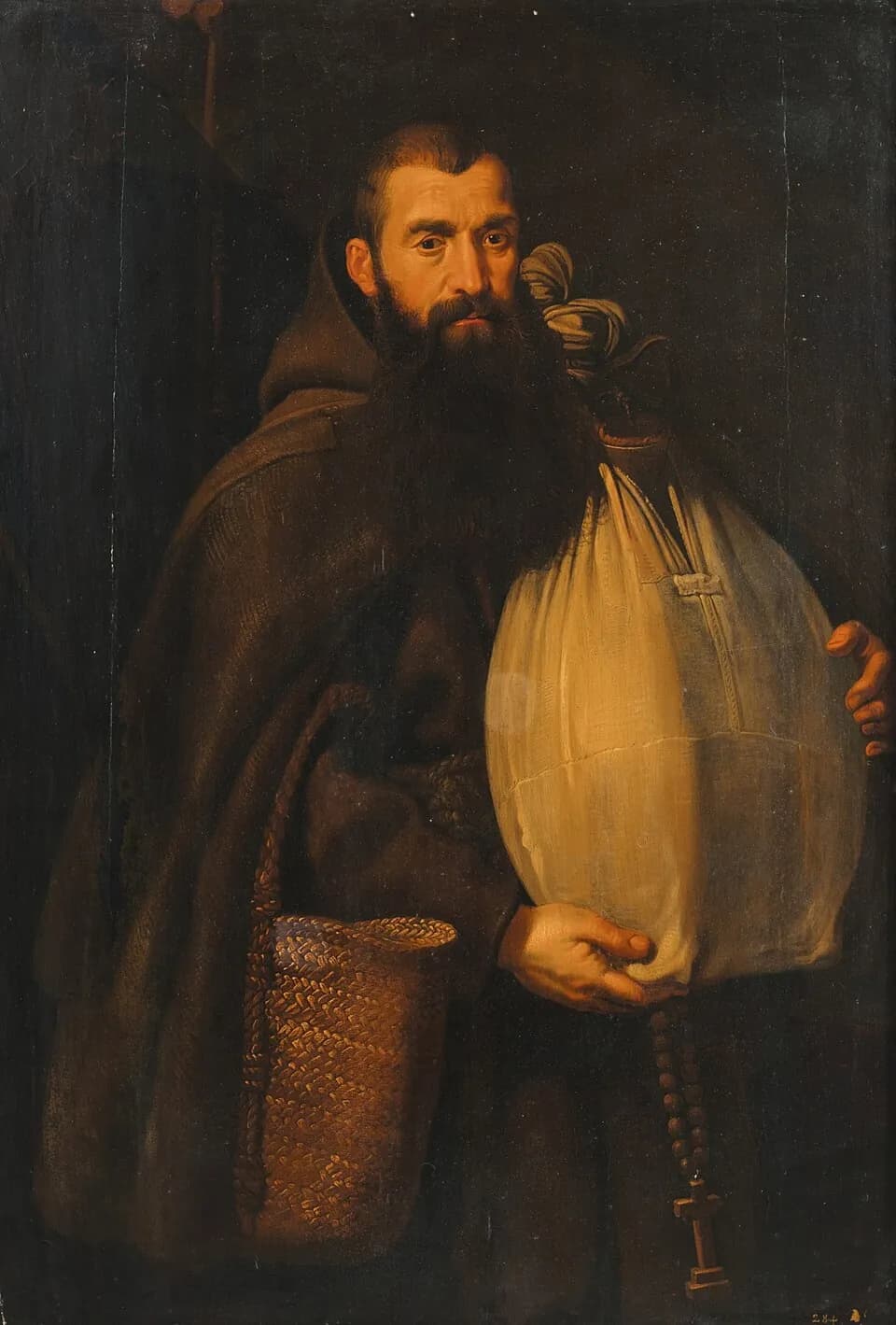
Saint Felix of Cantalice was a shepherd and plowman who became a Capuchin lay brother and spent about forty years begging bread for his friars in the streets of Rome. 12 He could not read, yet the encyclopedia says learned theologians came to consult him, and Philip Neri once called him the greatest saint then living in the Church. 1 The children of Rome called him "Brother Deo gratias." 2 He died in 1587, was the first Capuchin to be canonized, and is kept on May 18. 12
A shepherd near Rieti
He was born in 1515 to a peasant family in Cantalice, a village near Rieti on the northwestern edge of the Abruzzi, and Monti gives his name as Felix Porri. 12 He was set to tending sheep very young. 1 At nine he was hired out to a farmer at Cittaducale and stayed more than twenty years, first as a shepherd boy and then as a farm hand. 12
From his earliest years, the encyclopedia says, he spent his free time in prayer, and Monti says he was known for praying in the middle of his work. 12 The encyclopedia says a friend read him the lives of the Desert Fathers, and that he wanted to live as a hermit but was afraid to live without a superior to obey. 1 Monti tells a different story of the turning point. While breaking in a team of young oxen, the animals took fright, trampled him, and dragged the plow over his body. 2 He survived, and the near miss made him rethink his life. 2
A Capuchin lay brother
In 1543 he asked to be admitted to the Capuchins as a lay brother. 12 Monti places the request at Cittaducale; the encyclopedia says the friars hesitated, and that he received the habit at Anticoli, in the Roman province, that year. 12 Before he made his profession, the encyclopedia says, he went through temptations severe enough to damage his health. 1
Then he was sent to Rome, in 1547 according to the encyclopedia and 1548 according to Monti, and appointed questor, the friar who goes out each day with a sack to beg for the community. 12 He did that for the rest of his life. 1 Monti says he was allowed to share what he collected with the poor people he met, especially widows with children. 2 John Paul II describes him "begging food for his brothers, responding always with his famous 'Deo Gratias', and feeding the poor from his alms-sack." 3
He called himself "Ass of the Capuchins," the encyclopedia says. 1 John Paul II gives it as "the Capuchins' donkey." 3
Brother Deo gratias
He walked Rome barefoot in all weather, Monti says, singing spiritual songs he made up as he went. 2 The children who crowded around to hear his stories named him "Brother Deo gratias," from his habit of saying "Thanks be to God" for every alms he was given. 2 The encyclopedia says his "special apostolate was amongst the children of the city." 1 He gathered them in circles and taught them to sing canticles of his own, about "the beauty of a good life and the ugliness of sin." 1 The songs caught on, and benefactors would invite him in to sing, which he used as a chance to put some truth of the faith into verse on the spot. 1
He also rebuked people. The encyclopedia says that he would stop those living badly in the street and urge them to change, that he tried especially to hold young men back, and that judges and dignitaries got the same treatment, since he was "no respecter of persons when it was a matter of preventing sin." 1 The writer took his standing with the Romans as "an evidence of the inherent power of personal holiness over the consciences of men." 1 One Carnival he and Philip Neri led a procession into the middle of the revels: a crucifix, then the Capuchin friars, then Felix leading a well-known Capuchin preacher, Fra Lupo, by a rope around his neck, to represent Christ led to judgment. 1 The procession halted and Fra Lupo preached. "The Carnival, with its open vice, was broken up for that year." 1
In the famine of 1580 the directors of the city's charities asked his superiors to lend him to them to collect alms for the starving, and the encyclopedia says he was "untiring in his quest." 1
Philip Neri's friend
Philip Neri had a deep affection for him and once proclaimed him the greatest saint then living in the Church. 1 Monti says Philip often asked his advice. 2 When Charles Borromeo wanted Philip's help drawing up the constitutions for his Oblates, Philip took him to Felix, according to the encyclopedia, as the most competent adviser on such matters. 1 "He had no learning he could not even read," the encyclopedia says, "yet learned theologians came to consult him upon the science of the spiritual life and the Scriptures." 1
He is usually painted holding the Infant Jesus. 1 The encyclopedia explains that the Virgin once appeared to him and placed the Child in his arms. 1 John Paul II read the image another way as well: "in bearing the burdens of the needy he had carried in his arms the poor Christ himself." 3
His death and his sisters
He died in Rome on May 18, 1587, and the people of the city acclaimed him a saint at once. 1 Urban VIII beatified him in 1625, and Clement XI canonized him in 1712; Monti notes he was the first Capuchin to be canonized. 12 His body lies under an altar dedicated to him in the Capuchin church of the Immaculate Conception in Rome. 12
Centuries later a Polish congregation took his name. John Paul II told the Felician Sisters in 2000 that their foundress, Blessed Mary Angela Truszkowska, drew her inspiration from Francis of Assisi and from Felix, and that she used to take the children in her care to the Capuchin church in Warsaw where Felix is shown carrying the Child. 3 "In the figure of the Holy Child," he said, "Blessed Mary Angela recognized the little ones she was called to serve." 3
What is Saint Felix of Cantalice the patron saint of?
None of the sources consulted names a patronage for Saint Felix of Cantalice. 123 John Paul II, speaking to the Felician Sisters who carry his name, said their foundress's life stood "within a tradition of holiness reaching back through Saint Felix and Saint Francis to the Crucified Lord himself." 3
Saint Felix of Cantalice's feast day
Praying with Saint Felix of Cantalice
He spent his working life doing the same thing every day: walking out with a sack and asking for food. 12 He was a laborer for twenty years before he was a friar, and as a friar he was a beggar for forty. 12 He prayed in the middle of the work rather than instead of it. 2
What he said, over and over, was "Thanks be to God." 2 He said it on the doorsteps of Rome to anyone who gave him anything, and the children made it his name. 23
His humility was not the same as quietness. He told judges they were wrong and helped Philip Neri lead a procession into the middle of Carnival. 1 With children he sang. 12
John Paul II found in him a way out of a hard question. Speaking of a nation that had lost its freedom, he said Felix and Francis had taught the Felicians' foundress "that the way to true freedom was not violence, but joyful self-emptying." 3
Saint Felix of Cantalice, pray for us.
Sources
- 1.Lawrence Hess, "St. Felix of Cantalice," The Catholic Encyclopedia, Vol. 6 (New York: Robert Appleton Company, 1909).
- 2.Dominic Monti, OFM, "Saint Felix of Cantalice: Humble Servant," Commission on the Franciscan Intellectual Tradition, May 16, 2026.
- 3.John Paul II, Address to the Sisters of Saint Felix of Cantalice, June 16, 2000.
- 4."St. Felix of Cantalice, Capuchin friar," Saint of the Day, May 18, Vatican News.
Saints to turn to next
Others in this collection who are turned to for some of the same things.
- Saint André BessetteAugust 9, 1845 - January 6, 1937PrayerWork and vocationPoverty and simplicity
- Saint Benedict the Moor1524 or 1526 - April 4, 1589Work and vocationPoverty and simplicityPrayer
- Saint Crispin of ViterboNovember 13, 1668 - May 19, 1750Work and vocationPoverty and simplicityPrayer
- Saint Didacus of Alcalác. 1400 - November 12, 1463Work and vocationPoverty and simplicityPrayer