Saint Didacus of Alcalá
c. 1400 - November 12, 1463
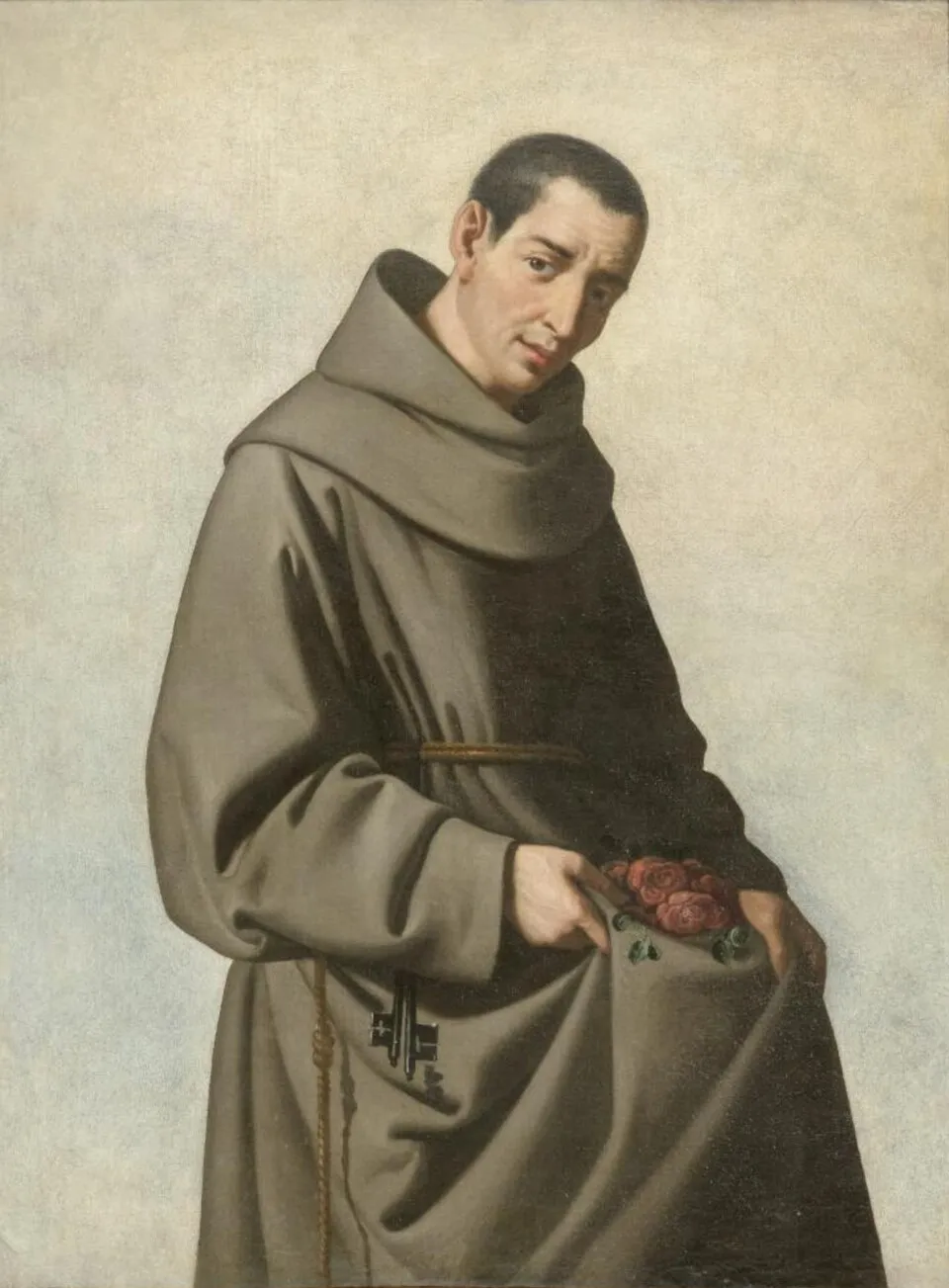
- Born
- About 1400 at San Nicolás del Puerto, in Andalusia; the encyclopedia calls the date uncertain 13
- Canonized
- 1588, by Pope Sixtus V 1
Saint Didacus of Alcalá, San Diego in Spanish, was a Franciscan lay brother of the fifteenth century who was never ordained, had little schooling, and was nonetheless put in charge of a mission friary in the Canary Islands. 134 He nursed the sick in Rome in 1450 and died at Alcalá on November 12, 1463. 1 He was the first Friar Minor to be canonized who was not ordained, and a California mission and the city of San Diego carry his name. 35
A hermit's pupil in Andalusia
The sources are frank about how little is known. The 1908 Catholic Encyclopedia says his date of birth is uncertain, and Dominic Monti, a Franciscan historian, begins his account with the admission that "Little is known about Diego's early years." 13 Monti and Vatican News put his birth about 1400. 23
He came from a poor family in San Nicolás del Puerto, a town in Andalusia. 13 Vatican News alone names his birthplace as "Alcalà del Puerto." 2 His parents placed him with a hermit who lived near the town, the encyclopedia says, and Monti adds that he spent some years as "a wandering penitent hermit" himself. 13 Franciscan Media has him join the Secular Franciscan Order as a young man before living as a hermit. 5
He then asked to enter the Franciscans and was received as a lay brother at the friary of Arizafa, which the life excerpted by Catholic Culture places near Córdoba. 14 Monti says he worked at various manual trades to support the brotherhood. 3 Franciscan Media remembers two things about him in those years: penances it calls heroic, and a generosity to the poor so free that "the friars sometimes grew uneasy about his charity." 5
Guardian on Fuerteventura
Monti says he went to the Canary Islands in 1441 as one of the first missionaries there. 3 The encyclopedia picks up the story in 1445, when he was chosen guardian, that is, superior, of the Franciscan community on the island of Fuerteventura. 1 A lay brother was not supposed to hold that office. The encyclopedia calls it "an exception to the ordinary rules" and says his "great zeal, prudence, and sanctity" justified the choice. 1 Vatican News makes the same point from the other side: "Although not a priest, he was sent to establish the Faith in the Canary Islands." 2
He stayed until 1449. The encyclopedia says only that he was recalled to Spain. 1 Monti gives a reason: at Fuerteventura he "defended the rights of the indigenous people," and "The opposition of the colonizers sent him back to Spain." 3
Rome, 1450
In 1450 he went to Rome for the Holy Year and for the canonization of Saint Bernardine of Siena. 13 He ended up working as infirmarian at the friary of Ara Coeli, and Parsch says it was Pope Nicholas V who put the sick there in his care. 14 The sources explain this in slightly different ways. Franciscan Media says that many of the friars gathered for the canonization fell ill and that Didacus stayed three months to nurse them. 5 Vatican News speaks of a plague in the city and says he "remained to assist the sick, even after the Curia had fled." 2 Monti has him remain in Rome "for some years," tending the infirm friars and going out to the poor of the city. 3
The encyclopedia notes that "his biographers record the miraculous cure of many whom he attended." 1 The life by Pius Parsch that Catholic Culture excerpts is more specific and harder to read: he cleaned the wounds of the sick with his tongue, and healed many with oil from the lamp that burned before a picture of the Blessed Virgin, or with the sign of the cross. 4
Alcalá
Recalled to Spain again, he was sent to Alcalá de Henares, not far from Madrid, where according to the encyclopedia he spent his remaining years "in penance, solitude, and the delights of contemplation." 13 Monti describes the same years as spent "in tasks of humble service." 3 He had little formal education, and yet Franciscan Media says he had a reputation for great insight into the ways of God. 45
He died at Alcalá on November 12, 1463. 1 Parsch says he felt the end coming and, wrapped in discarded rags, died with his eyes fixed on a crucifix, praying the words of the hymn Dulce lignum, dulces clavos. 4 Franciscan Media gives the words in English, quoting Marion Habig: "O faithful wood, O precious nails! You have borne an exceedingly sweet burden, for you have been judged worthy to bear the Lord and King of heaven." 5 Parsch adds that his body remained incorrupt for a long time. 4
A king, a canonization and a city
Pope Sixtus V canonized him in 1588. 1 Monti says King Philip II of Spain was especially eager for it, "in gratitude for a miracle worked at the Franciscan's intercession on behalf of his son." 3 The canonization mattered inside the order for another reason: he was "the first Friar Minor to be canonized who was not ordained." 3 He remains especially popular in Spain and Latin America. 3
His name traveled further than he did. Mission San Diego was founded in 1769 by Saint Junípero Serra, the first of the California missions, and it still serves as a parish. 34 The city of San Diego is named for him. 5
Catholic Culture lists his symbols in art as "Bread and roses in a tunic" and a cross held by an angel. 4 The portrait on this page shows the first of these, a friar holding roses in the fold of his habit. None of the sources consulted here tells the story behind the roses, so this page does not tell it either. 4
What is Saint Didacus of Alcalá the patron saint of?
Monti calls him "the Patron of San Diego, California," and Catholic Culture lists the Diocese of San Diego, Franciscan laity and Franciscan lay brothers. 34 Within the order, Monti writes, he was venerated for many years "as the special patron of those brothers engaged in manual 'blue collar' work." 3 The sources do not name him patron of working people in general.
Saint Didacus of Alcalá's feast day
Three dates are in use. He died on November 12, and that is where Vatican News lists him and where, Catholic Culture notes, the Roman Martyrology commemorates him; the encyclopedia in 1908 said his feast was kept in the order "on the twelfth of November." 124 Monti, writing in 2025, says Franciscans in most countries now keep his memory on November 13, and that in the United States the memorial is observed on November 7, "since the 13th is the feast of St. Frances X. Cabrini." 3 Franciscan Media accordingly makes him its saint for November 7. 5
Praying with Saint Didacus of Alcalá
There is not much of a story here, and the sources do not pretend otherwise. A poor man with little schooling worked with his hands, ran a friary on a remote island, nursed sick friars, and went home to pray. 13 Franciscan Media opens its page on him with Saint Paul: God "chose what is foolish in the world to shame the wise; God chose what is weak in the world to shame the strong." 5
Monti ties him to words of Saint Francis, which he quotes: "And I worked with my hands, and I still desire to work." 3 For many years the brothers who did the order's manual work looked to Didacus as their patron, because he was the first unordained friar the Church canonized. 3
He was also given a responsibility a lay brother was not supposed to have, over a community of friars, and later, by Parsch's account, the care of the sick at Ara Coeli. 14 In the Canaries, Monti says, he used it to defend the islanders, and it cost him the post. 3
His last recorded act was to look at a crucifix and address the wood and the nails. 45 The sources give no deathbed advice from him and no summary of his life. They give a man in rags praying a hymn.
Saint Didacus of Alcalá, pray for us.
Sources
- 1.Stephen Donovan, "St. Didacus," The Catholic Encyclopedia, vol. 4 (New York: Robert Appleton Company, 1908).
- 2."St. Diego, lay Franciscan," Saint of the Day, 12 November, Vatican News.
- 3.Dominic Monti, OFM, "Saint Didacus of Alcalá: 'Blue-Collar' Franciscan," Franciscan Tradition, November 11, 2025.
- 4."St. Didacus," Liturgical Year, November 12, Catholic Culture; with a life excerpted from Pius Parsch, The Church's Year of Grace.
- 5."Saint Didacus," Saint of the Day, November 7, Franciscan Media.
Saints to turn to next
Others in this collection who are turned to for some of the same things.
- Saint André BessetteAugust 9, 1845 - January 6, 1937PrayerWork and vocationPoverty and simplicity
- Saint Benedict the Moor1524 or 1526 - April 4, 1589Work and vocationPoverty and simplicityPrayer
- Saint Crispin of ViterboNovember 13, 1668 - May 19, 1750Work and vocationPoverty and simplicityPrayer
- Saint Felix of Cantalice1515 - May 18, 1587Poverty and simplicityWork and vocationPrayer