Saint Theodore the Studite
759 - November 11, 826
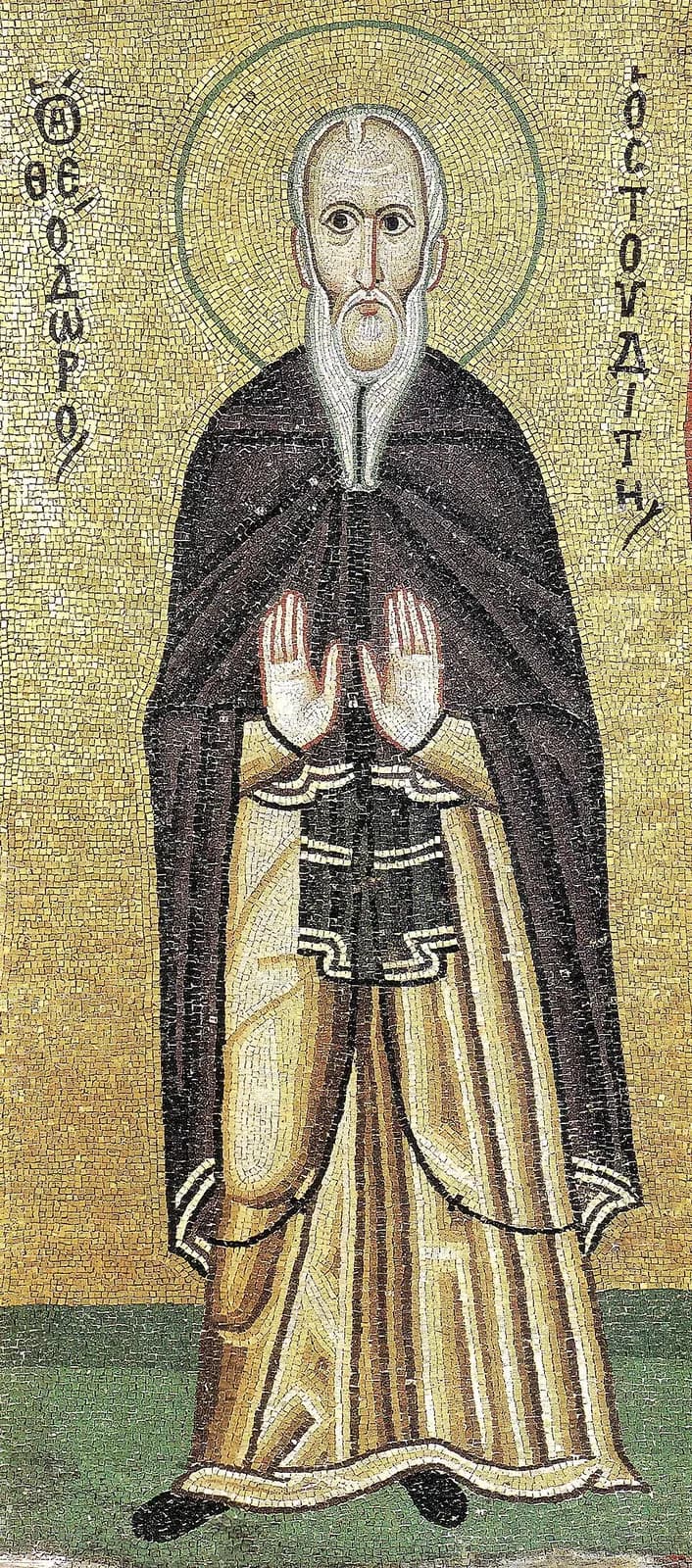
- Also called
- Theodore of Studium 2
- Family
- His mother Theoctista and his uncle Plato are venerated as saints; his brother Joseph became Archbishop of Thessalonica 12
Saint Theodore the Studite was the abbot of the Studion, the great monastery of Constantinople, whose rule became the model for Byzantine monks from Mount Athos to Kiev. 12 He was exiled three times, twice for opposing an emperor's second marriage and once for defending icons, when he was scourged and imprisoned. 12 Benedict XVI called him "one of the great reformers of monastic life." 1 He died on November 11, 826, and is kept on that day in the Byzantine calendar. 12
A family of saints
He was born in 759 into a devout and distinguished family. 12 Benedict XVI notes that his mother, Theoctista, and his uncle Plato, abbot of the monastery of Saccudion in Bithynia, are both venerated as saints. 1 The 1912 Catholic Encyclopedia says he and his two brothers were highly educated, and that one of them, Joseph, became Archbishop of Thessalonica. 2
His uncle guided him toward the monastic life, which he took up at twenty-two. 1 He was ordained a priest by Patriarch Tarasius, in 781 according to the encyclopedia, and in 794 he succeeded his uncle as abbot. 12 The encyclopedia says he insisted on the exact observance of the monastic rule from the start. 2
The emperor's marriage
His first conflict was over the Emperor Constantine VI, who divorced his wife and remarried. 12 Benedict XVI says Theodore broke with Patriarch Tarasius over the tolerance he showed this "adulterous marriage." 1 The emperor banished Theodore to Thessalonica in 796. 12 He returned in triumph after the emperor's overthrow, the encyclopedia says, and Benedict dates his reconciliation with the court to the following year, under the Empress Irene. 12
The quarrel broke out again in 809, and the encyclopedia says Theodore was exiled a second time as leader of the strict party, and recalled in 811. 2
The Studion
In 799, with Saccudion threatened by Arab raids, he took a large part of the community into Constantinople, to the monastery of the Studion. 12 Benedict XVI credits the move to the goodwill of the Empress Irene and dates the beginning of the "Studite Reform" from it. 1 The encyclopedia's article on the monastery says it had been founded in 462 or 463 by a Roman consul named Studios and was dedicated to Saint John the Baptist, and that Theodore is the abbot "to whom the monastery owes the most of its fame." 3
The numbers alone were remarkable. 1 Monasteries of the time rarely held more than thirty or forty monks, Benedict says; Theodore speaks of about three hundred in his own house, and the life of Theodore counts more than a thousand Studite monks in all. 1 The encyclopedia says the rule he gave them added concrete regulations on enclosure, poverty, discipline, study, services, fasting and manual work to the "somewhat theoretical" rules of Saint Basil. 2
He wanted a monastery to be what he called a true "Body of Christ," a single family rather than a collection of individuals. 1 Benedict explains that the persecutions had scattered monks and left each one used to living by his own judgment, and that Theodore set out to bring them back into a common life of order and obedience. 1 Monastic profession, for Theodore, was a kind of "new Baptism," marked by taking the habit. 1 What set monks apart from lay people was the commitment to poverty, chastity and obedience, and Benedict says Theodore talked to his monks about poverty in a practical, sometimes picturesque way. 1 He went back for guidance to the Fathers, above all to Saint Basil and to Dorotheus of Gaza. 1
He also founded a school of calligraphy at the Studion, which the encyclopedia says made the monastery famous. 3 Benedict XVI lists what the Studites became in Byzantine culture: calligraphers, painters, poets, teachers of the young, schoolmasters and librarians. 1
Leo V and the icons
The Emperor Leo V the Armenian revived the campaign against icons, and Theodore became the leader of the resistance. 1 The encyclopedia says he denied outright the emperor's right to interfere in the affairs of the Church. 2 Benedict XVI says a procession of icons organized by the Studite monks brought the police down on them. 1
Between 815 and 821, Benedict says, Theodore was scourged, imprisoned and exiled to several places in Asia Minor. 1 The encyclopedia names them: Metopa in Bithynia from 814, then Bonita from 819, and finally Smyrna. 2 It says he was treated "with great cruelty," and that his monastery was filled with iconoclast monks; its article on the Studion adds that his monks were driven out several times and some of them put to death. 23 Even in exile he remained the center of the opposition. 2
Theodore saw the dispute as touching the Incarnation itself. 1 In his three books of Refutations, Benedict explains, he argued that to abolish the veneration of the icon of Christ would mean repudiating his redeeming work, since the eternal Word had appeared in visible human flesh and sanctified the visible world. 1
His last years
The Emperor Michael II let the exiles return but did not repeal Leo's laws, so the struggle went on. 2 He was able to return to Constantinople, but never to the Studion. 12 Benedict XVI says he settled with his monks on the other side of the Bosporus. 1 He died on November 11, 826; the encyclopedia places his death on the peninsula of Tryphon, near the promontory of Akrita, and Benedict says he is believed to have died at Prinkipo. 12 The encyclopedia closes its account bluntly: he "died without having attained his ideals." 2
His rule outlived him. 1 Benedict XVI says it was written down soon after his death as the Hypotyposis, adopted at Mount Athos when Saint Athanasius founded the Great Laura there in 962, and brought to Kievan Rus' by Saint Theodosius for the Laura of the Grottos. 1 He left some 550 letters, two collections of sermons called the Great and Little Catecheses, and hymns that the encyclopedia praises for their "fiery feeling and a high spirit." 2
What is Saint Theodore the Studite the patron saint of?
Saint Theodore the Studite's feast day
Praying with Saint Theodore the Studite
The virtue Benedict XVI singled out was one with a Greek name, philergia, the love of work. 1 Theodore would not let a monk excuse himself from manual labor on the grounds of prayer, and called work the monk's "sacrifice" and his "liturgy." 1 Because it was a kind of liturgy, the profit from it was not for the monks' comfort; it went to the poor. 1
He was hard on self-will. 1 Fitting into a community of three hundred, he said, was a "martyrdom of submission." 1 Benedict read that as advice for any society, which cannot function if everyone puts themselves at the center. 1 Theodore did not hide his own struggles either; Benedict says that when he wrote about temptations against chastity, he spoke from experience. 1
He was also a spiritual father, in the way his mother and uncle had been to him. 1 Every evening after prayer, his biographer says, he stood before the iconostasis and listened to any monk who wanted to speak to him. 1 His letters, Benedict says, show "his open and affectionate character." 1
He spent much of his adult life in exile, and he died outside the monastery that bore his name, with the fight over icons still unsettled. 12
Saint Theodore the Studite, pray for us.
Sources
- 1.Pope Benedict XVI, "Saint Theodore the Studite," General Audience, May 27, 2009.
- 2.Klemens Löffler, "St. Theodore of Studium," The Catholic Encyclopedia, vol. 14 (New York: Robert Appleton Company, 1912).
- 3.Klemens Löffler, "Studion," The Catholic Encyclopedia, vol. 14 (New York: Robert Appleton Company, 1912).
Saints to turn to next
Others in this collection who are turned to for some of the same things.
- Saint BarnabasFirst centuryCourageWork and vocationPoverty and simplicity
- Saint Clement Mary HofbauerDecember 26, 1751 - March 15, 1820Work and vocationCouragePoverty and simplicity
- Saint Frances Xavier CabriniJuly 15, 1850 - December 22, 1917CouragePoverty and simplicityWork and vocation
- Saint François de LavalApril 30, 1623 - May 6, 1708CourageWork and vocationPoverty and simplicity