Saint Theodore of Sykeon
Died April 22, 613
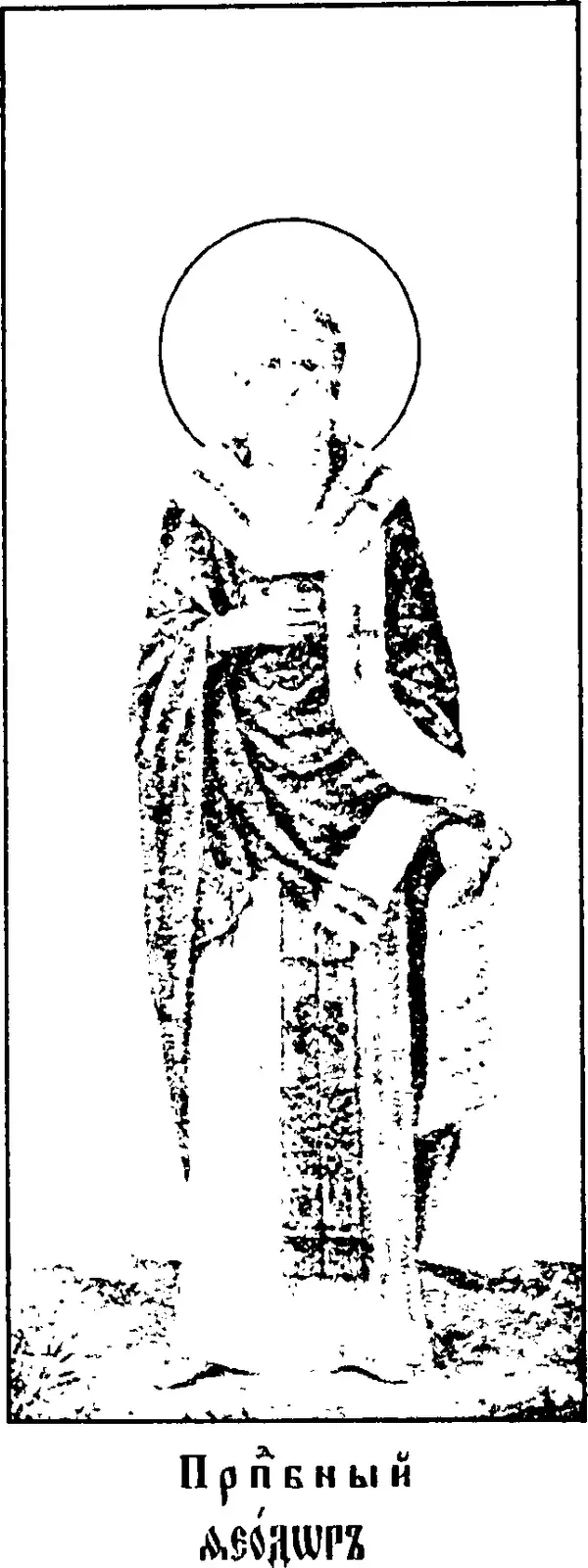
Saint Theodore of Sykeon was the son of a woman who kept an inn on the imperial road through Galatia, in the middle of what is now Turkey, and he grew up to be a hermit, a founder of monasteries and, against his will, bishop of the nearby city of Anastasiopolis. 124 The Life written by his disciple George is a long record of healings and exorcisms, and it also shows a man who fought for years to be let go from his see so that he could go back to his cell. 12 He died on April 22, 613, and that is his feast. 134
An inn on the imperial road
Sykeon was a village on the public post road, twelve miles from Anastasiopolis, and the Life opens at its inn, where a young woman named Mary lived with her mother Elpidia and her sister Despenia. 1 All three, the Life says, made their living from their bodies as well as from their guests, and katolsk.no says the same. 12 The Latin Life makes his father Cosmas, a man famous in horse-racing contests who came through on public business; katolsk.no calls him a circus performer whose specialty was acrobatic riding on camels. 12
When he was six his mother fitted him out with a gold belt and fine clothes to send him into the emperor's service in the capital. Saint George appeared to her in a dream and told her to drop the idea, and at eight he was sent to a teacher to learn his letters instead. 12 Then a devout cook named Stephen came to the inn. His food made the house famous, katolsk.no says, which let the women give up their other trade. 12 Stephen took the boy with him to church, and Theodore began to copy his fasting. He skipped the midday meal to pray in the chapel of Saint George on a nearby hill, and his mother beat him for it until, in the Life's telling, the saint appeared to the women with a drawn sword. 12
At about ten he nearly died of a sickness going through the district, which katolsk.no calls bubonic plague, and recovered in the church of Saint John the Baptist. 12 From then on he kept vigils at the chapel of Saint George, and katolsk.no says he championed George's cult all his life. 2
A boy in a cave
He began to shut himself away very young: first in a room of his mother's house from Epiphany to Palm Sunday, then, at fourteen, in the chapel itself, and then in a cave he dug under its altar. 12 His grandmother brought him fruit and vegetables on Saturdays and Sundays. He ate nothing on the other days. 12
Then he disappeared, "to avoid applause," as Butler puts it. 3 He walled himself into a cave higher up the mountain, and for two years only a deacon knew where he was and brought him a little food and water. His family mourned him as dead. 12 When the women made the deacon talk, they found him close to death, crusted with sores and crawling with lice. 12
Bishop Theodosius of Anastasiopolis came to see him, made him a lector, and the next day ordained him subdeacon, deacon and priest. 1 He was eighteen. 12 People objected that this was under the canonical age, and the Life has the bishop answer that Paul had made Timothy a bishop young. 1
Jerusalem, and the iron cage
He went on pilgrimage to Jerusalem and visited the holy places and the hermits of the desert around them. 12 The Life says he asked for and received the monastic habit at the monastery of the Mother of God at Choziba, near the Jordan; katolsk.no says a bishop clothed him in it. 12 While he was away his mother married a leading man of Ancyra, the provincial capital. His aunt, his grandmother and his little sister Blatta stayed near him. 12
Back at Sykeon his penance turned literal. A smith made him a narrow cell to stand in through the fasts, and he wore iron on his feet, his hands, his waist and his neck, with a breastplate and a heavy iron cross. 12 He spent the season from Christmas to Palm Sunday in a wooden cage and the rest of the year in the iron one. 12 The Life describes the iron cage as roofless, standing in the open above his cave; katolsk.no says it hung in the open air in front of the cliff. 12
The monastery at Sykeon
Disciples came, and a monastery grew around the cave with a church and a guesthouse for the crowds who came to ask for his prayers. 12 Butler says he built it near an old chapel of Saint George. 3 The Life tells of a silver chalice his archdeacon bought in Constantinople, which Theodore refused because he could see it was defiled; the silversmith admitted it had been made from a prostitute's silver pot, and sent pure vessels in its place. 12
On a second pilgrimage to Jerusalem he found the city in a drought with its cisterns dry. Butler says that "like another Elias, he, by his prayers, obtained rain from heaven." 3
A general named Maurice, coming back through Galatia from a campaign against the Persians, stopped at his cave to ask for a blessing. Theodore took him aside and told him he would be emperor, and to remember the poor when he was. 13 Maurice took the throne in 582 and wrote to him, and at Theodore's request granted the monastery six hundred measures of wheat a year for the poor. 13
Bishop against his will
When Bishop Timothy of Anastasiopolis died, the clergy and landowners asked Archbishop Paul of Ancyra for Theodore. 12 katolsk.no dates this to about 590. 2 He would not listen to them, so they carried him out of his monastery in a litter. 1 Butler's phrase is that he was "by main force, consecrated bishop." 3
An old hermit named Antiochus stopped with him on his way home from the capital. katolsk.no quotes the Life on his eyebrows that met in the middle, his white hair to his waist, and his sixty years without wine or oil. 12 Theodore asked him whether to give up the see, and Antiochus told him to do it as quickly as he could. Theodore gave him his own horse. 12 The old man died on the road a few days later. 1
The see had estates, and the men who managed them for the church treated the peasants badly. One of them, also named Theodosius, pushed the villagers until they armed themselves with swords and slings. When the bishop rebuked him, Theodosius accused him of stirring them up and kicked the chair out from under him, so that he fell on his back in front of everyone. 12 Theodore got up and said quietly that he would not die as their bishop. 12 He was also accused of neglecting his church; the Life answers that of the 365 gold pieces allotted to his table he spent forty a year and gave the rest back. 1
He told the clergy and people that they had forced the office on him, and that this was the eleventh year he had afflicted them and been afflicted by them. 1 Archbishop Paul refused to release him, and the dispute went to Patriarch Cyriacus of Constantinople and the emperor, who ordered his resignation accepted. 13 Butler and katolsk.no say he had been bishop for ten years, Henschenius for about eleven. 123
Constantinople and the last years
He withdrew for a while to an oratory of the Archangel Michael near Pidrum, in the district of Heliopolis. 12 There, the Life says, he told a priest named Julian, under a promise of secrecy, that on some days at Mass he saw a bright veil come down over the offerings. 1
Maurice and the patriarch then called him to Constantinople to bless them. The emperor and empress received him warmly, and his monasteries were placed under the Great Church of the capital and no other bishop. 12 He healed one of the emperor's sons, of leprosy in the Life and Butler, of elephantiasis according to katolsk.no, which notes that another source says leprosy. 123
He went home to Sykeon and died there on April 22 in the third year of Heraclius, which the Bollandist editor reckons as 613. 13 katolsk.no notes that it was the day before the feast of his favorite saint, George, and that his body was later taken to Constantinople. 2 His biographer George, born to a childless couple after Theodore blessed them, lived twelve years at his side and wrote the Life after his death. 1
What is Saint Theodore of Sykeon the patron saint of?
Saint Theodore of Sykeon's feast day
Saint Theodore of Sykeon's feast is April 22, the day he died. The current Roman Martyrology enters him on that day at Sykeon, as bishop and hegumen, recalling that he was drawn to solitude from childhood, was made bishop of Anastasiopolis against his will, and pleaded with the patriarch of Constantinople to be allowed back to his hermitage. 4 The 1897 Martyrology and katolsk.no give the same day, and Butler notes that on it "his name occurs in the Roman Martyrology." 235
Praying with Saint Theodore
Theodore started with as little as anyone in the Life: a father who did not stay, a mother and grandmother who worked the inn in more ways than one. 12 What changed it, in the Life's account, was a cook. Stephen fasted while he served other people their dinners, prayed morning and evening, and spent what he earned on the churches, and a small boy watching him decided to do the same. 12
His penances are hard to read now, and the sources do not soften them. The cave where he nearly died, the iron on his body, the cage open to the snow are all in the Life as the Life tells them. 12 The same pages show him giving his horse to an old hermit, refusing a beautiful chalice, and asking an emperor for wheat for the poor. 12
As bishop he was pushed out of his chair by his own steward and accused of neglecting his church, and he asked the patriarch and the emperor to let him go. 12 The current Martyrology remembers exactly that, a bishop who insisted on going back to his hermitage. 4
Saint Theodore of Sykeon, pray for us.
Sources
- 1.George (Eleusius) of Sykeon, Vita S. Theodori Siceotae, Latin translation by Petrus Franciscus Zinus, with the commentary of Godefridus Henschenius, "De S. Theodoro Siceota episcopo Anastasiopolitano," April 22, Acta Sanctorum, Aprilis tomus III (Paris and Rome: Victor Palmé, 1866), pp. 32-62, Internet Archive (in Latin).
- 2."Den hellige Theodor av Sykeon," Den katolske kirke, the saints database of the Catholic Church in Norway, katolsk.no (in Norwegian).
- 3.Alban Butler, "Saint Theodorus of Siceon, Bishop and Confessor," April 22, in The Lives of the Fathers, Martyrs, and Other Principal Saints, Vol. IV, April (Derby: Richardson and Son, 1843), Internet Archive.
- 4.Roman Martyrology, entry for April 22, "San Teodoro vescovo e egúmeno," Santo del giorno, Conferenza Episcopale Italiana (in Italian).
- 5.The Roman Martyrology, April 22 (Baltimore: John Murphy Company, 1897), Internet Archive.
Saints to turn to next
Others in this collection who are turned to for some of the same things.