Saint Thecla
First century, according to her legend
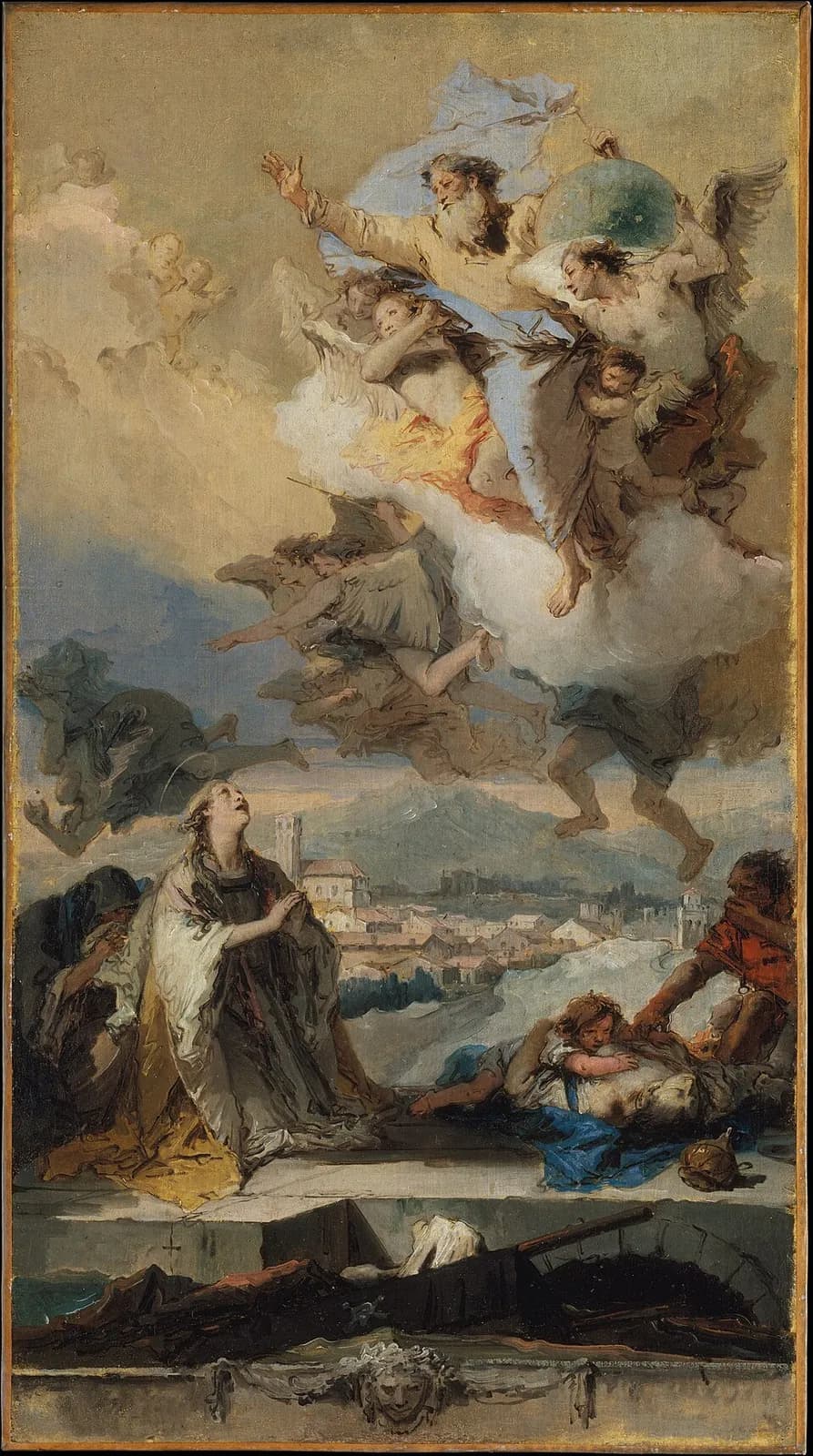
- Feast day
- September 23 in the Roman Martyrology of 1912 and the 1962 Missal; not on the General Roman Calendar since its reform 145
- Eastern feast
- September 24 in the Greek Church 1
- Known from
- The apocryphal Acts of Paul and Thecla, written about 180 1
- Titles
- "Apostle and protomartyr among women" in the Eastern Church 1
- Burial, by tradition
- Seleucia 1
Saint Thecla was, by an ancient and much-loved story, a young woman of Iconium who heard Saint Paul preach, refused the marriage arranged for her, and survived the fire and the wild beasts to become a preacher herself. 13 Everything known of her comes from the Acts of Paul and Thecla, an apocryphal book of about the year 180, and the Catholic Encyclopedia calls the whole story legendary while allowing that a real convert of Paul may lie behind it. 1 Her feast was kept in the Roman Church on September 23. 14
One book, and what the Church made of it
J. P. Kirsch, writing in the Catholic Encyclopedia, puts the problem in a sentence: "Our knowledge of her is derived exclusively from these Acts, which appeared about 180." 1 The Acts of Paul and Thecla are a section of a longer work, the Acts of Paul, which circulated separately from an early date. 2
The Church knew quite early where the book came from. Tertullian reports that it was the work of a priest of Asia Minor who, when the fraud was discovered, was removed from his office and "confessed that he forged the book out of love for St. Paul." 2 Tertullian brought it up, George Reid explains in the encyclopedia's article on the apocrypha, to warn his readers against "the tale of Thecla preaching and baptizing herself." 2 Benedict XVI, surveying the early veneration of Paul in 2009, chose to leave aside "the apocryphal literature, such as the Acts of Paul and Thekla." 7
The book was loved all the same. Reid says it enjoyed "an immense and persistent popularity" through the age of the Fathers and the Middle Ages, and he credits its author with "simplicity, clearness, and vigour." 2 He and Catholic Culture both note that its praise of sexual abstinence is strong enough to suggest the influence of Encratite ideas. 26
Is there anyone real behind it? Kirsch thinks there may be: "Notwithstanding the purely legendary character of the entire story, it is not impossible that it is connected with an historical person." 1 Reid agrees that "a Christian virgin of that name may well have been converted by St. Paul at Iconium, and suffered persecution," and points out that one character in the story, Queen Tryphena, has been shown to be a historical person. 2 What follows is the legend, told as the Acts tell it.
The window in Iconium
In the Acts, Paul comes to Iconium and preaches in the house of a man named Onesiphorus. The book stops to describe the apostle as Onesiphorus first sees him on the road: "a man small in size, bald-headed, bandy-legged, well-built, with eyebrows meeting, rather long-nosed, full of grace." 3
Thecla lives next door. She is the daughter of Theocleia and is engaged to a leading citizen named Thamyris. Sitting at her window, she listens to Paul "night and day," and for three days and nights does not get up to eat or drink. 3 Her mother complains that she is "tied to the window like a spider." 3
Thamyris has Paul arrested. Thecla bribes the gatekeeper with her bracelets and the jailer with a silver mirror, goes into the prison at night, and sits at Paul's feet to listen. 3 When she is found there, both are brought before the governor. Asked why she will not marry Thamyris, she says nothing. Her own mother calls for her to be burned in the theater as a warning to other women. 3
The fire and the beasts
Paul is scourged and thrown out of the city, and Thecla is sent to the stake. She makes the sign of the cross and climbs onto the wood. "And though a great fire was blazing, it did not touch her," the Acts say; the ground rumbles, a cloud "full of water and hail" bursts overhead, and the fire goes out. 3
She finds Paul sheltering in a tomb outside the city and offers to cut her hair and follow him anywhere. He hesitates, and puts off her request for baptism. 3 They travel together to Antioch, which Kirsch identifies as Antioch in Pisidia. 13 There a powerful man named Alexander seizes her in the street. She tears his cloak and knocks the crown from his head, and for that she is condemned to the wild beasts. The women of the city cry out at the sentence: "Evil judgment! Impious judgment!" 3
A widow named Tryphena, whose own daughter has died, takes Thecla in until the day of the games. 3 In the arena a lioness lies down at her feet and dies defending her against a bear and a lion. Seeing a trench full of water, Thecla throws herself in with the words, "In the name of Jesus Christ I am baptized on my last day." 3 Nothing harms her. The governor asks who she is, and she answers, "I indeed am a servant of the living God." He releases her, and the women shout, "There is one God, the God of Thecla." 3
Teacher and hermit
She tracks Paul down at Myra and tells him she has been baptized. This time he gives her a commission: "Go, and teach the word of God." 3 She returns to Iconium, finds Thamyris dead and her mother living, and speaks to her mother of the Lord. Then she goes to Seleucia, where she "dwelt in a cave seventy-two years, living upon herbs and water. And she enlightened many by the word of God." 3 Kirsch notes that the Acts present her, with Paul's consent, as a kind of "female Apostle." 1
The legend does not agree with itself about her end. In one version printed in the translation, the rock opens to hide her from attackers and closes behind her. In another she travels to Rome, finds Paul already dead, and is buried near him. 3 The text gives her age as ninety. 3 Kirsch says simply that she died at Seleucia and was buried there. 1
How she was honored
Whatever the book's origin, devotion to her was early and wide. Catholic Culture says her cult goes back to the second century. 4 In the East, Kirsch writes, the circulation of the Acts led to "a great veneration," especially at Seleucia, at Iconium and at Nicomedia, and she was called "Apostle and protomartyr among women." 1 Catholic Culture likewise says she is considered the first woman martyr. 4 In the Acts themselves she comes through every ordeal alive. 3
In the West her cult appears very early too, particularly where the Gallican liturgy was used, and Kirsch says there is direct proof of it in the fourth century. 1 The old martyrology that goes under Jerome's name mentions a Thecla on several days of the year, and Kirsch judges that the same saint, the pupil of Paul, is meant each time. 1
She is one of several saints of the name. Kirsch's article lists others, among them a Thecla of Gaza who was killed in 304 or 305 and whose martyrdom Eusebius records. 1
What is Saint Thecla the patron saint of?
Saint Thecla's feast day
Saint Thecla's feast in the Roman Church was September 23. Kirsch says Bede's martyrology placed her on that day, and that it was "the same date as that on which her feast is given in the present Roman Martyrology," meaning the Martyrology of 1912. 1 Catholic Culture says September 23 is her feast in the 1962 Missal, shared with Pope Saint Linus. 4
She is no longer on the general calendar. An earlier edition of the same Catholic Culture page puts it in the past tense: "Before the reform of the General Roman Calendar today was the feast of St. Linus," and "It was also the feast of St. Thecla." 5 September 23 is now the memorial of Saint Pio of Pietrelcina. 45 The sources read for this page do not say on which day the current Roman Martyrology lists her.
The Greek Church keeps her on September 24, under the title "Protomartyr among women and equal to the Apostles." 1 That is also the day named in the closing lines of the Acts. 3
Praying with Saint Thecla
A reader coming to Thecla has to hold two things at once. The Church's own scholars say the story is a second-century composition by a priest who admitted writing it. 2 The Church also kept her feast for many centuries, East and West. 14
The encyclopedia's way through is modest. It grants that women like her existed: Kirsch finds it easy to believe that a convert of Paul named Thecla, a native of Iconium, "like many other women of the Apostolic and later times, laboured in the work of Christian missions." 1
Within the story, what stands out is that she acts. She listens for three days and then goes to the prison herself. Before the governor at Iconium she does not answer at all. 3 In the arena, the governor asks what it is about her that the beasts will not touch, and she answers by naming the one she believes in. 3
The Acts end with a woman in a cave for seventy-two years, living on herbs and water and teaching those who came. 3 Paul's last words to her in the book are the commission to go and teach the word of God. 3
Saint Thecla, pray for us.
Sources
- 1.Johann Peter Kirsch, "Sts. Thecla," The Catholic Encyclopedia, vol. 14 (New York: Robert Appleton Company, 1912).
- 2.George J. Reid, "Apocrypha," The Catholic Encyclopedia, vol. 1 (New York: Robert Appleton Company, 1907).
- 3.Acts of Paul and Thecla, trans. Alexander Walker, Ante-Nicene Fathers, vol. 8 (Buffalo: Christian Literature Publishing Co., 1886). New Advent.
- 4."Memorial of St. Padre Pio," Liturgical Year, September 23, 2019, Catholic Culture.
- 5."St. Padre Pio," Liturgical Year, September 23, 2005, Catholic Culture.
- 6."Acts of Paul and Thecla," Fathers of the Church, Catholic Culture library.
- 7.Pope Benedict XVI, General Audience of 4 February 2009: Saint Paul (20), St Paul's martyrdom and heritage. The Holy See.
Saints to turn to next
Others in this collection who are turned to for some of the same things.