Saint Teresa of Avila
1515 - October 15, 1582
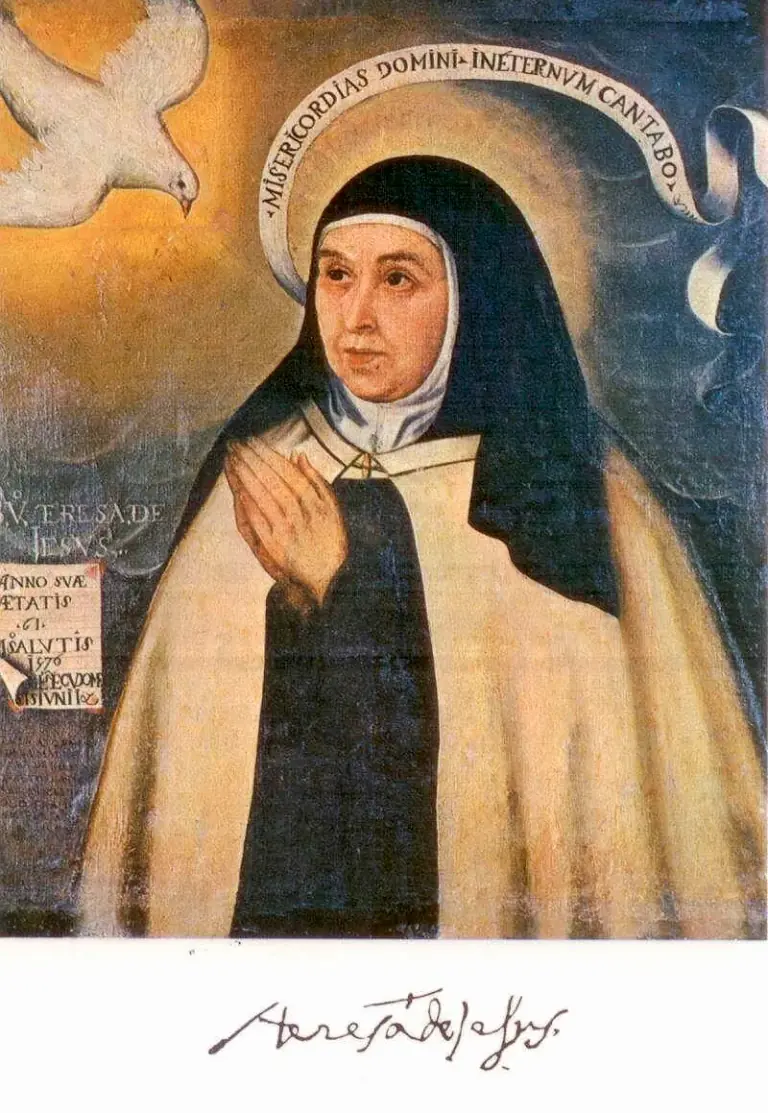
- Patron saint of
- Relief from headaches 2
- Feast day
- October 15 2
- Died
- Alba de Tormes, October 15, 1582 1
- Entered Carmel
- At the age of twenty, at the Monastery of the Incarnation in Avila 1
- Canonized
- 1622, by Pope Gregory XV 1
Saint Teresa of Avila is the Church's great teacher of prayer, and her definition of it is the least intimidating one ever written: prayer means being on terms of friendship with God, frequently conversing in secret with the one who, we know, loves us. She spent decades reforming an order, founding convents, and being investigated for it, and she wrote the books people still open when their prayer has stopped working.
Avila, and a slow start
Teresa was born at Avila in Spain in 1515 and entered the Carmelite Monastery of the Incarnation there at the age of twenty. 12 She was not a prodigy of holiness. Her own account of her early religious life describes years of divided attention, and the books she later wrote about prayer are credible precisely because she wrote them as somebody who had found it difficult.
The reform
In 1562 she founded the first reformed Carmel at Avila, returning the order to a stricter and simpler observance. 1 In 1568, with Saint John of the Cross, she established the first house of Discalced Carmelite friars at Duruelo. 1 In 1580 she obtained papal authorization for her reformed Carmels as a separate autonomous province. 1
That is eighteen years of founding houses, arguing with authorities, and traveling badly on Spanish roads. She is not a contemplative who withdrew from practical life; she is a contemplative who ran an organization.
What she wrote
Teresa wrote four major works: The Book of Her Life in 1565, The Way of Perfection in 1566, The Book of the Foundations between 1573 and 1582, and, in 1577, The Interior Castle. 1 The last describes the soul as a castle of many rooms with God in the innermost one, and it remains the map people are handed when they want to know where they actually are in prayer.
Prayer as friendship
Her definition of prayer is the sentence to take away. Prayer, she wrote, "means being on terms of friendship with God frequently conversing in secret with him who, we know, loves us." 1 Not a technique, not a performance, and not primarily a request - a friendship, which is built the way friendships are built, by spending time.
Benedict XVI drew the practical conclusion out of her: "Time devoted to prayer is not time wasted, it is time in which the path of life unfolds." 1 For anybody who cannot justify the half hour, that is the answer.
Doctor of the Church
Teresa was canonized in 1622 by Pope Gregory XV. 1 In 1970 Pope Paul VI proclaimed her a Doctor of the Church - she and Catherine of Siena were the first two women given the title. 12 The Church did not merely approve her holiness; it ranked her teaching on prayer among the writings the whole Church should learn from.
What is Saint Teresa of Avila the patron saint of?
Saint Teresa of Avila is the patron saint of relief from headaches, and that is the only patronage Franciscan Media lists for her. 2 It is an odd result and worth naming as one. The Church's great teacher of prayer, the first woman proclaimed a Doctor alongside Catherine of Siena, is on the lists for a headache. 12 The sources say what they say and it stands here uncorrected, but a reader who came looking for her because of what she taught wants the friendship she described rather than the ailment she was assigned. 1
Saint Teresa's feast day
The feast of Saint Teresa of Avila is celebrated on October 15. 2
Praying with Saint Teresa of Avila
Teresa's definition of prayer is the least intimidating one in the tradition: being on terms of friendship with God, talking often and in private with the one who we know loves us. 1 There is no method to get through first, and no standard to meet before you are allowed to begin.
For anyone who cannot justify the half hour, Benedict XVI's summary of her is the answer. Time given to prayer is not time wasted; it is the time in which the path of a life opens up. 1
She wrote The Interior Castle because she thought people needed a map of where they actually were. 1 If you suspect you are stuck, she assumed you would be and wrote accordingly.
None of this came easily to her, and she said so in print. Her own account of her first years in religion is not a success story. She was also founding houses and arguing with superiors and traveling bad roads for eighteen years while she wrote the century's best books on contemplation. 1
Saint Teresa of Avila, pray for us.
Sources
Saints to turn to next
Others in this collection who are turned to for some of the same things.