Saint Teresa Margaret Redi
July 15, 1747 - March 7, 1770
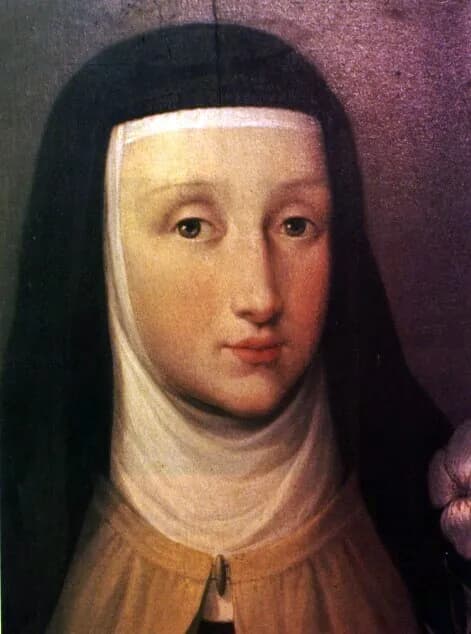
Saint Teresa Margaret Redi was a Discalced Carmelite nun who died of peritonitis in Florence on March 7, 1770, at twenty-two, after five years in the monastery, the last of them spent nursing its sick. 134 Born Anna Maria Redi at Arezzo in 1747, she "performed no brilliant, attention-getting deeds," as Edith Stein put it; what her order remembers is one sentence of Saint John, "God is love," which she repeated constantly. 23 Pius XI canonized her in 1934, and her memorial is kept on September 1. 14
The child who asked who God is
She was born on July 15, 1747, in the family palazzo facing the church of San Michele in Arezzo, the second child of Ignazio Redi and Camilla Ballati, a Sienese. 1 The next day, the feast of Our Lady of Mount Carmel, her grandfather Gregorio baptized her in the cathedral. 1
There were thirteen children. 12 The Discalced Carmelites' General Curia says that all of them except the first and the fifth, who died as children, gave themselves to God. 2 The Diocese of Arezzo counts differently: five died young, one married, four became nuns, one a Theatine and two Jesuits. 1
The earliest thing recorded of her is a question. As soon as she could ask questions at all she went from one adult to another with the same one, which the order's Postulation gives as "Tell me, who is this God?" 14 Her father took charge of her religious upbringing himself and taught her his own devotion to the Sacred Heart of Jesus, which, the Arezzo booklet notes, the Jansenists of the day opposed and the Jesuits spread. 1
Sant'Apollonia and a voice
On November 23, 1756, when she was nine, Ignazio took her to Florence and left her as a boarder with the Benedictine nuns of Sant'Apollonia. 12 She made her first Communion there on August 15, 1757, younger than was usual. 13 She learned Latin well enough to read Scripture and the liturgy in it. 12
The nuns hoped she would stay, and by the Curia's account she had thought of it. 12 Then, in 1763, a young woman from Arezzo named Cecilia Albergotti came to the parlor to say goodbye before entering the Carmel of Florence. 13 The Curia calls what followed "a chance conversation with a friend." 2 The other sources say more. Walking back to her room, Anna Maria heard words spoken within her, and heard them again in the chapel: "I am Teresa of Jesus, and I say to you that you will soon find yourself in my monastery." 13 She told no one at Sant'Apollonia. 13
Leaving Arezzo
Her father brought her home on April 8, 1764. 1 For more than three months she said nothing of her plans. 1 She used the time to test herself, praying in her room and quietly doing the servants' work in their place. 13 On her seventeenth birthday she told her mother. 13
Ignazio Redi consulted her Jesuit director, had a canon question her three days running, and then had her examined by the Carmelite provincial and by the bishop of Arezzo. All of them judged the vocation real. 1 When he tried to raise it with her himself he broke down. Stein gives his words, "Do you really intend to leave me, my dear daughter?", and his own testimony that she stood motionless for a time and then went to her room without speaking. 13
She left home in the last week of August. In the carriage, her father later testified, she sat silent for an hour and then turned to him as cheerful as ever. 13
She entered the monastery of St. Teresa in Florence on September 1, 1764. 124 The community was elderly and had several invalids; she called it the "house of angels." 13 In December she needed surgery for an infection in her knee and, by the custom of the time, was sent outside the enclosure for two months, not knowing, the Curia says, whether she would be taken back. 12 She received the habit on March 11, 1765, as Teresa Margaret of the Sacred Heart of Jesus; the Curia gives March 10. 1234 Thinking herself unworthy of the choir, she asked to be professed as a lay sister. The nuns refused, and she made solemn vows on March 12, 1766. 1
The infirmary, and "God is love"
After profession she was made sacristan and then assistant infirmarian. 13 One of her patients had lost her reason and answered care with insults and blows; when the infirmarian tried to take that patient away from her, Teresa Margaret begged until she was allowed to keep her. 123 Another, eighty years old, bedridden and deaf, could understand nobody else, and understood her even when she whispered. 13
On June 28, 1767, a Sunday after Pentecost, she was in choir for Terce when the short reading from the First Letter of John, that God is love and whoever abides in love abides in God, struck her with such force that for days she had to make an effort to carry on with ordinary life. 1 The Carmelite Proper calls it "a special contemplative experience concerning the words of St John, 'God is love.'" 5
What came after was not sweetness. The Arezzo booklet says that for the nearly three years left to her she walked a dark road, loving and convinced she no longer knew how. 1 The Curia is blunter: "great aridity in prayer," with "disgust, lack of feelings, terrors, temptations and antipathy towards virtue." 2 She had loved books since childhood and now could read only Saint Teresa; she got by on psalms and two words, "Good father!" 2 To stay awake through the two daily hours of mental prayer she pinched her earlobes with small iron clips hidden under her wimple. 1 Her sisters saw a diligent nurse. Only her confessor guessed the rest. 1
Three in the afternoon
On Sunday, March 4, 1770, she made a general confession, and asked to receive Communion the next day as though it were her last. 13 On the evening of March 6 she finished late with the sick and was eating alone in the refectory when violent abdominal pain took hold of her. 13 Through the night she asked the girl watching her to keep quiet so the nuns could sleep, and in the morning she gave instructions for the care of her patients. 13
She died at about three in the afternoon on Wednesday, March 7. 13 The chaplain arrived barely in time; the booklet says he gave her the sacraments in great haste, Stein that he could only anoint her. 13 She was twenty-two, though the Carmelite Proper says "aged twenty-three." 135
Her body, swollen and discolored by the illness, was carried to the burial vault on March 8 and was not buried, because the signs of decay went away. 13 The painter Anna Piattoli was commissioned to make a portrait. 1 The archbishop of Florence came with physicians to examine the body, and the coffin was sealed and entombed on March 31. 13
The cause was opened in Rome in 1807, and Gregory XVI declared her virtues heroic in 1839. 13 She was beatified on June 9, 1929, and canonized by Pius XI in St. Peter's on March 19, 1934; the Postulation's page prints March 13. 134 Since 1921 her body has rested in the Carmelite monastery in Via dei Bruni in Florence. 1
What is Saint Teresa Margaret Redi the patron saint of?
None of the sources used for this page names Saint Teresa Margaret Redi the patron saint of anything, and this page does not supply a patronage they do not state. 123
What they record is local. The Diocese of Arezzo calls her the only daughter of that church whose holiness has been recognized by canonical process. 1 In the 1960s a Carmelite bishop of Arezzo dedicated a new parish there to her. 1
Saint Teresa Margaret Redi's feast day
Saint Teresa Margaret Redi's feast day is September 1. 14 When she was canonized the memorial was set on March 7, the day she died. In 1967, with the reform of the calendar, it was moved to September 1, the anniversary of her entering the monastery, so that it would not fall in Lent. 1 The Postulation of the Discalced Carmelites lists September 1 as her memorial, and the Carmelite Proper assigns it readings from Ephesians 3 and John 15. 45
Praying with Saint Teresa Margaret Redi
Asked by her confessor whether she had begun to love God from the moment she came to know him, she answered, "But everyone does that, and how could anyone not do so?" 3 It is hard to tell whether that is innocence or precision.
Almost nobody around her knew what her inner life was like. The Curia says that it "was only after her death that the sisters in her community understood the sanctity of this young Carmelite." 2 What they had seen was a nurse who took the patients nobody wanted, who "was assiduous in small services to the sisters and would not allow gossip or criticism." 2 The verse she kept returning to was Saint Paul's, "your life is with Christ, hidden in God." 2
The hardest fact of her life is the order in which things came. The sentence "God is love" seized her in June 1767, and from then until she died she felt herself incapable of love, tempted and dry. 12 Nothing in the sources says the darkness lifted. A decree of the Congregation of Rites, issued a month before her canonization, offered a reason and no consolation: the greater love grows, the smaller it looks to the one who loves. 1
She went on nursing. On the last morning of her life she was giving instructions for her patients. 13 Stein, writing when the canonization was new, admitted that "the new saint is virtually unknown outside of our Order," and set down the short life anyway. 3
Saint Teresa Margaret Redi, pray for us.
Sources
- 1."Santa Teresa Margherita del Sacro Cuore di Gesù: La vita e il culto," Diocesi di Arezzo-Cortona-Sansepolcro, Centro Pastorale per il Culto, Anno della Vita consacrata 2015 (in Italian).
- 2."St. Teresa Margaret Redi," Discalced Carmelites, General Curia of the Teresian Carmel.
- 3.Edith Stein (St. Teresa Benedicta of the Cross), "St. Teresa Margaret (Redi) of the Sacred Heart," from The Hidden Life (ICS Publications), as published by the Discalced Carmelite Nuns of Lafayette, Louisiana.
- 4."Teresa Margherita del Sacro Cuore di Gesù," Postulation General of the Discalced Carmelites, biography and calendar of memorials.
- 5."Saint Teresa Margaret Redi of the Sacred Heart," Irish Province of Carmelites, with texts from the Carmelite Proper of the Liturgy of the Hours (Rome: Institutum Carmelitanum, 1993).
Saints to turn to next
Others in this collection who are turned to for some of the same things.
- Saint Bernardo TolomeiMay 10, 1272 - August 20, 1348DiscernmentPrayerSuffering and illness
- Saint Carmen RendilesAugust 11, 1903 - May 9, 1977PrayerDiscernmentSuffering and illness
- Saint Clare of Montefalcoc. 1268 - August 1308PrayerSuffering and illnessDiscernment
- Saint Claude de la Colombiere1641 - February 15, 1682DiscernmentPrayerSuffering and illness