Saint Telesphorus
Died about 136, or by Eusebius's reckoning 138
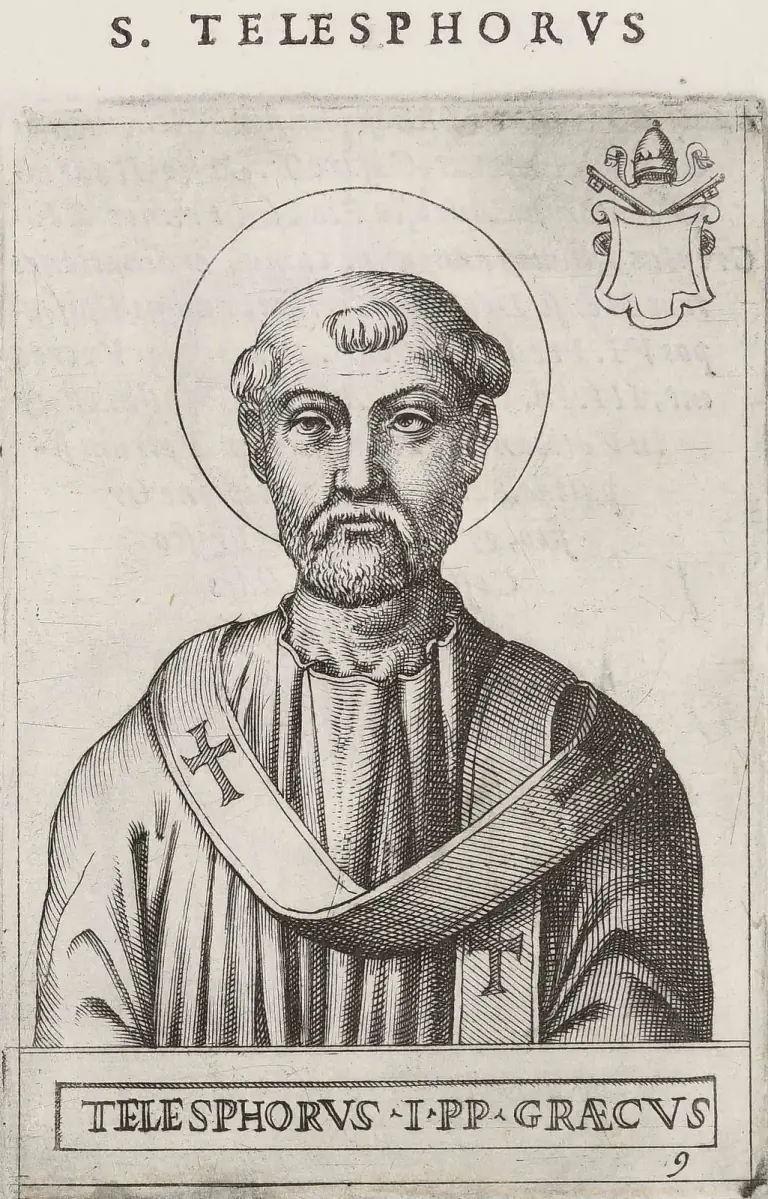
- Pope
- About 125 to 136, by Kirsch's heading 1; from the twelfth year of Hadrian to the first of Antoninus Pius, by Eusebius 5; 127 to 137 in the Liberian Catalogue 7
- Died
- A martyr, by the witness of Irenaeus 134; under Hadrian, says katolsk.no 2; under Antoninus Pius, says the 1897 Martyrology 8
Saint Telesphorus was bishop of Rome for about eleven years in the early second century, the seventh in succession from the apostles. 145 When Saint Irenaeus of Lyons listed the bishops of Rome later in the same century, Telesphorus was the only one he called a martyr, pausing at his name to say that he "was gloriously martyred." 47 The Church keeps his memory on January 2, the day the Liber Pontificalis gives for his burial. 37
The seventh after the apostles
Irenaeus wrote his list of Roman bishops to show that the teaching of the apostles had come down in an unbroken line. It runs from Linus through Anacletus, Clement, Evaristus and Alexander to Sixtus, "sixth from the apostles," and then to Telesphorus, and after him Hyginus, Pius and Anicetus. 4 Eusebius names him "the seventh in succession from the apostles," and the current Roman Martyrology says the same in its own words. 35
His dates can only be approximated. Eusebius says that he succeeded Xystus, as he spells the name, in the twelfth year of the emperor Hadrian, and that he died in the first year of Antoninus Pius, "in the eleventh year of his episcopate." 5 Johann Peter Kirsch, in the Catholic Encyclopedia, converts those reigns to 128-129 and 138-139 but heads his article "Lived about 125-136," and refers the reader to the modern scholars who had reworked the early Roman chronology. 1 The Liber Pontificalis, a Roman collection compiled centuries later, gives him eleven years, three months and twenty-one days, "in the time of Antoninus and Marcus." 7 Louise Ropes Loomis, its translator, adds in a note that the fourth-century Liberian Catalogue dates him from the consulship of 127 to the year 137. 7 The Norwegian bishops' saints database (katolsk.no) puts his death at about 136. 2
Of the man himself, the Liber Pontificalis says that he was "by nationality a Greek, previously an anchorite." 7 katolsk.no observes that his Greek name bears the first claim out, and repeats the second without comment. 2 Irenaeus and Eusebius, the early witnesses, say nothing of his life before he became bishop. 45
Rome in the reign of Hadrian
The sources say almost nothing of what Telesphorus did, but Eusebius describes the world in which he led the Roman church. Two Christians, Quadratus and Aristides, wrote defenses of the faith addressed to Hadrian himself, and Eusebius says both were still being read in his own day. 5 A governor wrote to Hadrian that it was unjust to put Christians to death without a trial, "merely for the sake of gratifying the outcries of the populace," and the emperor answered with a rescript to the proconsul of Asia forbidding him to condemn anyone without an indictment. 5
In Judea the Jewish revolt led by Bar Kokhba, whom Eusebius calls Barcocheba, ended in the destruction of the Jewish population of Jerusalem, and the city was rebuilt as the Roman colony of Aelia. 25 Eusebius quotes Saint Justin's report that the rebel leader had ordered Christians alone to be "visited with terrible punishments unless they would deny and blaspheme Jesus Christ." 5 The Jerusalem church, which until then had had fifteen bishops of Jewish birth, received its first Gentile bishop. 5
The same years saw the teachers Eusebius calls leaders of "knowledge falsely so-called": Saturninus in Syria, Basilides in Alexandria, and Carpocrates. 5 Their followers, he says, brought slander on the whole Christian name. 5 It was under Telesphorus's successor Hyginus that Valentinus and Cerdon came to Rome. 5
A glorious martyrdom
Irenaeus compiled his list while Eleutherius was bishop of Rome, during the persecution under Marcus Aurelius, and he adds a word about only a few of the names on it. 47 Of Linus he notes the mention in Saint Paul's letters, of Clement that he had seen the apostles, and of Telesphorus that he was "gloriously martyred." 47 Eusebius repeats it: "Irenæus records that Telesphorus' death was made glorious by martyrdom." 5 Kirsch accepts the witness, and the current Martyrology rests its notice on it, saying that, as Saint Irenaeus attests, Telesphorus suffered a glorious martyrdom. 13
The Liber Pontificalis marks him, as it marks every one of the first fourteen successors of Peter, as "crowned with martyrdom." 27 katolsk.no points out that the martyrdom of most of the others cannot be proven, and that Telesphorus stands apart because Irenaeus vouches for his. 2 Nothing more is known of how he died. 2
When he died is less settled. katolsk.no places the martyrdom under Hadrian, who died in 138. 2 The 1897 English edition of the Roman Martyrology entered him under Antoninus Pius, as a pope "who, under Antoninus Pius, after many labors, underwent a glorious martyrdom for the confession of Christ." 8 Eusebius's dating would also put his death in Antoninus's first year. 5 He was buried, the Liber Pontificalis says, "near the body of the blessed Peter in the Vatican." 27
Easter on a Sunday
The one thing an early witness shows him doing comes out of a quarrel two generations later, about the year 190. 10 The churches of Asia kept Easter on the fourteenth day of the month, on whatever day of the week it fell, and Rome kept it on a Sunday. 16 When Pope Victor tried to cut the Asian churches off over the difference, Irenaeus wrote to remind him of the bishops who had gone before. 6
"We mean Anicetus, and Pius, and Hyginus, and Telesphorus, and Xystus," he wrote. "They neither observed it themselves, nor did they permit those after them to do so. And yet though not observing it, they were none the less at peace with those who came to them from the parishes in which it was observed." 6 Those earlier bishops, he went on, "sent the eucharist to those of other parishes who observed it." 6 Kirsch sums it up: Telesphorus kept Easter on Sunday "without, however, abandoning church fellowship with those communities that did not follow this custom." 1
The decrees credited to him
The Liber Pontificalis credits Telesphorus with three rules about worship: that "the fast of seven weeks should be kept before Easter," that Mass be celebrated at night on the feast of the Nativity, and that the angelic hymn, "Gloria in excelsis deo," be sung before the sacrifice, "but only upon the night of the Lord's nativity." 7 Kirsch is plain that none of the statements in it about this pope's liturgical and other decisions are genuine. 1
The other witnesses explain why. On the fast, Loomis notes that it was kept before Telesphorus but that its length "was at first variable." 7 Herbert Thurston, writing on Lent in the same encyclopedia, concludes from Irenaeus's letter to Victor that "Irenaeus about the year 190 knew nothing of any Easter fast of forty days." 10 katolsk.no is more generous: it thinks it quite possible that Telesphorus laid down some rule about how long the fast should last. 2
On Christmas, Loomis observes that the night Mass "can hardly have been instituted before the date of the Nativity was fixed during the fourth century," and katolsk.no reports that scholars put it several centuries after him. 27 Adrian Fortescue, writing on the Gloria, quotes the decree and traces from it how the hymn was sung first at Christmas, then on Sundays and great feasts, and for a long time only by bishops. 9 Loomis notes that Roman priests were still forbidden to sing it except at Easter as late as the eleventh century. 7
What is Saint Telesphorus the patron saint of?
Saint Telesphorus's feast day
Saint Telesphorus's feast day is January 2. The Roman Martyrology, in the text the Italian bishops publish, keeps on that day at Rome the burial of Saint Telesphorus, pope, who, as Saint Irenaeus attests, was the seventh bishop after the apostle and suffered a glorious martyrdom. 3 The date agrees with the Liber Pontificalis, which says he was buried on January 2. 7
For centuries the date was January 5. Kirsch gives it as the feast in the Roman Martyrology of his day, and the 1897 English Martyrology enters him on that day, the vigil of the Epiphany. 18 katolsk.no says January 5 stood in the Roman calendar until 1969, and that it came from an early martyrologist who had confused him with another Roman martyr. 2 The Greek Church keeps his feast on February 22. 12
Praying with Saint Telesphorus
Almost everything known of Telesphorus is in a few words written by other people. He left no letters, and the decrees later credited to him are not his. 17 What remains is a name in a list and, beside it, the note that he died a martyr. 4 Irenaeus thought it worth recording, and Eusebius copied it into his history. 45
The one glimpse of his ordinary work is a matter of peace. He kept the Roman custom for Easter and stayed at peace with Christians who came to Rome from churches that kept another day. 6 Irenaeus counted him among the Roman bishops who sent the Eucharist to those churches all the same. 6 It was this example he set before Pope Victor, who was ready to break communion over the date. 6
His years were not quiet ones. Christians were slandered across the empire and punished in Judea, Christian writers were defending the faith to the emperor, and a governor had to ask that they not be condemned without a trial. 5 Telesphorus led a church in that climate for about a decade, and by Irenaeus's account it cost him his life. 14
Saint Telesphorus, pray for us.
Sources
- 1.Johann Peter Kirsch, "Pope St. Telesphorus," The Catholic Encyclopedia, vol. 14 (New York: Robert Appleton Company, 1912).
- 2."Den hellige pave Telesforus ( - ~136)," Den katolske kirke (katolsk.no), Catholic Diocese of Oslo (in Norwegian).
- 3.Roman Martyrology, entry for January 2, "San Telesforo, papa," Santo del giorno, Conferenza Episcopale Italiana (in Italian).
- 4.Saint Irenaeus, Against Heresies, Book III, chapter 3, translated by Alexander Roberts and William Rambaut, Ante-Nicene Fathers, vol. 1 (Buffalo: Christian Literature Publishing Co., 1885), as hosted by New Advent.
- 5.Eusebius, Church History, Book IV, chapters 3 to 10, translated by Arthur Cushman McGiffert, Nicene and Post-Nicene Fathers, Second Series, vol. 1 (Buffalo: Christian Literature Publishing Co., 1890), as hosted by New Advent.
- 6.Eusebius, Church History, Book V, chapter 24, quoting Irenaeus's letter to Pope Victor, translated by Arthur Cushman McGiffert, Nicene and Post-Nicene Fathers, Second Series, vol. 1 (Buffalo: Christian Literature Publishing Co., 1890), as hosted by New Advent.
- 7.The Book of the Popes (Liber Pontificalis), I: To the Pontificate of Gregory I, translated by Louise Ropes Loomis (New York: Columbia University Press, 1916), introduction and life of Telesphorus, with the translator's notes.
- 8.The Roman Martyrology, January 5 (Baltimore: John Murphy Company, 1897).
- 9.Adrian Fortescue, "Gloria in Excelsis Deo," The Catholic Encyclopedia, vol. 6 (New York: Robert Appleton Company, 1909).
- 10.Herbert Thurston, "Lent," The Catholic Encyclopedia, vol. 9 (New York: Robert Appleton Company, 1910).
Saints to turn to next
Others in this collection who are turned to for some of the same things.