Saint Symphorosa
Died under Hadrian (117-138)
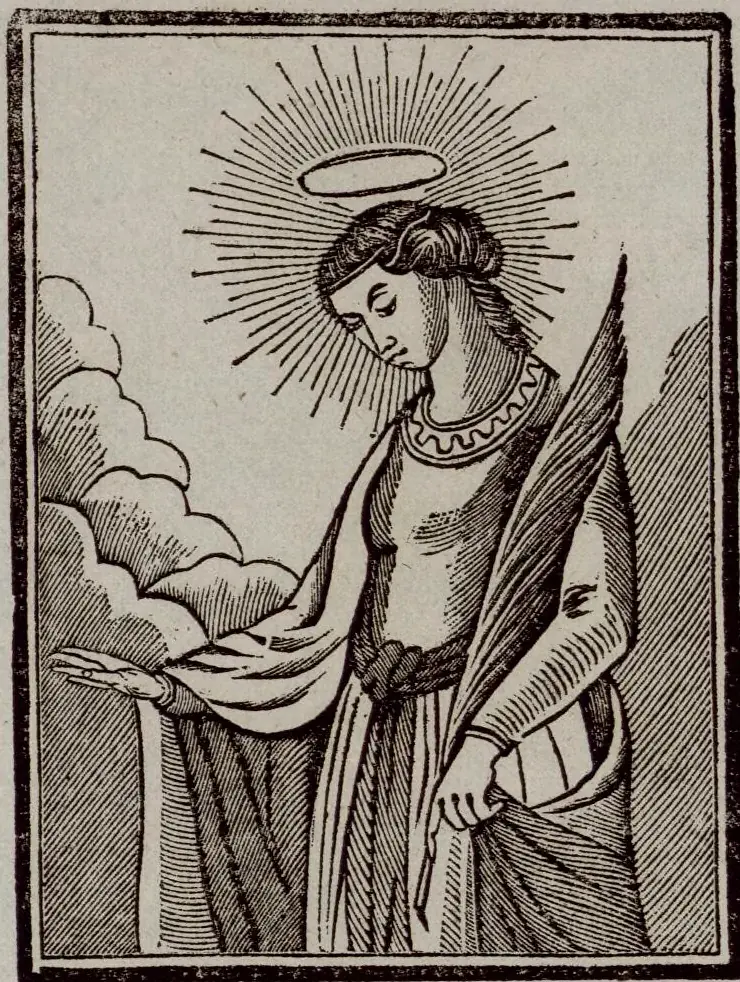
- Died
- Drowned in the river Anio under the emperor Hadrian; her seven sons were killed the next day, according to the Passio 123
- Patronage
- The Diocese of Tivoli honors them as patrons 1
Saint Symphorosa was a widow of Tibur, the town now called Tivoli, east of Rome, who according to her Passio was drowned in the river Anio under the emperor Hadrian for refusing to sacrifice, and whose seven sons were put to death the next day. 12 How much of that story is history has been questioned for a long time, but the place of their burial at the ninth mile of the Via Tiburtina is real, and the basilica built over it has been found. 1 Her feast is July 18. 14
The Passio
Almost everything told about her comes from one old text, the Passio of Saint Symphorosa and her seven sons. 13 Alban Butler, writing in the eighteenth century, followed what he called "their genuine Acts in Ruinart." 2 The Catholic Encyclopedia of 1912 tells the same story and then says plainly that "the reliability of which is seriously questioned by many modern hagiologists." 1 This page tells the Passio first, as both of them do, and then what the evidence will and will not bear.
In the Passio she is a widow living at Tibur, the wife of a tribune named Getulius who had already been martyred under Hadrian. 13 Butler adds that she lived with her seven sons on a large estate there, that she spent freely on the poor and on Christians suffering for the faith, and that she had buried Getulius and his brother Amantius on her own land. 2
Hadrian had built his great palace at Tibur, on the banks of the Anio, and began to dedicate it with sacrifices. 12 The oracle he received, in Butler's version, was this: "The widow Symphorosa and her seven sons daily torment us by invoking their God; if they sacrifice, we promise to be favorable to your vows." 2
Before the emperor
She was brought before him with her sons. Butler says she came "with joy in her countenance," praying that God would give them all the grace to confess his name. 2 Hadrian asked her mildly at first to sacrifice. She answered that her husband and his brother had died rather than do so: "The death they suffered drew upon them ignominy among men, but glory among the angels." 2
The emperor threatened her and her sons with death. She told him, "Do not imagine that fear will make me change; I am desirous to be at rest with my husband, whom you put to death for the name of Jesus Christ." 2 He had her taken to the temple of Hercules, struck in the face and hung up by her hair, and when that did not move her, thrown into the river with a great stone tied to her neck. 12 Her brother Eugenius, a member of the council of Tibur, recovered her body and buried it outside the town. 12
The seven
The next day Hadrian called for the seven sons together, urged them not to imitate their mother's obstinacy, and threatened them. 12 When that failed he had seven stakes set up around the temple of Hercules and the young men bound to them and stretched. 12
Each died a different death. In the Catholic Encyclopedia's list, Crescens was pierced through the throat, Julian through the breast, Nemesius through the heart, Primitivus at the navel, Justin through the back, Stracteus in the side, and Eugenius, the youngest, was cut in two from head to foot. 12 The santiebeati account gives the same names but has Stracteus thrown into the river. 3 Their bodies were thrown into a deep pit, which the pagan priests called "Ad septem Biothanatos," a Greek word used for those who died by violence and, by the pagans, for martyrs. 12
The persecution then stopped for a year and a half, the Passio says, and in that time the Christians buried the eight martyrs on the Via Tiburtina, between Tivoli and Rome. 12
What the evidence will bear
The Catholic Encyclopedia sets out the difficulties. The old opinion that the Acts were written by Julius Africanus, which Butler mentions, has been almost universally rejected, since no early writer refers to any such work. 12 The Hieronymian Martyrology, compiled in the fifth century, does commemorate Symphorosa and her sons on July 18, but the names it gives the sons are entirely different from those in the Acts. 1
The same Martyrology has, on June 27, seven brothers whose names are exactly the names the Acts give to her sons. 1 The encyclopedia's conclusion is that the author of the Acts probably knew a tradition that Symphorosa had seven martyred sons and gave them the names he found on June 27, so that, "provided Symphorosa had seven sons at all," those were not their names. 1 It adds that some scholars see the seven sons, like those of Felicitas, as an echo of the mother of the seven Maccabees. 1
The santiebeati account says the same more gently: the core of the story may preserve the memory of a real early Christian family and a local cult that grew up very early, while many of the details follow the literary patterns of the passions of the martyrs, and the names of the sons and the exact chronology cannot be established. 3 Even the date is loose. Butler heads his chapter "A. D. 120," while the encyclopedia places the martyrdom toward the end of Hadrian's reign, which ran from 117 to 138. 12
The current Roman Martyrology has taken note. It commemorates, at the ninth mile of the Via Tiburtina, "i santi Sinforosa e sette compagni," Symphorosa and seven companions, gives the seven names, and says they suffered martyrdom by different kinds of torture, "divenendo fratelli in Cristo," becoming brothers in Christ. 4 It no longer calls them her sons.
The tomb on the Via Tiburtina
What is not in doubt is the place. In the seventeenth century Bosio found the ruins of a basilica at a spot on the Via Tiburtina, nine miles from Rome, that local people called "le sette fratte," the seven brothers. 1 Both the Acts and the Hieronymian Martyrology name that spot as the tomb of Symphorosa and her sons, and later excavations by Stevenson, the encyclopedia says, "leave no room for doubt that the basilica was built over their tomb." 1 Butler, writing long before Stevenson, already knew of remains of a church there at a place still called the Seven Brothers. 2
Their relics were later carried into Rome, to the church of Sant'Angelo in Pescheria by the fish market. 12 The encyclopedia dates the translation to Pope Stephen (II) III in 752, and says a sarcophagus was found there in 1610 with the inscription "Hic requiescunt corpora SS. Martyrum Simforosae, viri sui Zotici (Getulii) et Filiorum ejus a Stephano Papa translata": here rest the bodies of the holy martyrs Symphorosa, her husband Zoticus, and her sons, translated by Pope Stephen. 1 Butler places the finding in the pontificate of Pius IV and names no year. 2
What is Saint Symphorosa the patron saint of?
Saint Symphorosa's feast day
Saint Symphorosa's feast day is July 18. 123 The Hieronymian Martyrology already commemorated her and her sons on that day in the fifth century, and the Catholic Encyclopedia says the whole Church keeps their feast on it. 1 The current Roman Martyrology, as the Italian bishops publish it, commemorates Symphorosa and seven companions on July 18. 4
Praying with Saint Symphorosa
Her story, as the Passio tells it, is a mother's. Butler imagines her speaking to her children not of their birth or their father's career but of his faith and his death, and being taken before the emperor praying for them. 2 The Church has kept that picture for many centuries, and it is the reason the story was told. 13
The Church has also kept the questions. The encyclopedia doubts the names of the sons and wonders whether there were seven sons at all, and the current Martyrology, more carefully than any of its predecessors, calls the seven her companions who became brothers in Christ. 14 A reader does not have to choose between the devotion and the doubt. Both are there in the sources, side by side.
What remains when the details fall away is a woman and seven men who died for Christ near Tivoli and were buried together on the Via Tiburtina, where Christians came to pray at their grave and built a church over it. 134 That grave was found again. 1
Saint Symphorosa, pray for us.
Sources
- 1.Michael Ott, "St. Symphorosa," in The Catholic Encyclopedia, Vol. 14 (New York: Robert Appleton Company, 1912).
- 2.Alban Butler, "St. Symphorosa and Her Seven Sons, Martyrs," July 18, in The Lives of the Fathers, Martyrs, and Other Principal Saints, Vol. VII (New York: P. J. Kenedy, 1908), via Project Gutenberg.
- 3.Giampietro Cattini, "Santi Sinforosa e sette compagni martiri," with the Roman Martyrology entry, Santi, beati e testimoni, santiebeati.it (in Italian).
- 4.Roman Martyrology, entries for July 18, Santo del giorno, Conferenza Episcopale Italiana (in Italian).
Saints to turn to next
Others in this collection who are turned to for some of the same things.