Saint Stephen the Younger
714 or 715 - 764
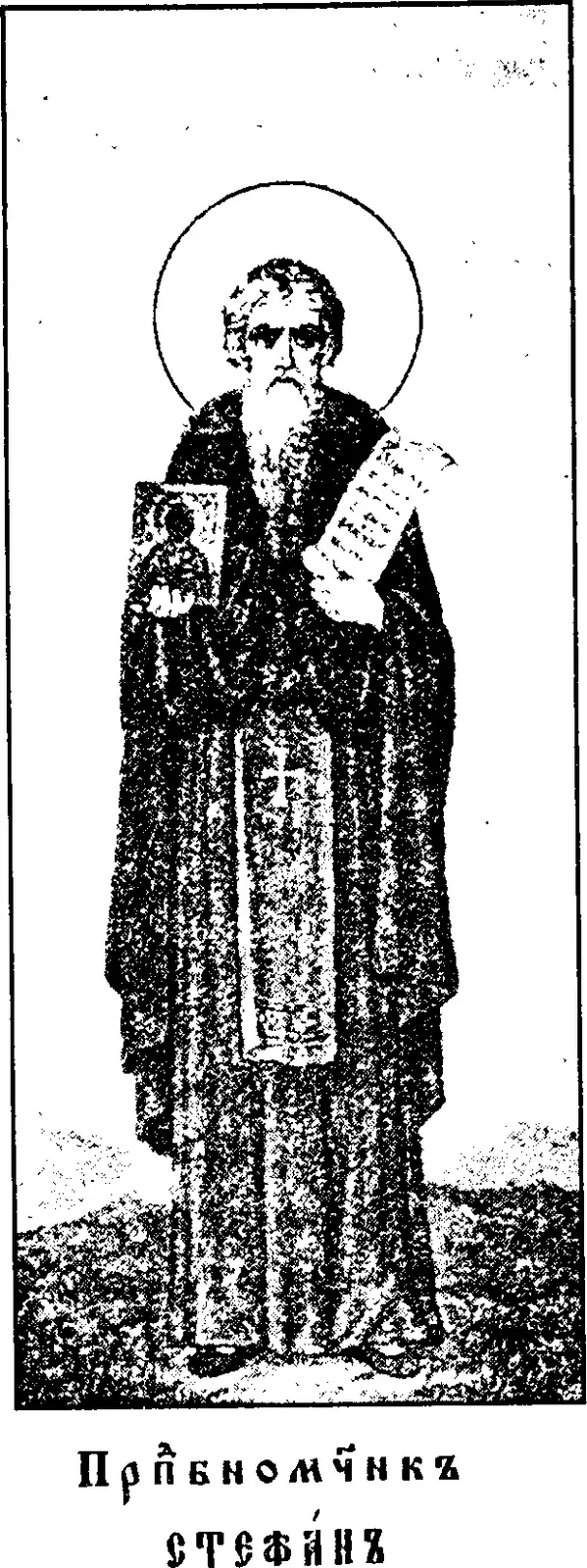
Saint Stephen the Younger was a monk of Mount Saint Auxentius, near Chalcedon, who lived for years in a cell too small to stand or lie down in. 1 When the emperor Constantine V demanded that he accept the synod that condemned holy images, he refused, and he was exiled, imprisoned and finally killed in the streets of Constantinople in 764. 12 His feast is November 28. 4
A child of the capital
He was born at Constantinople, in 714 by Butler's count and in 715 by santiebeati's, and his parents dedicated him to God before he was born. 12 They were wealthy, Butler writes, "but much richer in virtue," and gave him good teachers. 1
He grew up as the emperor Leo III, the Isaurian, began to move against the veneration of images in 726. 2 Butler says his parents, with many others, left the city rather than risk their faith, and placed their son at fifteen in the monastery of Saint Auxentius, not far from Chalcedon; the abbot gave him the habit the following year. 1 santiebeati says he first lived under the direction of a hermit and then entered the monastery. 2
His first work was fetching the community's daily provisions. 1 When his father died he went back to Constantinople, sold everything he had and gave it to the poor. One of his two sisters was already a nun in the city; he took the other, with his mother, to a monastery in Bithynia. 1
The cave on the mountain
The monastery was not a single building but a scattering of small cells over one of the highest mountains in the province. 1 When the abbot John died, Stephen, only thirty, was chosen unanimously to succeed him, and he took over his predecessor's tiny cave on the summit. 1
He read the Scriptures with the works of Saint John Chrysostom as his commentary. 1 He copied books and made nets, earning his own living and adding to what the community gave the poor; santiebeati remembers him above all as a copyist. 12 He wore a thin sheepskin and an iron belt. 1 Many came to live under his direction, and a young widow of high rank who took the name Anne became a nun in a convent at the foot of the mountain. 1
After some years he gave up the abbacy to a monk named Marinus and built himself a cell narrower still, in which, Butler says, he could neither lie down nor stand up at ease. He shut himself in at forty-two. 1
The synod of 754
Constantine V, called Copronymus, carried on his father's war on images for twenty years. 1 In 754 he gathered a synod at Constantinople, of 338 bishops by Butler's count and about 340 by the Catholic Encyclopedia's, which condemned the use of holy images and claimed to be an ecumenical council; santiebeati calls it the Council of Hieria and dates it to 753. 123 Every bishop of the empire was required to sign its acts. 3
The emperor's hostility fell most heavily on the monks. The encyclopedia records that monasteries were turned into barracks and the monastic habit forbidden. 3 Butler says the emperor knew how much weight Stephen's example carried and wanted his signature above all. A patrician named Callistus was sent to get it and came back without it. 1
Arrest and exile
Callistus was sent back with soldiers. They found Stephen so wasted by fasting and so cramped by his cell that they had to carry him down the mountain on their shoulders. 1 Witnesses were bribed to accuse him of misconduct with the widow Anne. She swore he was innocent and a holy man, and for it she was whipped and shut in a convent in the city, where she soon died. 1
Then, Butler says, the emperor laid a trap. The monasteries had been forbidden to receive novices, and a courtier named George came to the mountain begging for the habit. Stephen knew him for a courtier by his shaven face, warned him of the law, and gave way only when the man pleaded that his salvation depended on it. 1 George ran straight to the palace. The next day the emperor showed him in the habit to a crowd in the amphitheater, tore it off him and let the people trample it. 1
Soldiers dispersed the monks and burned the monastery and its church. 1 Stephen was taken to a monastery at Chrysopolis, where Callistus and several iconoclast bishops examined him. 12 He asked how a council could be called general when the pope of Rome had not approved it, nor the patriarchs of Alexandria, Antioch or Jerusalem. 1 Callistus reported to the emperor: "My lord, we are overcome: this man is very powerful in argument and learning; and despises death." 1
He was exiled to the island of Proconnesus in the Sea of Marmara. 12 Butler says many of his monks joined him there; santiebeati says his mother and sister were allowed to come, and dates the order that began it all to June 762. 12
The coin
His reputation grew in exile, and the emperor had him brought back to prison in Constantinople, in irons. 1 santiebeati places his return in 763, at a time when more than three hundred monks were in prison for their attachment to the images. 2
Brought before Constantine, he was asked whether he believed that men trampled on Christ by trampling on his image. "God forbid," he answered. 1 Then he took a coin in his hand and asked what a man would deserve who stamped on the emperor's image on it. The court cried out that he ought to be severely punished. "Is it then," said the saint, "so great a crime to insult the image of the emperor of the earth; and none to cast into the fire that of the King of heaven?" 1
His death
The sources tell his death differently. In Butler's account the emperor sentenced him to be beheaded, recalled the sentence on the way, and ordered him scourged to death in prison instead. 1 The men who did it left him alive, and the emperor cried out, "Will no one rid me of this monk?" Courtiers stirred up a mob, which dragged him from the prison through the streets by his feet until one man killed him with a club. 1
santiebeati says only that after another year of harassment he was killed on November 28, 764, by officials of the palace, during celebrations for the empress Eudoxia, and without any order from the emperor. 2 Butler follows the chronicler Cedrenus for 764, and notes that Theophanes puts his death in 757. 1
The encyclopedia records that in November 767 a great number of monks were tortured to death in various ways, and points to the Martyrology for November 28. 3 Twenty-three years after Stephen's death, the Second Council of Nicaea in 787 restored the veneration of images. 23
What is Saint Stephen the Younger the patron saint of?
Saint Stephen the Younger's feast day
Saint Stephen the Younger's feast day is November 28. The current Roman Martyrology enters him that day at Constantinople, as a monk and martyr who, under the emperor Constantine Copronymus, was subjected to various tortures for defending the cult of holy images and confirmed the Catholic truth with his blood. 4 Butler keeps him on November 28, and santiebeati says the Greek Church set his commemoration on that day and the Roman Martyrology includes him there. 12
Praying with Saint Stephen the Younger
He chose a smaller and smaller life: a cave, then a cell he could not stand in. 1 The argument over images found him there anyway, and he did not climb out to meet it; he had to be carried down. 1
His answer to the emperor was a coin held up in a courtroom. 1 It made a plain point about honor and the one it is paid to, and it cost him his life.
The story has others in it who paid too. Anne was whipped for refusing to lie about him, and died of it. 1 The monks of the mountain were scattered and their church burned. 1 Hundreds more sat in prison. 2 His witness is remembered with theirs, on the same day. 3
Saint Stephen the Younger, pray for us.
Sources
- 1.Alban Butler, "St. Stephen the Younger, M.," November 28, in The Lives of the Fathers, Martyrs, and Other Principal Saints, Vol. XI (Derby: Richardson and Son, 1842), Internet Archive.
- 2.Antonio Borrelli, "Santo Stefano il Giovane," with a notice from Avvenire, Santi, beati e testimoni, santiebeati.it (in Italian).
- 3.Adrian Fortescue, "Iconoclasm," The Catholic Encyclopedia, Vol. 7 (New York: Robert Appleton Company, 1910).
- 4.Roman Martyrology, entries for November 28, Santo del giorno, Conferenza Episcopale Italiana (in Italian).
Saints to turn to next
Others in this collection who are turned to for some of the same things.