Saint Stephen of Muret
Born about 1045; died February 8, 1124
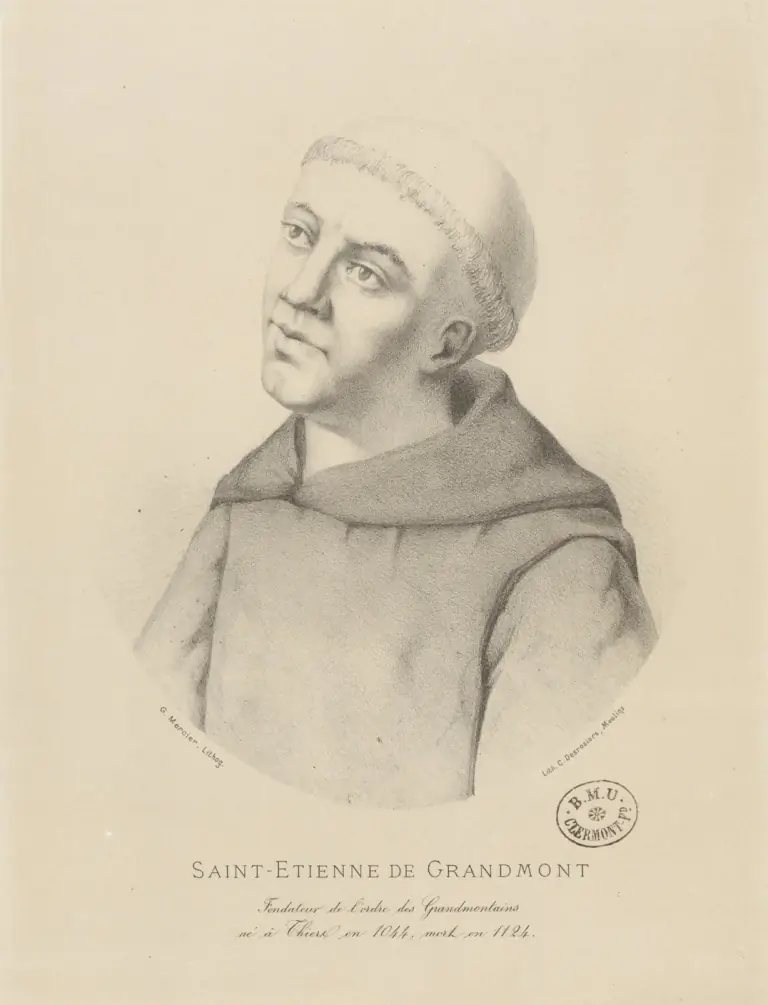
Saint Stephen of Muret was the son of a viscount of Auvergne who spent nearly half a century as a hermit on a cold, barren hill near Limoges, living in a hut of branches and receiving anyone who wanted to share that life. 13 When two papal legates asked him whether he and his companions were monks, canons or hermits, he told them they were none of these, only sinners doing penance. 3 His disciples became the Order of Grandmont, and his feast is February 8. 25
A viscount's son from Thiers
Stephen was the son of the viscount of Thiers, whom Butler calls "the first nobleman of Auvergne." 13 The Catholic Encyclopedia gives his birth as 1045. 1 Butler says his parents had prayed and fasted for him, and that he was always their favorite child. 3
The usual account of his youth runs like this. As a boy he went to Italy with his father and was left in the household of Milo, archbishop of Benevento, for twelve years; he lived among monks in Calabria without taking the habit; when Milo died he spent four years in Rome, and Pope Gregory VII gave him leave to found a community like the one he had seen in Calabria. 13 Butler tells it this way, with a footnote correcting the dates of the medieval biographer Gerard Ithier. 3
D. R. Webster, writing the Catholic Encyclopedia article in 1912, will not have it. The story "is impossible," he says: the relics of Saint Nicholas, which the father was supposedly visiting at Bari, were not there yet, and Milo was not archbishop for twelve years. 1 In the companion article on Grandmont he adds that the bull of Gregory VII "now shown to be a forgery" is what the whole traditional story rests on. 2 What is left, Webster says, is that Stephen went to Italy and saw religious whose life he wanted to imitate, "but who they were, Carthusians or Benedictines, we do not know." 1
The hut on Muret
His parents were dead by the time he came home, and the rest of his family tried to keep him in the world. He left them without telling anyone. 3 Butler describes where he stopped: Muret, "a desolate, barren mountain, in the neighborhood of Limoges, haunted by wild beasts, and of an exceeding cold situation." 3
There he made a vow and wrote it down: "I, Stephen, renounce the devil and his pomps, and do offer and dedicate myself to the Father, Son, and Holy Ghost, one God in three Persons." He kept the paper with him always, Butler says, with a ring as its sign. 3 He built a hut of branches. For a time he ate wild herbs and roots, until shepherds found him in his second summer and brought him bread, which country people went on doing for the rest of his life. 3
Butler's account of his penances is severe: a hair shirt with iron plates under one coarse garment worn summer and winter, sleep on boards laid out like a coffin, whole days of prayer prostrate on the ground. He took nothing but water until he was sixty, when a weak stomach made him allow a few drops of wine in it. 3
When this began is uncertain. Webster says Stephen "is said to have settled at Muret in 1076," and reports Martène's view that the order cannot be dated earlier than about 1100. 12 The Norwegian bishops' saints database puts the founding at Muret about 1110. 4 Butler gives two figures for the length of his stay: forty-six years in one place and "fifty years, bating two months" in another, citing an early writer, William of Dandina, for the forty-sixth year. 3
"A prison without either door or hole"
Others came to live with him. Butler says he was hard on himself and gentle with them, matching their penances to their strength, but that he gave no ground on silence, poverty and the giving up of one's own will. 3 To anyone asking to join he said: "This is a prison without either door or hole whereby to return into the world, unless a person makes for himself a breach." 3
He took the lowest place among his disciples, would not let anyone stand up for him, and at meals sat on the ground among them and read aloud from the lives of the saints. 3 The rule of Grandmont, as Webster describes it, carried that poverty into law: no lands, no cattle, no revenues, no churches with their incomes, and begging only when there was no food in the house, after telling the local bishop. 2
"We are sinners"
Late in his life two cardinals traveling to France as papal legates came up to see him; one of them, Butler says, later became Pope Innocent II. 3 They asked whether he was a canon, a monk or a hermit, and he answered that he was none of them. 3
Pressed, he said: "We are sinners, whom the mercy of God hath conducted into this wilderness to do penance." They did not wear the habit of monks or canons, he told the legates, and were "still further from usurping those names, which we respect and honor at a distance." 3 The legates, Butler says, left much edified. 3
Eight days later he knew he was going to die. He fell ill, gave his disciples his last instructions, and had himself carried to the chapel to hear Mass and receive the last sacraments. He died on February 8, 1124, repeating, "Lord, into thy hands I commend my spirit." 3 The Catholic Encyclopedia gives the same day and year, at Muret. 1
From Muret to Grandmont
His disciples buried him quietly to keep the crowds away, but the crowds came anyway. 3 Four months after his death the priory of Ambazac, a dependency of the Benedictine abbey of Saint Augustine at Limoges, claimed the land of Muret. 3 Butler says the hermits gave it up without a quarrel and moved about a league away to a rocky waste called Grandmont, taking his body with them. 3 Webster gives the same move and the same reason, a dispute over who owned Muret. 2 The order took its name from the new place. 23
Pope Clement III canonized him in 1189; Butler adds that he did so at the request of King Henry II of England. 13 Webster notes that his head was kept, in his day, in the parish church of Saint-Sylvestre, in the canton of Laurière. 1
"No rule save the Gospel of Christ"
The maxim the order kept in his name was "There is no rule save the Gospel of Christ." 2 Whether he wrote the rule that went with it is disputed. Butler, following Martène and Mabillon, says Stephen calls himself its author in the prologue and in several chapters. 3 Webster says flatly that "the founder himself left no authentic writings," and that the so-called Rule of Saint Stephen was compiled by Hugh of Lacerta at the request of the fourth prior and records the customs of Grandmont twenty or thirty years after Stephen's death. 2 The shorter article adds that the works printed under his name are not authentic. 1
What kind of order it was is disputed too. Webster says Benedictines and Canons Regular both claimed Grandmont as a branch of their own, while the Grandmontines always said they were a distinct order, and Martène thought Stephen had modeled his community on the Carthusians. 2 Butler says Mabillon proved that Stephen followed neither the rule of Benedict nor that of Augustine. 3 The Norwegian bishops' database calls Grandmont a reform of the Benedictine rule, and notes that the order has died out. 4
It flourished for a time. Webster counts sixty houses by 1170 and says the kings of England and France competed in generosity to the "bons hommes," as they were called. 2 Its golden age, in his judgment, lasted only about sixty years after the founder's death, and the last two monks were expelled from the mother house in 1787. 2 Webster's verdict on Stephen himself is short: he "did little for his disciples except offer them the example of his holy life." 1
What is Saint Stephen of Muret the patron saint of?
Saint Stephen of Muret's feast day
Saint Stephen of Muret's feast day is February 8, the day of his death. 13 The current Roman Martyrology, as the Italian bishops publish it, remembers him that day as the abbot near Muret in the territory of Limoges who founded the Order of Grandmont. 5 The Catholic Encyclopedia, Butler and the Norwegian bishops' database give the same date. 134
Praying with Saint Stephen of Muret
Much of what is told about Stephen is uncertain, and the sources say so. The story of his youth may be a later invention, and the rule that bears his name may not be his. 12 What is not in dispute is the hill, the hut and the long years on it. 123
His answer to the legates is the clearest thing he left. Asked which recognized way of life he belonged to, he would not claim any of them, and called himself and his companions sinners hoping for mercy. 3 The maxim his followers kept, that the Gospel is the only rule, says much the same thing from the other side. 2
He did not make the life easy for those who came. He called it a prison with no door back to the world. 3 Yet Butler says he was gentler with others than with himself, and that he sat on the ground among his disciples and read to them while they ate. 3
His death came with the words of Christ on the cross. Four months later his disciples were asked to leave the land, and they left it without a lawsuit, carrying his body with them. 3
Saint Stephen of Muret, pray for us.
Sources
- 1.D. R. Webster, "St. Stephen of Muret," The Catholic Encyclopedia, Vol. 14 (New York: Robert Appleton Company, 1912).
- 2.D. R. Webster, "Abbey and Order of Grandmont," The Catholic Encyclopedia, Vol. 6 (New York: Robert Appleton Company, 1909).
- 3.Alban Butler, "St. Stephen of Grandmont, Abbot," February 8, in The Lives of the Fathers, Martyrs, and Other Principal Saints, Vol. I (New York, 1895), Project Gutenberg eBook #20450.
- 4."Den hellige Stefan av Muret," Den katolske kirke, the saints database of the Catholic Church in Norway, katolsk.no (in Norwegian).
- 5.Roman Martyrology, entry for February 8, "Santo Stefano, abate," Santo del giorno, Conferenza Episcopale Italiana (in Italian).
Saints to turn to next
Others in this collection who are turned to for some of the same things.
- Saint Agnes of Bohemiac. 1200-1205 - March 1281 or 1282Poverty and simplicityPrayer
- Saint Aidan of Lindisfarnec. 590 - August 31, 651Poverty and simplicityPrayer
- Saint Alexius of RomeFifth century, by traditionPoverty and simplicityPrayer
- Saint Alonso de OrozcoOctober 17, 1500 - September 19, 1591PrayerPoverty and simplicity