Saint Alonso de Orozco
October 17, 1500 - September 19, 1591
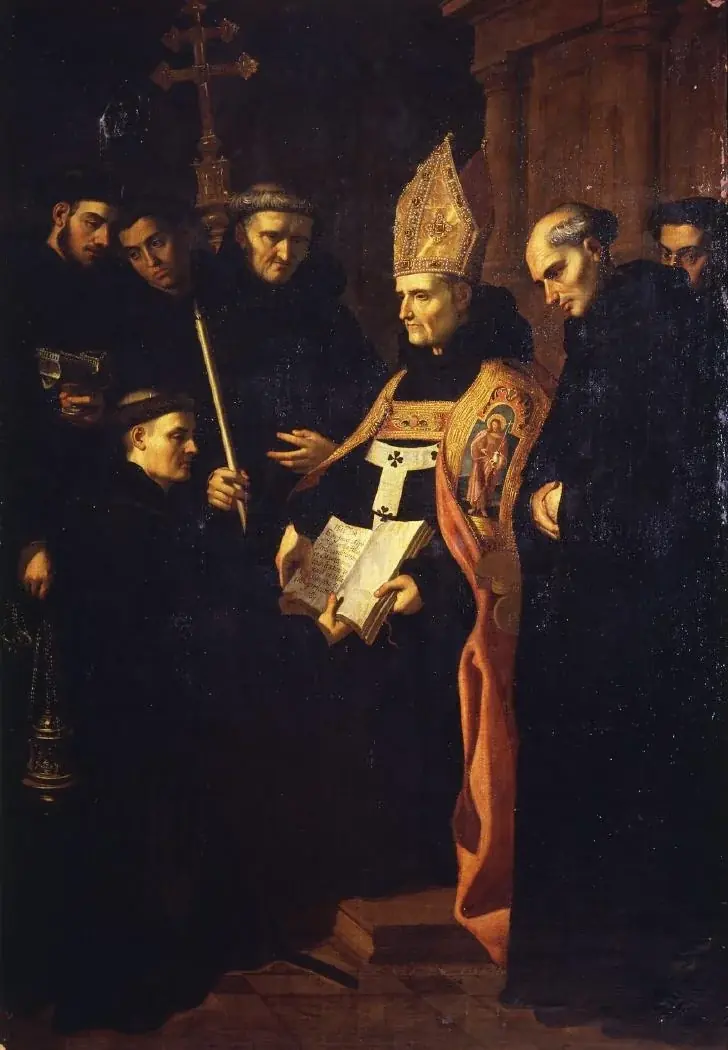
- Known for
- Royal preacher at the Spanish court from 1554, living as a poor friar; spiritual writer in Spanish and Latin 125
- Beatified
- By Leo XIII, January 15, 1882 2
Saint Alonso de Orozco was a Spanish Augustinian friar who spent the last thirty-seven years of his life as preacher to the royal court, first at Valladolid and then at Madrid, while living as a humble friar in austere poverty. 1 He slept on a table with vine cuttings for a pillow, kept his room by the door so the poor could reach him, and wrote some fifty books, many of them in Spanish so that ordinary people could read about prayer. 12 He died in Madrid on September 19, 1591, and September 19 is his feast. 15
Oropesa, Toledo and Salamanca
He was born on October 17, 1500, at Oropesa in the province of Toledo, where his father was governor of the castle. 1 He went to school in nearby Talavera de la Reina and spent three years as a choirboy in the cathedral of Toledo, where, the Holy See's biography says, "he made progress in the study of music." 1 The Maltese Augustinians add that music stayed close to his heart. 3
At fourteen his parents sent him to the University of Salamanca, where an elder brother was already studying. 1 The Augustinians of the Province of Saint Thomas of Villanova name the brother: Francisco. 2
In Salamanca, Thomas of Villanova was preaching, and he drew a number of young people into religious life. 2 The Holy See dates the decisive sermons to the Lent of 1520, on the psalm "When Israel went out of Egypt," and says that "a little later," drawn by the religious atmosphere of the friary, Alonso entered the Order of Saint Augustine there and made his profession "at the hands of Saint Thomas of Villanova." 1 The Augustinians give the dates: both brothers entered the novitiate in 1522, and Alonso was professed on June 9, 1523. 2
Years of trial
Francisco could not make his profession because he fell ill, and he died soon afterward. 2 The Augustinians write that his death made "a deep impression on Alonso who began to suffer physical and spiritual afflictions that lasted for many years," and that he went on living the religious life faithfully through them. 2
He was ordained a priest in 1527, and his superiors soon put him to preaching. From about the age of thirty he held one office after another, as prior of several houses, and the Holy See notes that for all his own austerity "his style of governing always showed him to be full of understanding." 12
He wanted to be a missionary. "Inspired by a desire for martyrdom," the Holy See writes, he set out for Mexico, but in the Canary Islands he was struck by severe arthritis and the doctors, fearing for his life, forbade him to go on. 1 The Holy See dates the attempt to 1549, the Maltese Augustinians to 1547. 13 He was ordered home. 2
Preacher to the court
In 1554, while he was prior of the friary at Valladolid, then the seat of the court, he was named royal preacher to the court of the emperor Charles V. 1 The Maltese Augustinians add that he went on preaching to Philip II. 3 When the court moved to Madrid, in 1561 by the Holy See's date or 1560 by the Maltese page's, he moved with it and lived in the friary of Saint Philip the Royal. 13
The office lay outside his superiors' authority and carried a salary, and he would have none of the privileges. 1 The Holy See's description of his life there is specific. He ate once a day, at midday. He slept no more than three hours. "A table was his bed; cut vines his pillow. His room had just one chair, a candle, a broom and some books." 1 He chose a room near the door "so that he could better attend to the poor who used to come there to ask his help." 1
He kept the choir office every day, and he went out to the sick in the hospitals, the prisoners in the jails and the poor in the streets and in their homes. 1 The people of Madrid called him "the saint of Saint Philip's," which, the Holy See says, displeased him. 1 The Roman Martyrology sums him up as an official preacher at the king's court who always showed himself austere and humble. 5
The great of the kingdom knew him too. Among the witnesses at his process, the Holy See names the Princess Isabel Clara Eugenia, the Dukes of Alba and of Lerma, and the writers Lope de Vega and Francisco de Quevedo. 1
Books and foundations
He wrote constantly, in Latin and in Spanish. The Augustinians count about fifty books, among them a commentary on the Rule, works on Saint Augustine and the saints of the order, and his own Confessions, and say he was one of the first to write on prayer and contemplation in the vernacular, "precisely to benefit ordinary people." 2 The Holy See names among others a Garden of Prayer and the Mount of Contemplation (1544), The Art of Loving God and Neighbor, and a treatise on the crown of Our Lady (1588). 1
His devotion to the Virgin was such, the Holy See says, "that he was convinced that he was writing in obedience to her command." 1 The Maltese page says the same, and that his writing grew out of his reading of the Bible. 3
He also founded houses: friaries, and monasteries of contemplative Augustinian nuns, out of a desire for reform that the Holy See says later grew into the movement of recollection in the order. 12
Death in Madrid
In August 1591 he fell ill with a fever, and went on saying Mass every day, "saying with a certain humour, God does no harm to anybody." 1 King Philip II came to see him, with the heir to the throne and the Infanta Isabel, and the Cardinal Archbishop of Toledo, Gaspar de Quiroga, fed him with his own hands and asked for his blessing. 1
He died on September 19, 1591, in the College of the Incarnation, which he had founded two years before; the Holy See notes that the building is now the seat of the Spanish Senate. 1 Francisco de Quevedo testified that the people filed past the body and broke down the church doors looking for relics, "a splinter of the bed, or a fragment of his clothes, his shoes or of his hair shirt." 1 His remains are kept by the Augustinian nuns of Madrid, in a community he founded himself. 23
Leo XIII beatified him on January 15, 1882, and John Paul II canonized him at Pentecost, May 19, 2002, with four others. 24 In the homily the pope said that his "pastoral dedication to serving the poorest in the hospitals and prisons makes him a model for all who, under the guidance of the Spirit, base their entire life on the love of God and of their neighbour." 4
What is Saint Alonso de Orozco the patron saint of?
Saint Alonso de Orozco's feast day
Praying with Saint Alonso
He wanted to die a martyr in Mexico and was sent back from the Canary Islands with arthritis. 1 The Augustinians read his life as a lesson that "God's ways are not our ways": he had his own idea of how to serve, and was given another. 2
What he was given was a court. He spent nearly forty years among kings, dukes and poets, and the sources remember the table he slept on, the broom in his room and the door the poor knocked at. 1
He wrote about prayer in the language his neighbors spoke, and he wrote because he believed he had been asked to. 12 The people who broke down the doors at his funeral wanted a splinter of his bed. 1
Saint Alonso de Orozco, pray for us.
Sources
- 1."Alonso de Orozco: biography (1500-1591)," Office for the Liturgical Celebrations of the Supreme Pontiff, for the canonization of May 19, 2002, Holy See.
- 2."September 19 - Saint Alonso de Orozco," The Augustinians, Province of Saint Thomas of Villanova.
- 3."Saint Alfons from Orozco - 19th September," Augustinian saints, Maltese Augustinian Province.
- 4.John Paul II, Homily for the Canonization of Five Blesseds, Pentecost Sunday, May 19, 2002, Holy See.
- 5.Roman Martyrology, entries for September 19, Santo del giorno, Conferenza Episcopale Italiana (in Italian).
Saints to turn to next
Others in this collection who are turned to for some of the same things.
- Saint Agnes of Bohemiac. 1200-1205 - March 1281 or 1282Poverty and simplicityPrayer
- Saint Aidan of Lindisfarnec. 590 - August 31, 651Poverty and simplicityPrayer
- Saint Alexius of RomeFifth century, by traditionPoverty and simplicityPrayer
- Saint André BessetteAugust 9, 1845 - January 6, 1937PrayerPoverty and simplicity