Saint Stephen Harding
Mid-eleventh century - March 28, 1134
- Known for
- The Charter of Charity, approved by Pope Callistus II in 1119; general chapters and visitations 125
- Patron saint of
- No patronage is stated by the sources consulted
- Feast day
- March 28 in the Roman Martyrology; January 26 with Saints Robert and Alberic for the Cistercians; April 17 in the Roman calendar of 1912 1356
- Died
- March 28, 1134; buried in the cloister of Cîteaux 1
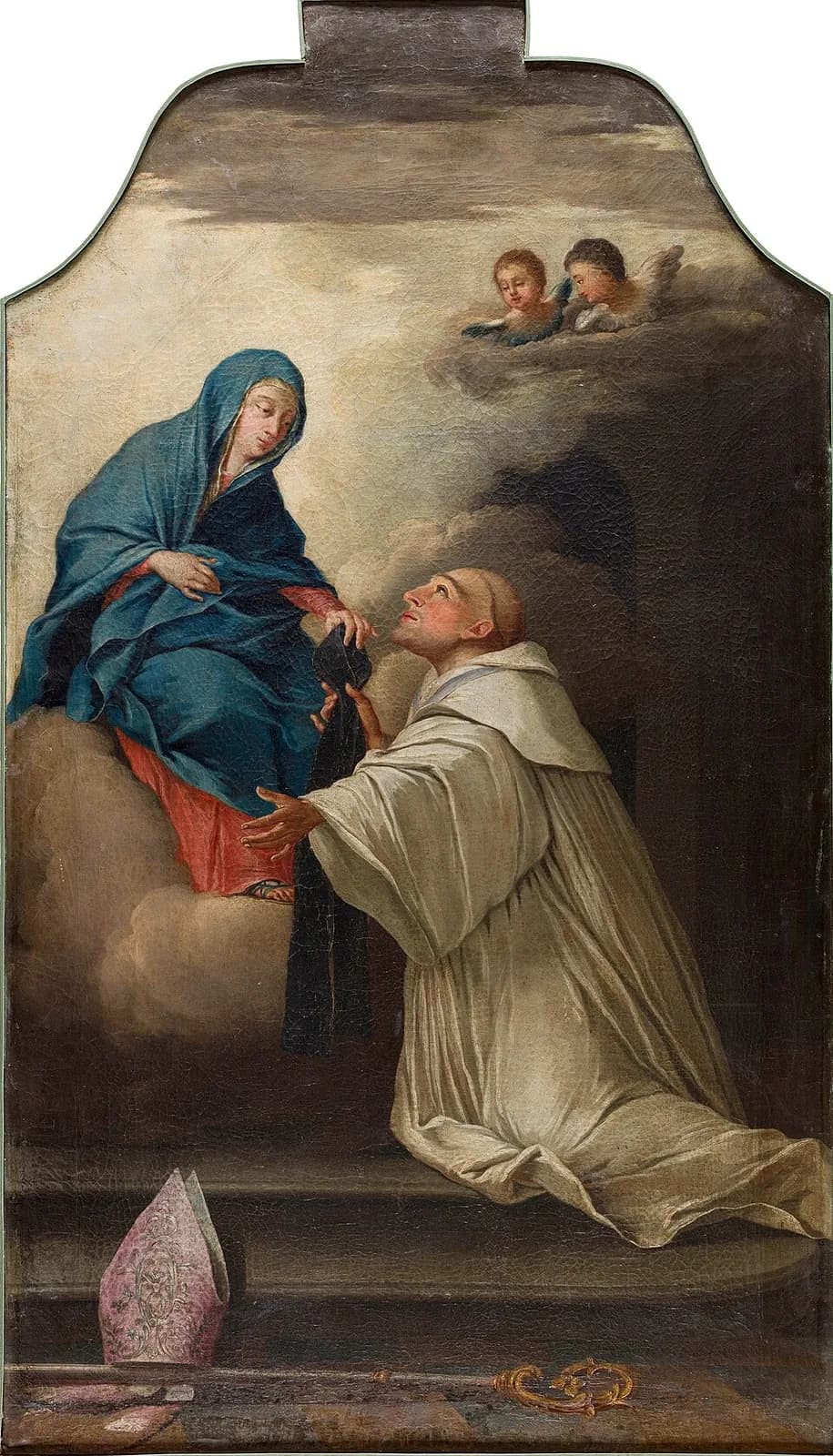
Saint Stephen Harding was an Englishman from Sherborne who joined the monks who left Molesme in 1098 to found the New Monastery of Cîteaux, became its third abbot, and wrote the Charter of Charity that bound the Cistercian houses together. 126 It was Stephen who in 1115 sent the young Bernard to found Clairvaux. 4 He died on March 28, 1134, the date on which the Roman Martyrology now remembers him; the Cistercians honor him with Saints Robert and Alberic on January 26. 135
From Sherborne to Molesme
He was born at Sherborne in Dorsetshire, England, about the middle of the eleventh century, and was educated in the monastery there. 1 CatholicCulture.org's excerpt calls him the son of an English noble. 3 He went on to study in Paris and in Rome. 1 Gildas, writing on the Cistercians in the 1913 Catholic Encyclopedia, calls him "well versed in sacred and profane science." 2
On his way back from Rome he stopped at the abbey of Molesme, and, Huddleston says, "being much impressed by the holiness of St. Robert, the abbot, joined that community." 1 There he practiced great austerities and became one of Robert's chief supporters. 1
The New Monastery
Robert had tried and failed to bring Molesme back to a strict observance of the Rule of Saint Benedict. 2 With six monks, Alberic and Stephen among them, he went to Hugh, Archbishop of Lyons and legate of the Holy See, who authorized a reform. 2 Twenty-one monks in all left for the solitude of Cîteaux, and Stephen was one of them; CatholicCulture.org's excerpt counts the three founders and another twenty. 123 They began to build on March 21, 1098, the feast of Saint Benedict. 2 The Constitutions of the Cistercians of the Strict Observance, as New Melleray Abbey quotes them, say the three abbots "gave the Benedictine tradition a particular form when in 1098 they built the New Monastery of Cîteaux." 6
What they wanted, in Gildas's words, was "to resume manual labour, to adopt a more severe regimen, and to restore in monastic churches and church ceremonies the gravity and simplicity proper to the monastic profession." 2 He adds that "they never thought of founding a new order." 2
In 1099 Robert was recalled to Molesme. Alberic became abbot and Stephen his prior. 1 When Alberic died in 1110, Stephen was elected abbot while he was away from the monastery. 1
Those were the years in which the house took its shape. Gildas says Alberic obtained a letter of Pope Paschal II, dated April 18, 1100, taking Cîteaux under the protection of the Apostolic See. 2 From then on, he writes, the monks kept the exact observance of the Rule, exchanged the black Benedictine habit for a white one, and took in lay brothers to carry the manual labor and the business of the house, so that the monks could keep the office day and night. 2
Near extinction
The community was small and getting smaller. Huddleston says no novices had come to take the place of the monks who had died, but Stephen insisted on keeping the strict observance. 1 He offended the Duke of Burgundy, the monastery's great patron, by forbidding him and his family to enter the cloister, and he was reduced to begging alms from door to door. 1 "It seemed as if the foundation were doomed to die out," Huddleston writes. 1
CatholicCulture.org's excerpt says that with so few novices Stephen began to doubt that the new house was pleasing to God, prayed for light, and received an answer that encouraged him. 3 Then Bernard arrived with thirty companions; Huddleston dates it to 1112. 13 It was, Huddleston says, "the beginning of extraordinary prosperity." 1
Clairvaux and the daughter houses
The next year Stephen founded the first daughter house at La Ferté. 1 The Cistercian Abbey of Our Lady of Dallas lists the first four in quick succession: La Ferté in 1113, Pontigny in 1114, and Clairvaux and Morimond in 1115. 5 Benedict XVI, in his general audience on Saint Bernard, said that "in 1115, Bernard was sent by Stephen Harding, the third Abbot of Cîteaux, to found the monastery of Clairvaux." 4 Bernard was twenty-five. 4
Huddleston says Stephen founded thirteen monasteries in all. 1 Gildas says that when Stephen died, the order had seventy monasteries, fifty-five of them in France. 2 New Melleray's page adds that about 1125 he founded the nuns' monastery of Tart as Cîteaux's own daughter house. 6
The Charter of Charity
Huddleston calls his powers as an organizer "exceptional." 1 Cluny had already joined its houses together; Stephen added general chapters and regular visitations, so that discipline was examined and abuses corrected. 2 To keep all his foundations alike he drew up the "Charter of Charity," the statutes for governing every monastery united to Cîteaux, which Pope Callistus II approved in 1119. 12 CatholicCulture.org's excerpt describes it as a six-page constitution setting out the relations between the houses and their abbots and holding them to charity and the Rule of Benedict. 3
The Dallas abbey explains how it worked: each abbot visited his daughter houses every year, and all the abbots met each year at Cîteaux for a general chapter. 5 It says the system was copied widely, and that the Fourth Lateran Council in 1215, pointing to the Cistercians as a model, required general chapters of the religious orders that did not already hold them. 5
He was a scholar as well. Gildas says he left a work on the Bible "superior to anything of its kind produced by any contemporary monastery," and that the library of Dijon preserves his manuscript, meant as the model for every Cistercian Bible. 2 Huddleston adds that two of his sermons and two letters survive. 1
Blindness and death
In 1133, "old, infirm, and almost blind," Huddleston writes, Stephen resigned and named Robert de Monte as his successor; the monks elected him, but the choice "proved unfortunate" and the new abbot lasted two years. 1 Stephen died on March 28, 1134, and was buried in the tomb of Alberic, his predecessor, in the cloister of Cîteaux. 1
What is Saint Stephen Harding the patron saint of?
Saint Stephen Harding's feast day
Saint Stephen Harding's feast has moved. Writing in 1912, Huddleston said it was April 17 in the Roman calendar, while the Cistercians kept it on July 15 with an octave. 1 CatholicCulture.org now lists him in the Roman Martyrology on March 28, the day he died. 3 The Cistercians keep a single solemnity of the founders of Cîteaux, Robert, Alberic and Stephen, on January 26, as both the Dallas abbey and New Melleray Abbey print it. 56
Praying with Saint Stephen Harding
He spent years keeping a house alive that seemed to be dying. 1 The monks were few, the great patron had been offended, and the abbot was begging at doors. 1 By the account CatholicCulture.org gives, he wondered whether God wanted the thing at all, and he prayed about it rather than giving it up. 3
When help came it came in a crowd, and he did not keep it. He sent the young Bernard off to found Clairvaux, and then founded house after house. 145 What he wrote to hold them together is called the Charter of Charity. 1
He ended old and nearly blind, handing his office to a man who turned out to be the wrong choice. 1 He was buried in his predecessor's tomb. 1 Benedict XVI, telling the story of Bernard, named him in one line, as the abbot who sent him. 4
Saint Stephen Harding, pray for us.
Sources
- 1.Gilbert Huddleston, "St. Stephen Harding," The Catholic Encyclopedia, Vol. 14 (New York: Robert Appleton Company, 1912).
- 2.Marie Gildas, "Cistercians," The Catholic Encyclopedia, Vol. 3 (New York: Robert Appleton Company, 1908).
- 3."March 28," Liturgical Year calendar, CatholicCulture.org, excerpting Catholic Fire.
- 4.Pope Benedict XVI, General Audience, "Saint Bernard of Clairvaux," October 21, 2009.
- 5."Cistercian Beginnings," Cistercian Abbey of Our Lady of Dallas, Irving, Texas.
- 6."Jan 26 - Solemnity of the Founders of Cîteaux," New Melleray Abbey, quoting the Constitutions of the Cistercian Order of the Strict Observance.
Saints to turn to next
Others in this collection who are turned to for some of the same things.
- Saint Robert of Molesmec. 1029 - April 17, 1111PrayerDiscernmentPoverty and simplicityWork and vocation
- Saint Agnes of Bohemiac. 1200-1205 - March 1281 or 1282Poverty and simplicityPrayerDiscernment
- Saint Agnes of Montepulcianoc. 1268 - April 1317PrayerWork and vocationDiscernment
- Saint Albert ChmielowskiAugust 20, 1845 - December 25, 1916Poverty and simplicityDiscernmentWork and vocation