Saint Robert of Molesme
c. 1029 - April 17, 1111
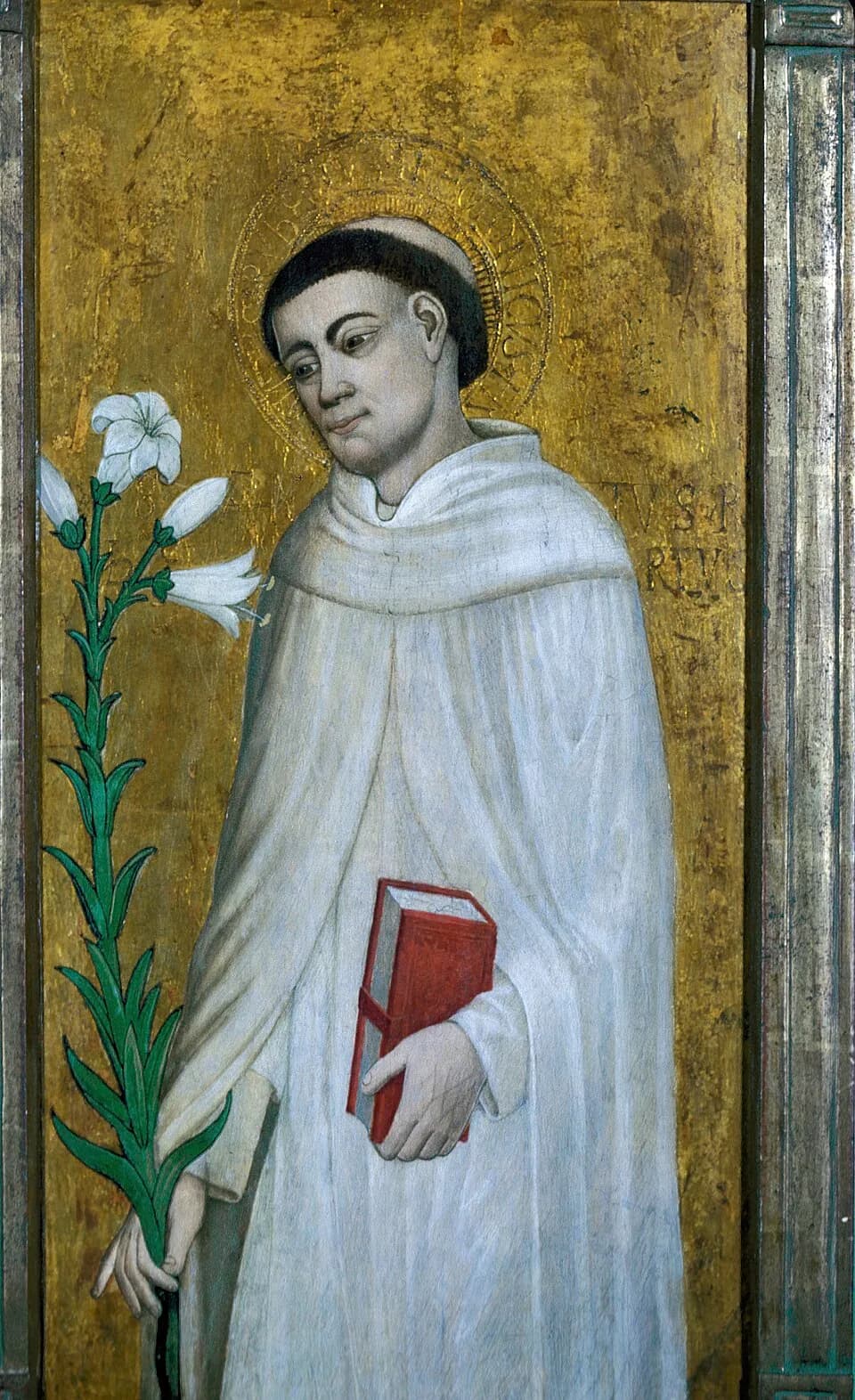
- Known as
- The first of the three founders of the Cistercian Order, with Alberic and Stephen Harding 56
- Patron saint of
- No patronage is stated by the sources consulted
Saint Robert of Molesme was the Benedictine abbot who in 1098 led twenty-one monks out of his own monastery of Molesme into the marshy woodland of Cîteaux, to keep the Rule of Saint Benedict to the letter, and so began the Cistercian Order. 123 Within about a year he was sent back to Molesme, and he died there; the Cistercians still honor him as the first of their three founders. 125 Aleteia keeps his feast on April 17, and the Cistercians keep it with Saints Alberic and Stephen Harding on January 26. 45
A monk at fifteen
He was born about 1029 in Champagne, according to Marie Gildas in the 1913 Catholic Encyclopedia, to noble parents named Thierry and Ermengarde. 1 Aleteia's profile puts his birth at Troyes in 1027. 4 At fifteen he began his novitiate in the abbey of Montier-la-Celle, near Troyes, and he later became its prior. 1 Aleteia dates his entry as a Benedictine monk to 1044. 4
In 1068 he became abbot of Saint Michael of Tonnerre, in the diocese of Langres. 1 At about that time seven hermits living in the forest of Collan asked to have him as their leader, but the monks of Tonnerre would not let him go, even though they resisted his authority at every turn. 1 Their intrigues, Gildas says, made him resign in 1071 and go back to Montier-la-Celle, and that same year he was put in charge of its priory of Saint Ayoul at Provins. 1
The hermits of Collan and Molesme
The hermits did not give up. Two of them went to Rome and asked Pope Gregory VII for the prior of Provins, and the pope agreed. 1 In 1074 Robert began to train them in the monastic life, and when Collan proved unsuitable he founded a new monastery at Molesme, in the valley of Langres, at the end of 1075. 1
At first, Gildas writes, "the primitive discipline was still in its full vigour, and the religious lived by the labour of their hands." 1 Molesme drew others looking for that life. Bruno of Reims came there before he founded the Carthusians: Mougel's article on Bruno says his first idea was to put himself and his companions under the direction of "an eminent solitary, St. Robert," though he soon found it was not his vocation. 7 Stephen Harding, coming back from Rome, stopped at Molesme and joined the community, Huddleston says, because he was "much impressed by the holiness of St. Robert." 8
Then the gifts came. Donations made the monastery wealthy, and with wealth, "despite the vigilance of the abbot, came laxity of discipline." 1 Aleteia says the income led to strife inside the house. 4 Robert tried to restore the old strictness, met so much resistance that he stepped down, and left the community to his prior, Alberic, who himself withdrew in 1093. 1 The next year the two came back to Molesme together, and in 1095 Urban II confirmed the institute. 1
Cîteaux
In 1098, still unable to reform the house, he obtained from Hugh, Archbishop of Lyons and legate of the Holy See, authority to found something new. 1 Twenty-one monks, Alberic and Stephen among them, "set out joyfully for a desert called Cîteaux" in the diocese of Châlons. 12 Aleteia counts Robert, Stephen, Alberic and eighteen others. 4
Gildas's article on the abbey describes the place: a marsh overgrown with rushes, called in the local tongue cistels, which gave Cîteaux its name, a spot "hitherto inhabited only by wild beasts." 3 The land belonged to Raynald, Viscount of Beaune, who gave it with his wife Hodierna. 3 Robert built the first monastery of the order and called it the New Monastery, to set it apart from Molesme. 3 Building began on the feast of Saint Benedict, March 21, 1098, which fell that year on Palm Sunday, and Gildas calls that day the birthday of the order. 2
What the founders wanted was a reaction against the laxity of Cluny, Gildas says: to take up manual labor again, to live more severely, and to bring back the gravity and simplicity proper to monks. 2 The Dallas abbey describes the same ideals as a balance of prayer and serious work, evangelical poverty, detachment from worldly affairs, and community life modeled on the apostles. 5
Sent back to Molesme
The monks left at Molesme appealed to Pope Urban II to have their abbot back, and the pope agreed. 12 Gildas says Robert governed Cîteaux for one year; Huddleston dates the recall 1099, and Aleteia says 1100. 248 Alberic succeeded him as abbot of Cîteaux, and after Alberic, Stephen Harding. 25
The Dallas abbey says tension had arisen between the new monastery and the house its monks had left, and that Robert went back "in order to preserve peace." 5 Some monks went with him, and those who stayed made their vow of stability to Cîteaux. 5 For this reason, it adds, Cistercian art often shows him in the black habit of a Benedictine rather than the white of the order he founded. 5
At Molesme it worked. After his return, Gildas says, the abbey "became an ardent centre of monastic life," and Aleteia says he carried out a successful series of reforms there. 14 Molesme lasted until the French Revolution. 1
Death and veneration
He died at Molesme on April 17, 1111, by Gildas's account, and was buried with great pomp in the abbey church. 1 Aleteia gives the date as March 21, 1110. 4 Gildas says Pope Honorius III authorized his veneration in the church of Molesme by letters apostolic in 1222, and that a later pontifical decree extended it to the whole Church; Aleteia says he was canonized in 1122. 14 His remains, Gildas wrote in 1912, were preserved in the parish church of Molesme. 1
What is Saint Robert of Molesme the patron saint of?
None of the sources consulted for this page names Saint Robert of Molesme as patron of anything, and the page does not supply one. 14 The Cistercians honor him as the first of their founders, and the Constitutions of the Strict Observance name him first among "the holy abbots" who built the New Monastery. 56
Saint Robert of Molesme's feast day
Aleteia keeps Saint Robert's feast on April 17. 4 Gildas says the feast was fixed at first on April 17 and later transferred to April 29. 1 The Cistercians keep one solemnity for the three founders of Cîteaux, Robert, Alberic and Stephen, on January 26, and Aleteia notes that the Benedictines join them in that common memorial. 456
Praying with Saint Robert of Molesme
His life was one attempt after another to live the Rule as it was written, among people who did not always want it. 1 Monks resisted him at Tonnerre; Molesme grew rich and slack around him; he stepped down, came back, and finally walked out with the ones who wanted what he wanted. 14
Then, after about a year in the new place, he was asked to go back. 12 The Dallas abbey says he went to keep the peace. 5 He spent the rest of his life at the house he had left, reforming it, while others built the order on what he had begun. 145
He is not remembered alone. The Cistercians keep his feast with Alberic and Stephen, the two who went with him into the marsh and stayed. 256 Aleteia sets beside his life a line from the Rule he spent it trying to keep: an abbot "should always remember what he is called, and live up the name of Superior." 4
Saint Robert of Molesme, pray for us.
Sources
- 1.Marie Gildas, "St. Robert of Molesme," The Catholic Encyclopedia, Vol. 13 (New York: Robert Appleton Company, 1912).
- 2.Marie Gildas, "Cistercians," The Catholic Encyclopedia, Vol. 3 (New York: Robert Appleton Company, 1908).
- 3.Marie Gildas, "Abbey of Cîteaux," The Catholic Encyclopedia, Vol. 3 (New York: Robert Appleton Company, 1908).
- 4.Brother Silas Henderson, S.D.S., "Saint of the Day: St. Robert of Molesmes," Aleteia, April 17.
- 5."Cistercian Beginnings," Cistercian Abbey of Our Lady of Dallas, Irving, Texas.
- 6."Jan 26 - Solemnity of the Founders of Cîteaux," New Melleray Abbey, quoting the Constitutions of the Cistercian Order of the Strict Observance.
- 7.Ambrose Mougel, "St. Bruno," The Catholic Encyclopedia, Vol. 3 (New York: Robert Appleton Company, 1908).
- 8.Gilbert Huddleston, "St. Stephen Harding," The Catholic Encyclopedia, Vol. 14 (New York: Robert Appleton Company, 1912).
Saints to turn to next
Others in this collection who are turned to for some of the same things.
- Saint Stephen HardingMid-eleventh century - March 28, 1134Work and vocationPrayerPoverty and simplicityDiscernment
- Saint Agnes of Bohemiac. 1200-1205 - March 1281 or 1282Poverty and simplicityPrayerDiscernment
- Saint Agnes of Montepulcianoc. 1268 - April 1317PrayerWork and vocationDiscernment
- Saint Albert ChmielowskiAugust 20, 1845 - December 25, 1916Poverty and simplicityDiscernmentWork and vocation