Saint Stanislaus Kostka
c. October 28, 1550 - August 15, 1568
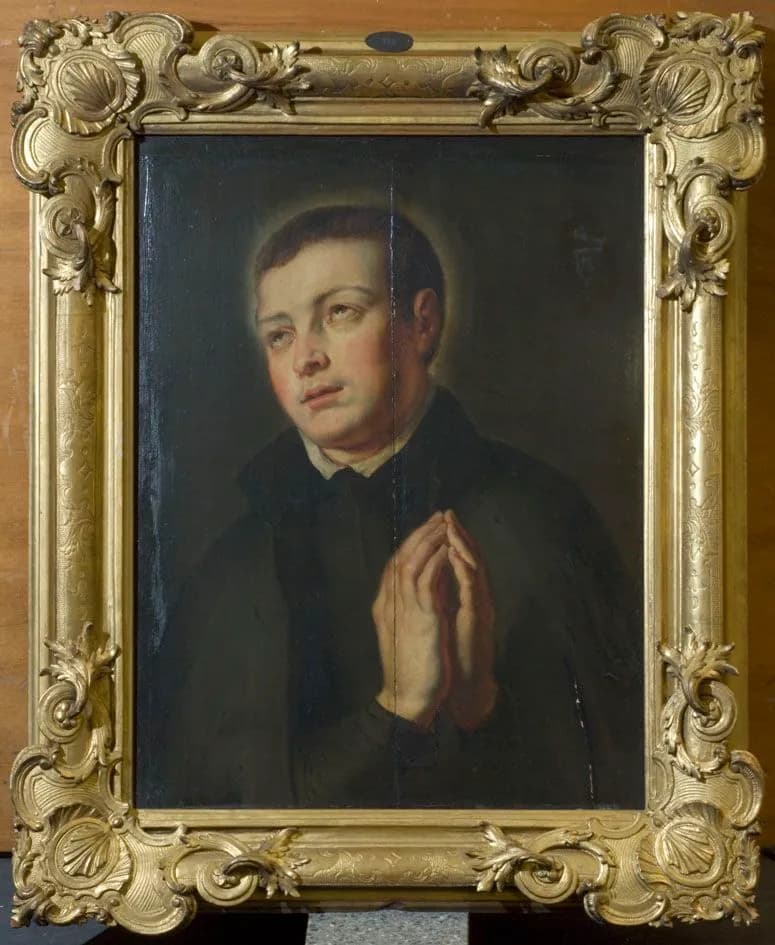
- Patron saint of
- Young people 23; Jesuit novices, students and Poland 4; novices and young Jesuits 59. Invoked for palpitations of the heart and dangerous illness 1
- Feast day
- November 13 among the Jesuits 9; September 18 in Poland 7. Vatican News lists him on August 15, the day he died 6
Saint Stanislaus Kostka was a Polish senator's son who slipped away from school in Vienna in 1567 to become a Jesuit, walked most of the way to Rome, and died there ten months into his novitiate. 18 John Paul II called him "the patron saint of the young," and the motto he is remembered by is four Latin words: "Ad maiora natus sum," I was born for greater things. 23
A noble household in Masovia
He was born at Rostkowo, near Przasnysz, about October 28, 1550. 1 Francis, writing for the 450th anniversary of his death, called Przasnysz the place of his baptism and Rostkowo the place of his birth. 3 His father, John Kostka, was a senator of the Kingdom of Poland and castellan of Zakroczym; his mother, Margaret Kryska, came from the family of the dukes palatine of Masovia. 18 There were seven children and Stanislaus was the second. 1
The 1912 Catholic Encyclopedia describes the education at home as marked by "firmness, even severity," and the Jesuit Curia says plainly that he was destined for public life. 18 Loyola Press adds that his father "was not pleased with the spiritual inclinations of his second son." 10
In 1564 he and his older brother Paul were sent with a tutor to the Jesuit college in Vienna, which had opened four years earlier. 18 They boarded with the Jesuits at first, and after seven months moved into the house of a Lutheran senator named Kimberker. 8
Vienna, and a brother
The encyclopedia, drawing on the witnesses at his beatification process, says he became known at the college for cheerfulness and fervor, and that he joined the student sodality of Saint Barbara. 1 It quotes Paul himself testifying that his brother "devoted himself so completely to spiritual thing that he frequently became unconscious." 1
Paul did not like it. The encyclopedia says his exasperation led him to treat his brother with violence, and that one night, after more blows, Stanislaus told him: "Your rough treatment will end in my going away never to return, and you will have to explain my leaving to our father and mother." 1 Paul swore at him. 1
In mid-December 1565 he fell seriously ill. 8 He asked for Viaticum, and the landlord would not allow a priest to bring the Eucharist into the house. 810 What followed is told as he told it. According to the encyclopedia, he later confided to his tutor and to a fellow Jesuit that Saint Barbara brought two angels to give him Communion, and the encyclopedia adds its own caution: "if the confidences he then made ... are to be believed." 1 The Jesuit Curia and Vatican News also describe a vision of Mary placing the Christ Child in his arms, which he understood to mean that he would not die yet and was to enter the Society of Jesus. 58
The walk to Rome
He recovered and asked to be admitted. The provincial in Vienna would not take him without his parents' consent, which he knew would not be given; the encyclopedia says the Jesuits there were afraid of the storm his father would raise. 18 Another Jesuit suggested he go to Peter Canisius, the provincial in Germany. 8
He left Vienna on the morning of August 10, 1567, telling a servant to let Paul and the tutor know he would not be home for dinner. 18 At the first opportunity he exchanged his clothes for a beggar's. 1 The two accounts of the pursuit differ. The encyclopedia says Paul and the tutor could not overtake him and offered excuses - exhausted horses, a broken wheel, the wrong road - and notes drily that "in his testimony Paul gives no explanation of his ill-luck." 1 The Jesuit Curia says his brother did follow him on the road and simply failed to recognize him in pilgrim's robes. 8
Canisius received him at Dillingen and, according to the encyclopedia, tested him for a month by putting him to work in the boarding school. 1 Loyola Press quotes what Canisius wrote of him: "I expect great things of him." 10 Canisius then sent him on with two young Jesuits to Rome, far enough from Poland that the family could not reach him. 8 He arrived on October 25, 1567. 18 The distances are given differently by each source, since each measures a different stretch: the Jesuit Curia counts 450 miles from Vienna to Augsburg, Loyola Press 350 miles from Dillingen to Rome. 810 In 2026, for the 300th anniversary of his canonization, young Polish pilgrims walked the whole route as a relay and Vatican News put it at 1,713 kilometers. 5
Francis Borgia, the general of the Society, received him. 18 On how soon he began the novitiate the sources part ways. The encyclopedia says Borgia made him wait several days because he was worn out from the journey; the Jesuit Curia says he stayed three months at the Gesu and briefly at the Roman College before going to the novitiate of Sant'Andrea. 18
Ten months as a novice
His novice master, Giulio Fazio, testified that he was "a model and mirror of religious perfection," and that despite a delicate constitution he did not spare himself any penance. 1 Loyola Press prints excerpts from the notes he kept as a novice, among them a set of questions: "What have I done for Christ? What am I doing for Christ? What ought I do for Christ?" 10
In early August 1568 he had a premonition that he would soon die. 8 On the eve of the feast of Saint Lawrence, the encyclopedia says, he wrote a letter to the Virgin asking to be taken so that he could keep the Assumption in heaven. 1 He had a fever that the infirmarian did not think serious, and on August 14 told him he would die the next day; that afternoon he lost all strength and received Viaticum. 8 The Jesuit Curia, writing in 2022, names the illness as malaria. 9
He died before dawn on August 15, the feast of the Assumption: "towards four in the morning" according to the encyclopedia, about three according to the Jesuit Curia, which adds that he said Mary was coming with angels to take him. 18 Here the sources disagree on his age. Van Ortroy's dates in the encyclopedia make him seventeen, and Vatican News in 2018 and Loyola Press both say seventeen; John Paul II, Francis and Vatican News in 2026 say eighteen. 1234510
The encyclopedia says the whole city proclaimed him a saint and people came to venerate his body. 1 He was beatified in 1605, with Paul still alive to see it, and canonized on December 31, 1726. 1 He is buried at Sant'Andrea al Quirinale. 26
What is Saint Stanislaus Kostka the patron saint of?
Saint Stanislaus Kostka is the patron saint of young people. John Paul II called him "the patron saint of the young" in 1978, and Francis addressed his 2018 message first "to the young people of whom Saint Stanislaus is patron." 23 Vatican News, reporting that message, names him patron of Jesuit novices, students and Poland. 4 The Jesuit Curia and Vatican News both call him patron of novices, and the encyclopedia notes that many religious institutes chose him as protector of their novitiates. 159 The same article says he is invoked for palpitations of the heart and in dangerous illness. 1
John Paul II noted that every November young people from all over Rome, "and especially students, pupils and novices," visit his tomb. 2
Saint Stanislaus Kostka's feast day
The feast of Saint Stanislaus Kostka is November 13 in the Society of Jesus, which marks it as the feast of the patron of its novices. 9 In Poland it is kept on September 18; Vatican News's Polish service reported Mass for that feast at the tomb of John Paul II in 2025. 7 Vatican News's Italian Saint of the Day lists him on August 15, the day he died. 6
Praying with Saint Stanislaus
John Paul II, speaking about the virtue of fortitude, chose him as his example, and the choice is worth noticing. He described him as "very sensitive and tender, yet very courageous," and said that his decision "met with firm opposition on the part of his circle." 2 The opposition was his father and his brother, and the sources describe him meeting it by leaving without their permission.
The questions in his novice notes are plain ones, and they look backward, at the present and forward: what have I done, what am I doing, what ought I to do. 10 He had ten months to try to answer the third.
Francis framed his short life with John Paul II's image of "a great cross-country race," from Rostkowo through Vienna to Rome, and wrote that the freedom he shows young people "is not a blind race, but rather the ability to discern the goal." 3 The walk is the most famous thing about him, and it was undertaken because the people nearest to him would not let him go.
Canisius expected great things of him, and he died before he could do any of them. 10 The sources record the ten months, a letter written to the Virgin, a fever that was not taken seriously, and a city that came out to venerate his body. 18
Saint Stanislaus Kostka, pray for us.
Sources
- 1.Francis Van Ortroy, "St. Stanislas Kostka," The Catholic Encyclopedia, Vol. 14 (New York: Robert Appleton Company, 1912).
- 2.John Paul II, General Audience, November 15, 1978 (on the virtue of fortitude). Libreria Editrice Vaticana.
- 3.Francis, Message for the 450th Anniversary of the Death of Saint Stanislaus Kostka, August 15, 2018. Libreria Editrice Vaticana.
- 4."Pope: St. Stanislaus teaches youth to run towards holiness," Vatican News, August 15, 2018.
- 5."A pilgrimage in the footsteps of St. Stanislaus Kostka reaches Rome," Vatican News, September 2026.
- 6."S. Stanislao Kostka, religioso gesuita," Santo del giorno, August 15, Vatican News (Italian).
- 7."Bp Stepnowski: sw. Stanislaw Kostka - mlody czlowiek, ktory wiedzial czego chce," Vatican News (Polish), September 2025.
- 8.Tom Rochford, SJ, ed., "Saint Stanislaus Kostka," Saints and Blesseds, The Society of Jesus (General Curia).
- 9."Being a novice means being called to know one's interior self better," Communications Office of the General Curia, The Society of Jesus, November 14, 2022.
- 10."St. Stanislaus Kostka, SJ (1550-1568)," Ignatian Voices, IgnatianSpirituality.com, Loyola Press.
Saints to turn to next
Others in this collection who are turned to for some of the same things.