Saint Spyridon of Trimythous
d. c. 348
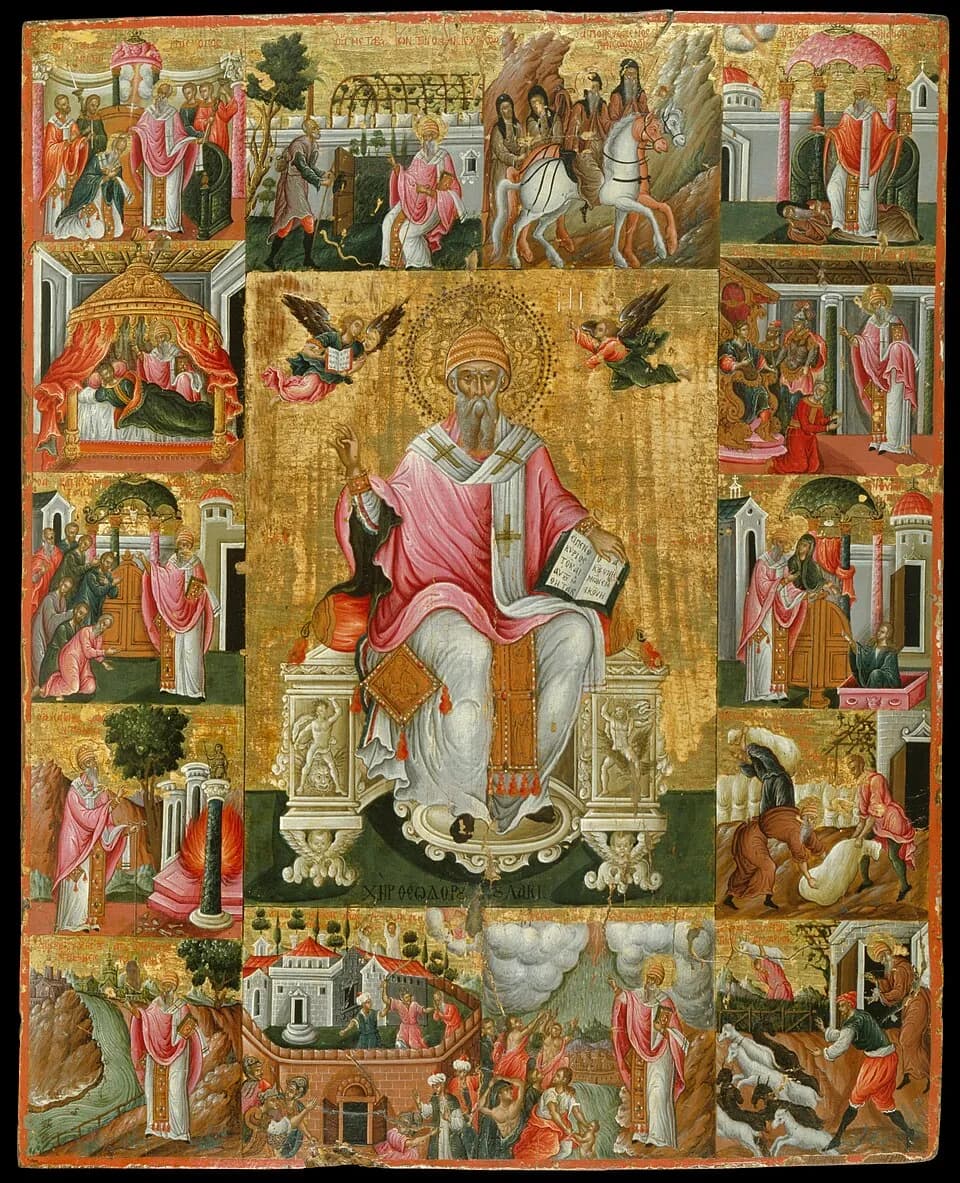
Saint Spyridon was a Cypriot shepherd with a wife and children who was chosen bishop of the small town of Trimythous early in the fourth century and went on herding his own sheep. 126 He sat among the bishops at the Council of Nicaea in 325, and the two early church historians who wrote about him remembered him chiefly for his kindness to thieves, debtors and strangers. 12 His relics have been on the Greek island of Corfu since about 1460, and the current Roman Martyrology keeps his feast on December 12. 468
A shepherd made bishop
Nearly everything known about Spyridon comes from two early historians of the Church, Socrates and Sozomen. Neither claims to have known him. Socrates says he had his stories "from many inhabitants of Cyprus" and from a Latin work by the priest Rufinus; Sozomen appeals to "the fame which still prevails about him." 12 Katolsk.no, the website of the Catholic Church in Norway, warns that most of what survives is anecdote of a legendary or uncertain kind. 6
He was born on Cyprus in the third century. 6 Sozomen sums up his station in a sentence: "He was a peasant, was married, and had children; yet was not, on this account, deficient in spiritual attainments." 2 He kept sheep, and by the Norwegian account he was unlettered and rough in his manners. 16 His fellow Christians admired him all the same, and early in the fourth century they chose him as bishop of Trimythous, a small and out-of-the-way place near Salamis. 6
Socrates puts the choice in a phrase that has clung to him ever since: "so great was his sanctity while a shepherd, that he was thought worthy of being made a Pastor of men." And the new bishop did not give up the old work. "On account of his extreme humility," Socrates writes, "he continued to feed his sheep during his incumbency of the bishopric." 1 The 1913 Catholic Encyclopedia calls him simply "the shepherd Bishop of Trimithus." 4
The thieves and the ram
Both historians tell the same first story. One night thieves got into his sheepfold and found themselves held fast, bound by no one they could see. Spyridon discovered them at daybreak, prayed, and let them go, with a lecture about earning a living honestly. 12 Then he gave them a ram. In Socrates he sends them off with it "humorously," adding: "that you may not appear to have watched all night in vain." 1
The second story concerns his daughter Irene, who kept house with him and shared his piety. 12 An acquaintance left something valuable in her keeping. She buried it for safety and died soon afterward without telling anyone where. 12 When the owner came for it, Spyridon searched the whole house and found nothing, and the man wept and tore his hair. 2 Socrates says the old bishop, "regarding this person's loss as his own misfortune," went to his daughter's tomb and prayed. She answered him and told him where the deposit lay, and he found it and gave it back. 12
Sozomen adds three more. Spyridon gave part of his harvest to the poor and lent another part freely, and he never measured anything out or counted anything back. He pointed to the storehouse and let people take what they needed or return what they owed. One man pretended to repay a loan and did not. When he came to borrow again he found the storehouse empty, and the bishop told him to consider whether he had really paid the first time: "Go, trust, and you will find." The man admitted what he had done. 2
At a meeting of the Cypriot bishops, Triphyllius of Ledri, an eloquent man who had practiced law at Berytus, was preaching on the text "Take up your bed and walk" and put another word in place of the Gospel's word for bed. Spyridon interrupted him: "Are you greater than he who uttered the word 'bed,' that you are ashamed to use his words?" 2
And once, during the Lenten fast, a traveler arrived exhausted on a day when the bishop's household was eating nothing. There was no bread in the house. Spyridon prayed, asked forgiveness, and told his daughter to cook some salt pork that happened to be there. He sat down and ate it with his guest, and when the man hesitated because he was a Christian, the bishop answered that this was exactly why he should not refuse, since "to the pure all things are pure." 2
Nicaea, Sardica and the mines
Socrates names him among the bishops at the Council of Nicaea in 325, one of two there "of extraordinary celebrity," and the encyclopedia says he attended with two other Cypriot bishops. 14 Katolsk.no notes that his name is not among those who signed the council's decrees. 6 His part in the next great dispute is better documented. Saint Athanasius, listing the bishops who put their names to the acts of the Council of Sardica in his defense, gives twelve from Cyprus, and Spyridon is one of them. 3 Triphyllius, the preacher he had corrected, is listed beside him. 3 Katolsk.no dates that council to 342 or 343 and says his presence in the list is not disputed. 6
The older Roman Martyrology says a good deal more. In the English edition of 1897 he "was one of those confessors who, after having their right eye pulled out and the joint of the left knee cut, were condemned to work in the mines," and at Nicaea "he confounded a heathen philosopher who insulted the Christian religion and brought him to the faith." 7 Katolsk.no places the maiming under the emperor Galerius and adds that the Orthodox tradition does not mention it. 6
The two early historians do not mention it either. Sozomen has a chapter on the confessors who came out of the persecution with an eye gone and a leg crippled, and it stands immediately before his chapter on Spyridon; he names Paphnutius of Egypt and Maximus of Jerusalem there, and not the bishop of Trimythous. 2 Socrates does tell of a plain-spoken man at Nicaea who silenced the professional debaters by reminding them that "Christ and his apostles did not teach us dialectics, art, nor vain subtlies, but simple-mindedness, which is preserved by faith and good works." But he calls that man a layman and a confessor and gives him no name. 1 The current Martyrology has let both claims go. Its entry says only that on Cyprus Spyridon was a true shepherd of his sheep, whose extraordinary deeds were on everyone's lips. 8
From Cyprus to Corfu
He is thought to have died about 348. 6 According to katolsk.no his relics were moved from Cyprus to Constantinople around the year 700 and kept in a chapel of the Church of the Apostles. After the city fell to the Turks in 1453, a priest named Georgios Kalochairetos carried them by way of Arta to Corfu in about 1460. 46 They are there still, standing upright in a sarcophagus in the church of Hagios Spyridon, built in 1589. 6
Corfu has its own stories about him. He is said to have averted a famine on the island in the sixteenth century, to have turned back the plague twice in the seventeenth, and in 1716 to have raised a terrible thunderstorm that put a besieging Turkish army to flight. 6 The island carries him in procession four times a year: on the Sunday before Easter, on Holy Saturday, on August 11, and on the first Sunday of November. 6
What is Saint Spyridon the patron saint of?
Saint Spyridon is the patron saint of Corfu. The encyclopedia says so in its article on the island: "The island honours as its patron the celebrated St. Spyridon, whose relics lie in the Greek cathedral." 5 Katolsk.no calls him the principal patron of Corfu and of two other Ionian islands, Zakynthos and Kefalonia. 6
None of the sources read for this page names a trade, an illness or a cause under his protection. In the Greek world, katolsk.no says, he is among the most highly venerated of all saints and is called Thaumaturgos, the wonderworker. 6
Saint Spyridon's feast day
Praying with Saint Spyridon
The stories about him are small. Nobody is martyred in them and no heresy is refuted. A man loses a night's sleep trying to steal sheep and is sent home with one. A guest is fed. A debt is called in so gently that the debtor confesses on his own. 12 Whatever their historical worth, these are what Cypriots were still telling when Socrates gathered them from people who lived on the island. 16
They show a bishop who went on being a peasant. He kept the flock, the storehouse stood open, and the Lenten fast gave way the moment a tired stranger came to the door. 12 His rebuke of Triphyllius is the one moment of sharpness in the record, and it is aimed at a preacher who, as Spyridon heard it, was ashamed of a word of the Gospel. 2
The scene at Irene's tomb is harder. A father has buried his daughter, and what brings him back to her grave is another man's lost property. Socrates says he asked God to show him "before its proper season the promised resurrection," and that when she had told him what he needed, "she once more departed." 1 The historians do not say what it cost him to go home afterward.
The current Martyrology, having set aside the mines and the philosopher, kept one phrase for him: a true shepherd of his sheep. 8
Saint Spyridon of Trimythous, pray for us.
Sources
- 1.Socrates Scholasticus, Ecclesiastical History, Book I, Chapters 8, 11 and 12, trans. A. C. Zenos, Nicene and Post-Nicene Fathers, Second Series, Vol. 2 (Buffalo: Christian Literature Publishing Co., 1890), via New Advent.
- 2.Sozomen, Ecclesiastical History, Book I, Chapters 10 and 11, trans. Chester D. Hartranft, Nicene and Post-Nicene Fathers, Second Series, Vol. 2 (Buffalo: Christian Literature Publishing Co., 1890), via New Advent.
- 3.Athanasius, Apologia Contra Arianos, Part I, section 50, trans. M. Atkinson and Archibald Robertson, Nicene and Post-Nicene Fathers, Second Series, Vol. 4 (Buffalo: Christian Literature Publishing Co., 1892), via New Advent.
- 4.Sophrone Petrides, "Cyprus," The Catholic Encyclopedia, Vol. 4 (New York: Robert Appleton Company, 1908).
- 5.Sophrone Petrides, "Corfu," The Catholic Encyclopedia, Vol. 4 (New York: Robert Appleton Company, 1908).
- 6.Per Einar Odden, "Den hellige Spiridion av Korfu (av Trimithon) ( -~348?)," Den katolske kirke (the Catholic Church in Norway), last updated April 12, 2004 (in Norwegian).
- 7.The Roman Martyrology, December 14 (Baltimore: John Murphy Company, 1897), and its index, "Spiridion, St., B., C. Dec. 14".
- 8.Roman Martyrology, entry for December 12, "San Spiridone, vescovo," as printed in "Santo del giorno," Conferenza Episcopale Italiana (in Italian).
Saints to turn to next
Others in this collection who are turned to for some of the same things.
- Saint Albert ChmielowskiAugust 20, 1845 - December 25, 1916Poverty and simplicityWork and vocation
- Saint Alexander Sauli1533 or 1534 - October 11, 1592Work and vocationPoverty and simplicity
- Saint André BessetteAugust 9, 1845 - January 6, 1937Work and vocationPoverty and simplicity
- Saint Andrew Corsinic. 1302 - January 6, 1374Poverty and simplicityWork and vocation