Saint Soter
Died about 174 or 175
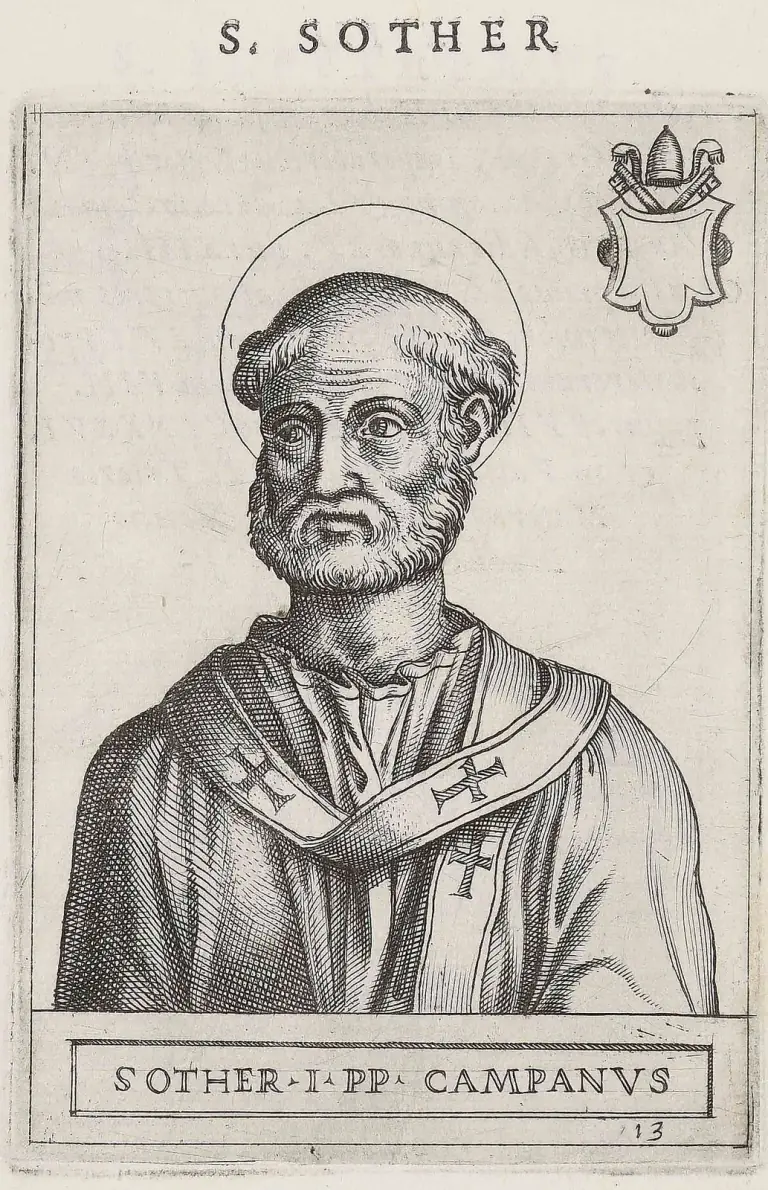
- Pope
- About 167 to 175, says Chapman, or 166 to 174 by Harnack's reckoning 1; eight years, says Eusebius 6
- Known for
- The generosity of the Roman church to poor churches and to Christians condemned to the mines, praised by Dionysius of Corinth 134
Saint Soter was bishop of Rome for about eight years in the 160s and 170s, between Anicetus and Eleutherus. 16 Nearly all that is known of him comes from a letter of thanks written by Bishop Dionysius of Corinth, praising the Roman church for sending help to poor churches and to Christians condemned to the mines, and Soter himself for increasing it, "as a loving father his children." 14 The Church keeps his memory on April 22. 3
Between Anicetus and Eleutherus
The second-century lists agree on where Soter belongs. Irenaeus of Lyons, writing under his successor, puts it in one line: "Soter having succeeded Anicetus, Eleutherius does now, in the twelfth place from the apostles, hold the inheritance of the episcopate." 9 The traveler Hegesippus, who came to Rome while Anicetus was bishop, gives the same order: "Anicetus was succeeded by Soter, and he by Eleutherus." 4
Eusebius dates his accession to the eighth year of the emperor Marcus Aurelius, after Anicetus "had held office eleven years in all," and says he "died after an episcopate of eight years." 46 John Chapman, in the 1908 Catholic Encyclopedia, gives about 167 to 175 and notes that Adolf von Harnack preferred 166 to 174. 1 The Liber Pontificalis gives nine years, six months and twenty-one days, between consulships it dates to 162 and 170. 7
The same book says Soter was "by nationality a Campanian, son of Concordius, from the city of Fundi," which is the modern Fondi, south of Rome. 7 The Norwegian bishops' saints database (katolsk.no) repeats the detail from it. 2
A letter from Corinth
While Soter was bishop the church of Rome wrote to the church of Corinth, and sent help. The Roman letter is lost. What survives is part of the answer, written by Dionysius, bishop of Corinth, "to the Romans, and addressed to Soter, who was bishop at that time," and copied by Eusebius. 4
Dionysius begins by praising a custom older than Soter. "For from the beginning it has been your practice to do good to all the brethren in various ways, and to send contributions to many churches in every city. Thus relieving the want of the needy, and making provision for the brethren in the mines by the gifts which you have sent from the beginning, you Romans keep up the hereditary customs of the Romans." 4 The brethren in the mines were Christians sentenced to forced labor. 23
Then he turns to the bishop. The custom is one "which your blessed bishop Soter has not only maintained, but also added to, furnishing an abundance of supplies to the saints, and encouraging the brethren from abroad with blessed words, as a loving father his children." 4 Chapman calls attention to "the reverence for the pope's paternal letter." 1 He also notes that the generosity of the Roman church was praised again in the third century, and that Eusebius says it was still going on in his own time. 1
Read on the Lord's day
Dionysius tells Soter what Corinth did with the Roman letter: "Today we have passed the Lord's holy day, in which we have read your epistle. From it, whenever we read it, we shall always be able to draw advice, as also from the former epistle, which was written to us through Clement." 4 The earlier letter was the one the church of Rome had sent to Corinth in the time of Pope Clement, which Irenaeus calls "a most powerful letter." 9 Eusebius quotes the passage to show that it had long been "the custom from the beginning to read it in the church." 4
In another passage from what Eusebius calls his epistle to the Romans, Dionysius ties the two churches together through the apostles. He tells the Romans that they "have thus by such an admonition bound together the planting of Peter and of Paul at Rome and Corinth," since both apostles had taught in Corinth and both "suffered martyrdom at the same time" in Italy. 5
Nobody knows for certain what the lost Roman letter said. Chapman reports that Harnack and others have tried to identify it with the text known as the Second Epistle of Clement, which has come down under Clement's name. 1 Chapman reports a later notice too: a fifth-century writer known as Praedestinatus says that Soter wrote a book against the Montanists, and that Tertullian wrote against him. Since Saint Jerome records that Tertullian did write against an Apollonius, Chapman thinks "this may be true." 1
What the later sources add
The Liber Pontificalis credits Soter with a rule that no monk should touch the consecrated altar cloth or offer incense in church. 7 Loomis notes that several manuscripts read "no nun" instead. 7 katolsk.no, reporting the rule, says that it comes from the sixth century and must be taken for what it is worth. 2 The same database says that under Soter, it is said, Easter began to be kept each year as a feast on the Sunday after the fourteenth of Nisan. 2
Soter has long been honored as a martyr. The 1897 English Roman Martyrology marks April 22 as "the birthday of St. Soter, pope and martyr," on the Appian Way. 8 katolsk.no says that he is venerated as a martyr but that there are no reliable sources for a martyrdom. 2 The current Martyrology does not call him one. 3 Eusebius records his death without comment: "About this time also Soter, bishop of the Church of Rome, departed this life." 4
The Liber Pontificalis gives two readings for his burial, near the body of Saint Peter or in the cemetery of Callistus on the Via Appia. 7 Loomis notes that the cemetery cannot yet have borne the name of Callistus, who was pope several decades later. 7 katolsk.no places him in the cemetery of Callistus. 2
What is Saint Soter the patron saint of?
Saint Soter's feast day
Saint Soter's feast day is April 22. The current Roman Martyrology, as the Italian bishops print it, enters him on that day: at Rome, Saint Soter, pope, whose outstanding charity toward the brethren, poor travelers, people in want and those condemned to forced labor Saint Dionysius of Corinth celebrates. 3
The date is old and settled. Chapman says that Soter and Pope Caius "have their feast together on 22 April, on which day they appear in most of the martyrologies," though Notker and a few others put Soter on the twenty-first. 1 The Liber Pontificalis gives April 22 as the day of his burial, and the 1897 Martyrology keeps him on that day. 78 katolsk.no adds that the shared memorial of Soter and Caius stood in the Roman calendar until 1969. 2
Praying with Saint Soter
Chapman ends his account of Soter with a short sentence: "Nothing further is known of this pope." 1 What is known is how he was seen from across the sea. A bishop in Greece, writing to thank him, chose the words "a loving father." 4
The help went to people who could do nothing in return: churches in want, and Christians sentenced to the mines. 4 Dionysius does not praise Soter for inventing the practice. He praises him for keeping what he inherited from the beginning and adding to it. 4 The current Martyrology remembers Soter for exactly that charity. 3
His letter came with words as well as goods, and the people of Corinth read it aloud at their Sunday gathering and meant to keep reading it. 4 The letter itself is lost; the gratitude is what survived. 14
Saint Soter, pray for us.
Sources
- 1.John Chapman, "Caius and Soter, Saints and Popes," The Catholic Encyclopedia, vol. 3 (New York: Robert Appleton Company, 1908).
- 2."Den hellige pave Soter," Den katolske kirke (katolsk.no), Catholic Diocese of Oslo (in Norwegian).
- 3.Roman Martyrology, entry for April 22, "San Sotero, papa," Santo del giorno, Conferenza Episcopale Italiana (in Italian).
- 4.Eusebius, Church History, Book IV, chapters 19, 22, 23 and 30, translated by Arthur Cushman McGiffert, Nicene and Post-Nicene Fathers, Second Series, vol. 1 (Buffalo: Christian Literature Publishing Co., 1890), as hosted by New Advent.
- 5.Eusebius, Church History, Book II, chapter 25, quoting Dionysius of Corinth, translated by Arthur Cushman McGiffert, Nicene and Post-Nicene Fathers, Second Series, vol. 1 (Buffalo: Christian Literature Publishing Co., 1890), as hosted by New Advent.
- 6.Eusebius, Church History, Book V, chapter 1, translated by Arthur Cushman McGiffert, Nicene and Post-Nicene Fathers, Second Series, vol. 1 (Buffalo: Christian Literature Publishing Co., 1890), as hosted by New Advent.
- 7.The Book of the Popes (Liber Pontificalis), I: To the Pontificate of Gregory I, translated by Louise Ropes Loomis (New York: Columbia University Press, 1916), life of Soter, with the translator's notes.
- 8.The Roman Martyrology, April 22 (Baltimore: John Murphy Company, 1897).
- 9.Saint Irenaeus, Against Heresies, Book III, chapter 3, translated by Alexander Roberts and William Rambaut, Ante-Nicene Fathers, vol. 1 (Buffalo: Christian Literature Publishing Co., 1885), as hosted by New Advent.
Saints to turn to next
Others in this collection who are turned to for some of the same things.
- Saint Albert ChmielowskiAugust 20, 1845 - December 25, 1916Poverty and simplicityWork and vocation
- Saint Alexander Sauli1533 or 1534 - October 11, 1592Work and vocationPoverty and simplicity
- Saint André BessetteAugust 9, 1845 - January 6, 1937Work and vocationPoverty and simplicity
- Saint Andrew Corsinic. 1302 - January 6, 1374Poverty and simplicityWork and vocation