Saint Simon the Apostle
First century
- Patron saint of
- Tanners, according to the 1912 Catholic Encyclopedia 2
- Not to be confused with
- Simon Peter, the other Simon among the Twelve 2
- Emblem
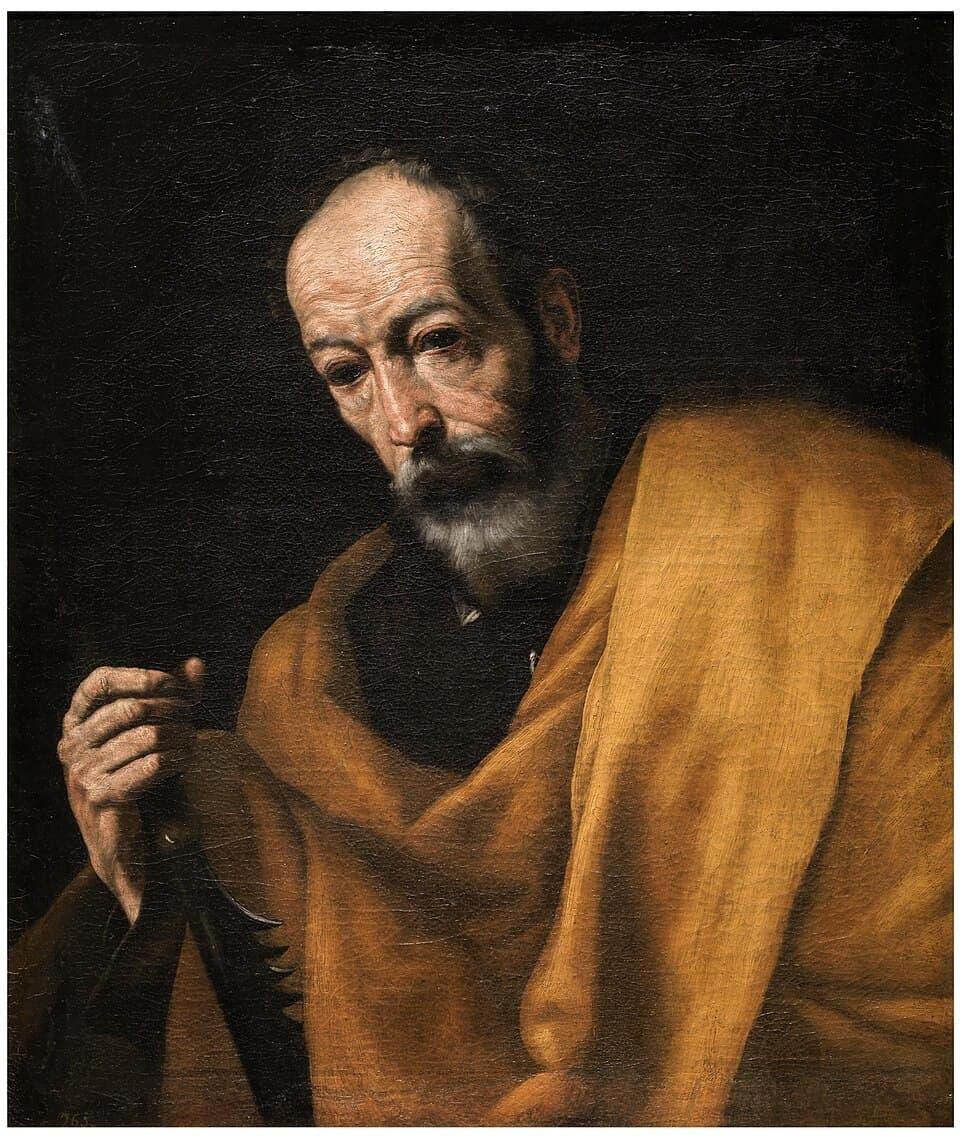
- A saw, and more rarely a lance 2
Saint Simon is the apostle the Gospels name and then leave alone. He appears in every list of the Twelve, always beside Jude Thaddeus, and what the New Testament keeps of him is a nickname: "the Cananaean" in Matthew and Mark, "the Zealot" in Luke. 12 Where he preached and how he died come from later traditions that contradict one another, and this page gives them as traditions.
Which apostle is Saint Simon?
There were two Simons among the Twelve, and the other one became Peter. The nickname is there to tell them apart. The 1912 Catholic Encyclopedia notes that "to distinguish him from St. Peter" this Simon is called Kananaios in Matthew and Mark and Zelotes in Luke and Acts. 2 Vatican News counts him as the tenth apostle in the Gospel list, just ahead of Jude. 4
Benedict XVI devoted a single catechesis to Simon and Jude together, for two reasons: they are always placed next to each other in the lists, and "there is very little information about them." 1 For Simon that is an understatement. His name occurs in the passages that list the apostles and nowhere else. 2 Jude at least asks Jesus a question at the Last Supper. 1 Simon is given no scene and no words.
Vatican News is candid about how little can be said even of his family. Many identify him with the Simon who was a cousin of Christ, the brother of James the Younger, but "as for Simon, things are shrouded in fog." 4
What "the Zealot" means
Benedict XVI explains that the two nicknames come to the same thing. The Hebrew verb qanà' means "to be jealous, ardent," and Scripture uses it both of God, who is jealous for his people, and of men like Elijah "who burn with zeal in serving the one God with unreserved devotion." 1 The encyclopedia agrees that Kananaios and Zelotes both translate the Hebrew for "the Zealous." Jerome and others took "Cananaean" to mean that Simon came from Cana, and the article calls that a mistake: a man from Cana would have been called Kanaios. 2
Whether he belonged to the Zealots as a party is where the sources part company. Franciscan Media takes the name at face value. It describes the Zealots as "an extreme of Jewish nationalism," for whom paying taxes to Rome "was a blasphemy against God," and it calls Simon "a former Zealot." 3 It does not make the movement sound gentle: many Zealots "raided and killed," and they were "chiefly responsible for the rebellion against Rome which ended in the destruction of Jerusalem in A.D. 70." 3
The encyclopedia says the opposite outright. The name, it says, "does not signify that he belonged to the party of Zealots," only that he had zeal for the Jewish law and kept it before Jesus called him. 2 Benedict XVI stands between the two. It is "highly likely," he says, "that even if this Simon was not exactly a member of the nationalist movement of Zealots, he was at least marked by passionate attachment to his Jewish identity, hence, for God, his People and divine Law." 1 All three readings agree that he was a man of zeal. They disagree about whether that zeal was ever political, and this page leaves the question where they leave it.
Simon and Matthew in the same company
Benedict draws out what the nickname means for the group around Jesus. If Simon was what the name suggests, he "was worlds apart from Matthew," a tax collector whose work was regarded as entirely impure. 1 Jesus called both. "It was people who interested him, not social classes or labels!" 1 The two men lived side by side in the same small company, and what held it together, Benedict says, was Jesus himself. 1
Franciscan Media makes a similar list of the people Jesus chose: "a former Zealot, a former (crooked) tax collector, an impetuous fisherman," the two sons of thunder, and Judas Iscariot. 3 Benedict goes a step further and calls the Twelve a prefiguration of the Church, "where there must be room for all charisms, peoples and races." 1
Where did Saint Simon preach?
Nobody knows. The encyclopedia puts it in one sentence: "Where he actually preached the Gospel is uncertain." 2 Then it lists the candidates, and they cover most of the known world. Greek tradition has him on the Black Sea, in Egypt, in North Africa and in Britain. A Latin text, the "Passio Simonis et Judae," places his work in Persia and his martyrdom at a place called Suanir, which the article thinks was probably in Colchis instead. The Armenian historian Moses of Chorene says he died at Weriosphora in Iberia, and the Georgians say he preached in Colchis. 2
Vatican News tells the Persian version. Jude, it says, traveled through Syria and Armenia into ancient Persia, met Simon there, and the two worked together "until the end," winning "tens of thousands of Babylonians" for Christ. 4 It cites Saint Fortunatus of Poitiers for the statement that both were martyred and buried at Suanir, which it calls a city in Persia. 4 Vatican News also summarizes the tradition as two apostles who were "both martyrs of the Gospel in Mesopotamia." 4
There is one more line of tradition, and it rests on a different identification. The chronicle known as the "Chronicon paschale" takes Simon to be Simon Clopas, and the Abyssinians accordingly say he preached in Samaria and was crucified as Bishop of Jerusalem. 2 The Greeks, Copts and Ethiopians identify him with Nathanael of Cana, and the Greeks also with the bridegroom at the wedding there. 2 Vatican News, describing the same Byzantine tradition, makes him the man in charge of the feast rather than the groom. 4
How did Saint Simon die?
The answer the sources support is that we do not know. The traditions above give him a martyrdom in Persia, in Colchis or in Iberia, or a crucifixion in Jerusalem. 2 The encyclopedia adds that "his place of burial is unknown." 2
The saw he holds in paintings comes from one of those traditions. "His usual attribute is the saw," the encyclopedia says, "since his body was said to have been sawed to pieces, and more rarely the lance." 2 Vatican News tells it differently. In its account, Simon and Jude were arrested and taken to the Temple of the Sun and ordered to worship Diana. When they refused, "it is said" that two demons came out of the temple, and the frightened crowd fell on the apostles and killed them. 4 Both accounts are given here as what they are.
His relics are as uncertain as his preaching. Traces of them, the encyclopedia says, are found "from Babylon to Rome and Toulouse," and in Rome they are venerated under the Altar of the Crucifixion in the Vatican. 2 Vatican News says the relics of both apostles are kept in Saint Peter's Basilica. 4
What is Saint Simon the patron saint of?
Saint Simon's feast day
Praying with Saint Simon
The one thing the Gospels kept about Simon is a word for burning devotion. 12 Benedict reads it as passion for God, for his people and for his law. 1 Franciscan Media adds a harder edge: "God needs no Zealots to bring about the kingdom by force." 3 Somewhere between those two sentences is a man who cared intensely and was called anyway, and who did not stop caring.
He was called into the same company as Matthew, a tax collector Benedict describes as worlds apart from him. 1 Benedict addresses that to "us who are often inclined to accentuate differences and even contrasts," and says that in Christ we are given "the strength to get the better of our continual conflicts." 1 For a parish or a family divided along the same lines that divided Simon and Matthew, that is the nearest thing his life offers to a lesson.
He is also, as Franciscan Media says of almost all the apostles, one of the men "who are really unknown," whose holiness "is simply taken to be a gift of Christ." 3 We do not know where he preached, how he died or where he is buried. 2 The Church keeps his feast every year regardless. 34
Benedict ends his catechesis by asking Simon and Jude to help us live the faith "without tiring, knowing how to bear a strong and at the same time peaceful witness to it." 1 Strong and peaceful together is a fair thing to ask of a zealot. It is a fair thing to ask of anyone.
Saint Simon the Apostle, pray for us.
Sources
- 1.Pope Benedict XVI, General Audience of 11 October 2006: Simon and Jude. The Holy See.
- 2.Klemens Löffler, "St. Simon the Apostle," The Catholic Encyclopedia, Vol. 13 (New York: Robert Appleton Company, 1912).
- 3."Saints Simon and Jude," Saint of the Day, Franciscan Media.
- 4."Sts. Simon and Jude (Taddeo), Apostles," Saint of the Day, Vatican News.
Saints to turn to next
Others in this collection who are turned to for some of the same things.