Saint Simon Stock
c. 1165 - c. 1265
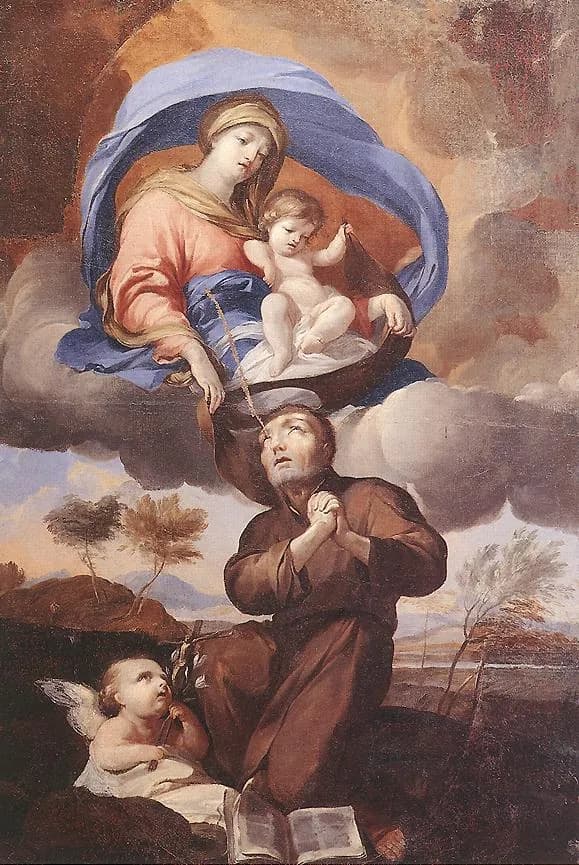
- Also called
- Simon Anglus, "Simon the Englishman" 1
- Prior general
- Elected 1247 at Aylesford, the sixth general of the order, according to the 1913 Catholic Encyclopedia 1
Saint Simon Stock was an English Carmelite, a prior general of his order in the 13th century, who died at Bordeaux around 1265 and was venerated there for his holiness and his devotion to the Virgin Mary. 134 He is best known for the vision in which, by Carmelite tradition, Mary gave him the brown scapular, and the Carmelites themselves are frank that almost everything else told of him is uncertain. 134 His feast is kept on May 16. 34
What can be known
The short note the Carmelites use for his feast says only that he was of English origin, lived in the 13th century, died in Bordeaux, and was venerated in the order for his holiness and devotion to the Blessed Virgin. 3 The order's own historians call that "an attempt" to summarize a "problematic" life. 3 The earliest references, the Carmelites say, describe an English prior general known for his holy life who died about 1265 at Bordeaux, where miracles were reported at his tomb and a local cult grew up in the 14th century. 4
Joseph Hilgers, writing in the Catholic Encyclopedia in 1912, gives him a fuller life. 1 Born in Kent about 1165, called Simon Anglus for his English birth, he is said to have lived as a hermit in the hollow trunk of an oak from the age of twelve, then to have preached on the roads, joined the Carmelites when they reached England, and spent some years on Mount Carmel itself. 1 Hilgers presents all of that as tradition. 1 The Carmelites go further and call the Kent birth and the hollow tree imaginary details, added once two separate stories about him had been merged. 4
Prior general
Hilgers says that the one thing historically certain is that in 1247 Simon was elected sixth general of the Carmelites, succeeding Alan, at the order's first chapter at Aylesford in England. 1 The Carmelites' own dictionary is less sure: it notes that his term would have to fit into one of the gaps in the list of priors general, and raises the possibility that two men named Simon, a prior general and a holy friar devoted to Mary, were later merged into one. 3
Hilgers credits his generalate with the order's spread across southern and western Europe, and above all with founding houses in the university cities: Cambridge in 1248, Oxford in 1253, Paris and Bologna in 1260. 1 He also won at least temporary approval from Innocent IV for a rule adapted to life in Europe. 1 The Carmelites had come west from the Holy Land, and Hilgers says they were still struggling everywhere for a footing, opposed by secular clergy and other orders. 14
In that difficulty, according to a writer of shortly after 1291 whom Hilgers quotes, the friars prayed to the Virgin, and "the Virgin Mary revealed to their prior that they were to apply fearlessly to Pope Innocent." 1 They did, and Hilgers calls it "an historical fact" that Innocent IV issued a letter protecting the Carmelites at Perugia on January 13, 1252. 1
The scapular vision
The story for which Simon Stock is known appears in later Carmelite writers. 1 Hilgers's earliest witness is Johannes Grossi, who wrote his "Viridarium" about 1430 and relates that the Mother of God appeared to Simon holding the scapular of the order, and promised that anyone dying in that habit would be saved. 1 In Grossi's telling, Hilgers adds, the "scapular" means the Carmelite habit itself and not the small scapular worn today, which probably came into use as a sign of the scapular confraternity only in the 16th century. 1
Hilgers concludes that Grossi's narrative and the Carmelite tradition are "worthy of belief, even though they have not the full value of historical proof." 1 In his article on the scapular he is plainer about the familiar version, set at Cambridge on Sunday, July 16, 1251: it first appears in that precise form in 1642, and "it has now been sufficiently shown that this testimony cannot be supported by historical documents." 2 He still calls its general content "a reliable pious tradition." 2
The Carmelites today put it more bluntly. Nothing is known of the place or date of the vision, they say, and it belongs to a literary form common in the Middle Ages, an exemplum, a short tale used in preaching to illustrate a point of doctrine; similar stories were told by other religious orders about their own habits. 34 In their account, a legend of a "holy Simon" who saw Our Lady with the scapular arose in the Low Countries around 1400 and was merged within a few years with the memory of the prior general. 4 They call both visions linked to the Carmelite scapular "doubtful as historical events." 4 A second claim attached to the scapular, the Sabbatine privilege, is a separate matter, which the encyclopedia leaves to an article of its own. 2
What the scapular means
The doubts about the vision have not displaced the scapular itself. 45 The Carmelites explain that it began as the "night" scapular friars wore so as never to be without their habit, and that from the end of the 15th century the order gave it to lay people as a way of joining them to the order; out of that grew the confraternities of the scapular. 4 John Paul II, writing to the Carmelite family in 2001 for what he called, "according to a venerable tradition of the Order itself," the 750th anniversary of the bestowal of the scapular, said that "the Scapular is essentially a 'habit'." 5
He named two truths it points to: the Virgin's protection "not only on life's journey, but also at the moment of passing into the fullness of eternal glory," and the awareness that devotion to her "must become a 'habit', that is, a permanent orientation of one's own Christian conduct, woven of prayer and interior life." 5 He added, of himself: "I too have worn the Scapular of Carmel over my heart for a long time!" 5
What is Saint Simon Stock the patron saint of?
None of the sources consulted names a patronage for Saint Simon Stock, and this page does not supply one. 13 He is honored in his order as the saint of the scapular, and the scapular's own feast is Our Lady of Mount Carmel on July 16, which John Paul II noted is kept on the calendar of the universal Church. 25
Saint Simon Stock's feast day
Saint Simon Stock's feast is May 16, an optional memorial in the Carmelite Order and an obligatory one in its British province. 34 Hilgers dates his death to May 16, 1265. 1 The feast has an uneven history. It was entered in the choir books at Bordeaux in 1435, reached Ireland and England by 1458, and was extended to the whole order by its general chapter in 1564. 13 The Carmelites add that it was dropped in the calendar reform of 1584, came back in the 17th century, was removed in 1972, and returned in 1978 with the Holy See's approval and the note "as long as care is taken to eliminate any relation to the problematic view of the scapular." 3
Praying with Saint Simon Stock
Very little of what is told about him can be shown to be true, and his own order says so on the page for his feast. 34 What survives is a short list: an Englishman, a prior general, a holy life, a death in Bordeaux, and a devotion to Mary that people noticed. 34 The Church kept his feast on that much.
The work that can be traced to his generation was unglamorous: getting a hermit order from the Holy Land a footing in European cities, in the universities, and in the good graces of a pope, against clergy who did not want it there. 1 The earliest account of a revelation to the order in his time, written shortly after 1291, is about exactly that: the friars prayed for help, and their prior was told to go to the pope. 1
The scapular is the part people know, and John Paul II described it as a habit in both senses: something worn, and a settled way of living, "woven of prayer and interior life, through frequent reception of the sacraments and the concrete practice of the spiritual and corporal works of mercy." 5 Read that way, it asks more of the wearer than it promises.
Holding a saint whose story is mostly legend is uncomfortable, and the Carmelites have not tried to make it easier. 34 They restored his feast in 1978 on condition that it be kept clear of a problematic view of the scapular, and they keep it every May 16. 3
Saint Simon Stock, pray for us.
Sources
- 1.Joseph Hilgers, "St. Simon Stock," The Catholic Encyclopedia, Vol. 13 (New York: Robert Appleton Company, 1912).
- 2.Joseph Hilgers, "Scapular," The Catholic Encyclopedia, Vol. 13 (New York: Robert Appleton Company, 1912).
- 3."St. Simon Stock, Religious," Calendar of Feasts and Memorials, Order of Carmelites (O.Carm.), General Curia, Rome, May 2023, quoting Emanuele Boaga, "Simone Stock," Dizionario Carmelitano (2008).
- 4."Memorial of St. Simon Stock, Religious," Calendar of Feasts and Memorials, Order of Carmelites (O.Carm.), General Curia, Rome, May 2024.
- 5.Pope John Paul II, Message to the Carmelite Family for the 750th anniversary of the Scapular, March 25, 2001.
Saints to turn to next
Others in this collection who are turned to for some of the same things.