Saint Genevieve
c. 419 or 422 - 512
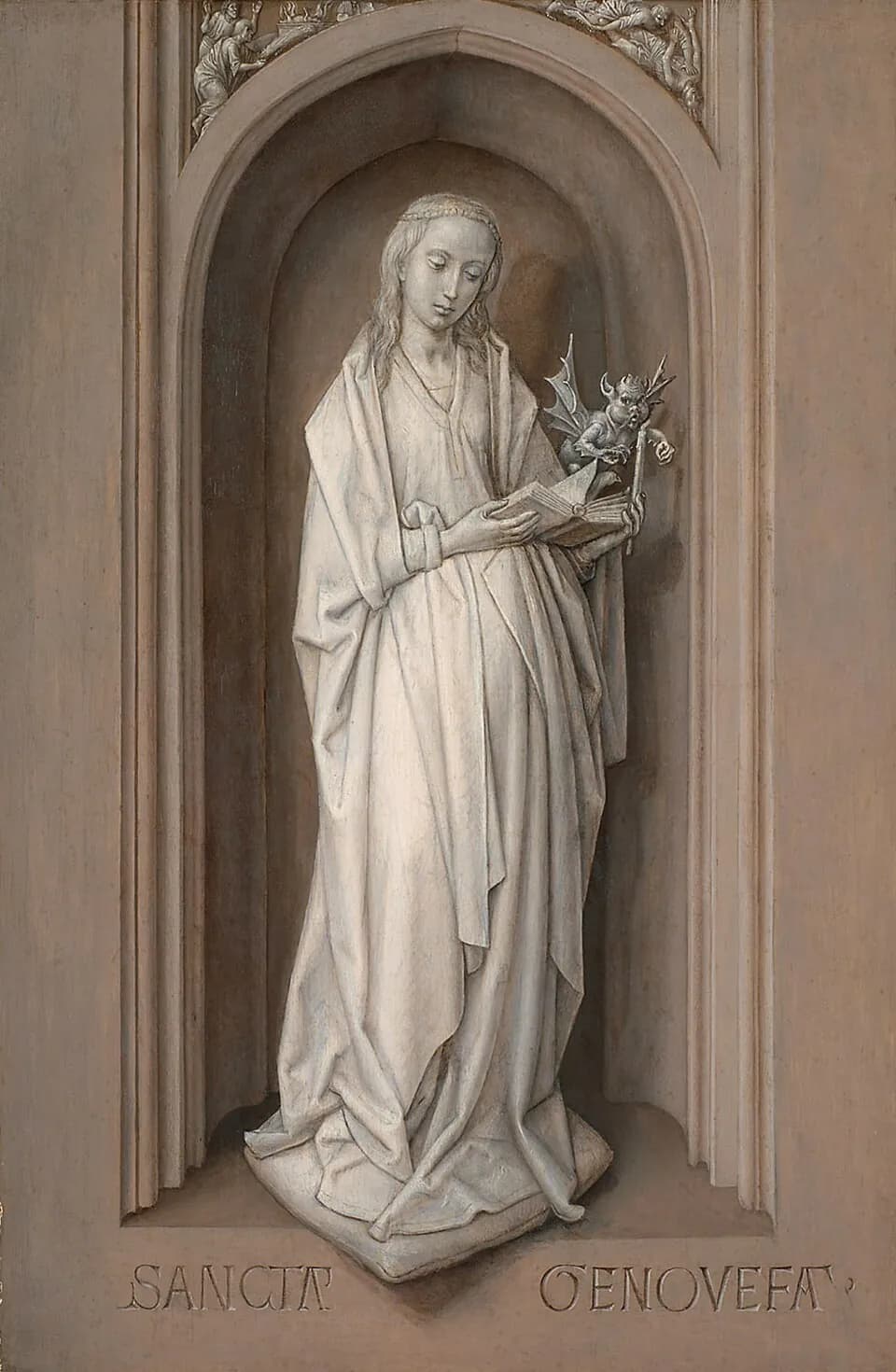
- Born
- Nanterre, about eight miles from Paris, c. 419 or 422 1
- Parents
- Severus and Gerontia 1
- Also known as
- Genovefa 3
Saint Genevieve is the patroness of Paris, a consecrated virgin who, in 451, told a city preparing to flee from Attila's Huns to trust in God, to pray and to fast. 13 The Huns turned toward Orléans and Paris was left untouched, and the story has been told about her ever since. 1 Her feast is January 3. 134
What the sources rest on
Both of the accounts this page draws on lean on an early Life of Genevieve. Loyola Press quotes a passage from "her biography" without dating it. 3 The 1909 Catholic Encyclopedia lists an edition of the Life printed in Paris in 1697 and the Bollandists' Acta Sanctorum among its sources, and tells her story from them. 1 It does not stop to weigh how reliable they are, and this page does not pretend it did.
The church she was buried in is better attested: the encyclopedia's article on Clovis counts its founding among the things history has preserved about him. 2 The same article warns that his history "has been so hopelessly distorted by popular poetry and so grossly disfigured by the vagaries of the barbarian imagination" that a true portrait of him is nearly impossible. 2 Where the two accounts differ, both are given.
A girl in Nanterre
Genevieve was born at Nanterre, a village about eight miles from Paris, around 419 or 422, the daughter of Severus and Gerontia. 1 Popular tradition made her parents poor peasants; the encyclopedia thought it "more likely that they were wealthy and respectable townspeople." 1
In 429 Germain of Auxerre and Lupus of Troyes were on their way to Britain to oppose Pelagianism and stopped for the night at Nanterre. 1 Germain preached, and a girl in the crowd caught his eye. 1 Loyola Press says she was seven, and that when he asked whether she wanted to give her life to God, "she enthusiastically said yes." 3 The encyclopedia has him speak to her parents and foretell that she would lead a holy life and draw many young women to consecrate themselves to God. 1 Before leaving the next morning he gave her a medal engraved with a cross, and told her to wear it "instead of her pearls and golden ornaments." 1
There seem to have been no convents near the village, so she stayed at home and lived a life of prayer. 1 When she formally took the veil is uncertain. The encyclopedia reports one tradition linking it to the return of the mission from Britain and another placing it at about sixteen, with two companions, at the hands of the bishop of Paris. 1 Loyola Press says she consecrated herself as a virgin at fifteen and went on living as a laywoman. 3
Paris, and a hostile welcome
After her parents died she moved to Paris to live with her godmother. 1 She gave herself to works of charity and kept a severe fast, eating no meat and breaking her fast only twice a week, for more than thirty years, until her superiors told her to ease it. 1 Loyola Press says her generosity to the poor made her known around the city. 3
It did not make her liked. The encyclopedia says neighbors, "filled with jealousy and envy," called her an impostor and a hypocrite, treated her visions and prophecies as frauds, and plotted to drown her. 1 Loyola Press says only that "for some unknown reason Genevieve met great hostility." 3 Both credit Germain with ending it: in Loyola Press's version he did so by public signs of his support. 13 The bishop of Paris then put her in charge of the virgins consecrated to God in the city. 1
Attila turns away
In 451 Attila and the Huns were crossing Gaul, and the people of Paris got ready to flee. 1 Genevieve told them to trust in God and to do penance, and promised that if they did, the city would be spared. 1 Loyola Press puts it more simply: she got the people to pray and fast for their safety. 3
The encyclopedia records that "the citizens recovered their calm, and Attila's hordes turned off towards Orléans, leaving Paris untouched." 1 Loyola Press says that the invader changed his course and the city was spared. 3 Neither source says why Attila went the way he did. Both set his turn beside her counsel and leave the connection to the reader.
Grain, captives and Clovis
Some years later Paris was besieged again, this time by the Franks. The encyclopedia names the besieger as Merowig and says Genevieve "distinguished herself by her charity and self-sacrifice," and that her influence won unusual clemency for the citizens from Merowig and from his successors Childeric and Clovis. 1
Loyola Press tells the siege through a passage from her Life. She led a convoy of boats up the Seine to Troyes for grain, and on the way back a storm tipped the ships until they took on water. 3 "Quickly Genovefa, her hands stretched toward heaven, begged Christ for assistance. Immediately the ships were righted." 3 Back in Paris she gave out the grain, and her servants kept finding loaves missing from the ovens until they saw "the needy carrying loaves throughout the city." 3 The same account says she persuaded Childeric, who had taken Paris, to release many captives, and that she became a trusted adviser to Clovis, king of the Franks. 3
Her death and her church
The encyclopedia says Genevieve first formed the plan for a church in Paris in honor of Saints Peter and Paul, which Clovis began shortly before his death in 511. 1 She died the following year, in 512, and was buried in it once it was finished. 1 Loyola Press dates her death to around 500. 3 Kurth's article on Clovis calls the same building the church of the Apostles, a foundation "undoubtedly due to Clovis," which he meant as a tomb for himself and his queen Clotilda. 2 It came to be called Sainte-Geneviève because of her burial there and the miracles reported at her tomb. 13
The encyclopedia follows that church through Norman plunder in 847 and rebuilding, and through the new church Louis XV began in 1764, which the Revolution took over in 1791 as the Panthéon. 1 Her relics fared worse. Most were destroyed by revolutionaries in 1793 and the rest scattered by a mob in 1871, though a large relic kept at Verneuil survived. 1
Paris kept turning to her in the meantime. The encyclopedia credits her intercession with saving the city from a flood in 834, and records that a plague called the mal des ardents, which killed more than 14,000 people in 1129, ended suddenly during a procession in her honor. 1 Pope Innocent II, in Paris in 1130, looked into it himself and ordered the event kept every year on November 26. 1
What is Saint Genevieve the patron saint of?
Saint Genevieve is the patroness of Paris. The Catholic Encyclopedia names her so in its first words. 1 In 2024 Pope Francis, writing ahead of the Paris Olympic Games, entrusted them "to Saint Genevieve and Saint Denis, Patrons of Paris." 5 Pope Leo XIV, speaking in Paris on September 26, 2026, invoked "the intercession of Saint Genevieve and Saint Denis, the protectors of this city." 6 In the same texts, both popes name the Virgin Mary as patroness of France. 56 None of the sources consulted gives Genevieve another patronage.
Saint Genevieve's feast day
Praying with Saint Genevieve
The best-known moment of her life is a city deciding not to run. 1 What she asked of Paris in 451 was ordinary: trust in God, fast, pray and do penance. 13 The sources record that the people listened and that Attila went elsewhere. They do not claim to know what passed in Attila's mind, and nothing here needs to.
Much of the rest is slower work. She fasted for more than thirty years, until her superiors told her to stop. 1 She was called a fraud by her neighbors and nearly killed by them, and it took a bishop's word to end it. 13 After that she was put in charge of other young women trying to live the same way. 1
In the siege the Life remembers her as practical: boats, grain, bread taken from her own ovens, captives asked for by name from a king who had taken the city. 3 Her prayer on the river is short. Her hands were raised and she asked Christ for help. 3
Paris kept her relics for centuries, carried them in procession every year, and lost nearly all of them in 1793 and 1871. 1 Popes still name her when they bless the city. 56
Saint Genevieve, pray for us.
Sources
- 1.Andrew MacErlean, "St. Genevieve," The Catholic Encyclopedia, Vol. 6 (New York: Robert Appleton Company, 1909).
- 2.Godefroid Kurth, "Clovis," The Catholic Encyclopedia, Vol. 4 (New York: Robert Appleton Company, 1908).
- 3."Saint Genevieve," Saints Stories for All Ages, Loyola Press, from Bert Ghezzi, Voices of the Saints.
- 4."St. Geneviève, Virgin," Saint of the Day, Vatican News.
- 5.Deborah Castellano Lubov, "Pope prays that 2024 Paris Olympic Games will promote 'esteem and harmony'," Vatican News, July 19, 2024, quoting Pope Francis's letter to the Mass for Peace in Paris.
- 6.Pope Leo XIV, Address to the Provincial Synodal Assembly, Catechumens and Newly Baptized, Institut Catholique de Paris, September 26, 2026.
Saints to turn to next
Others in this collection who are turned to for some of the same things.