Saint Edmund the Martyr
c. 840 - November 20, 869 or 870
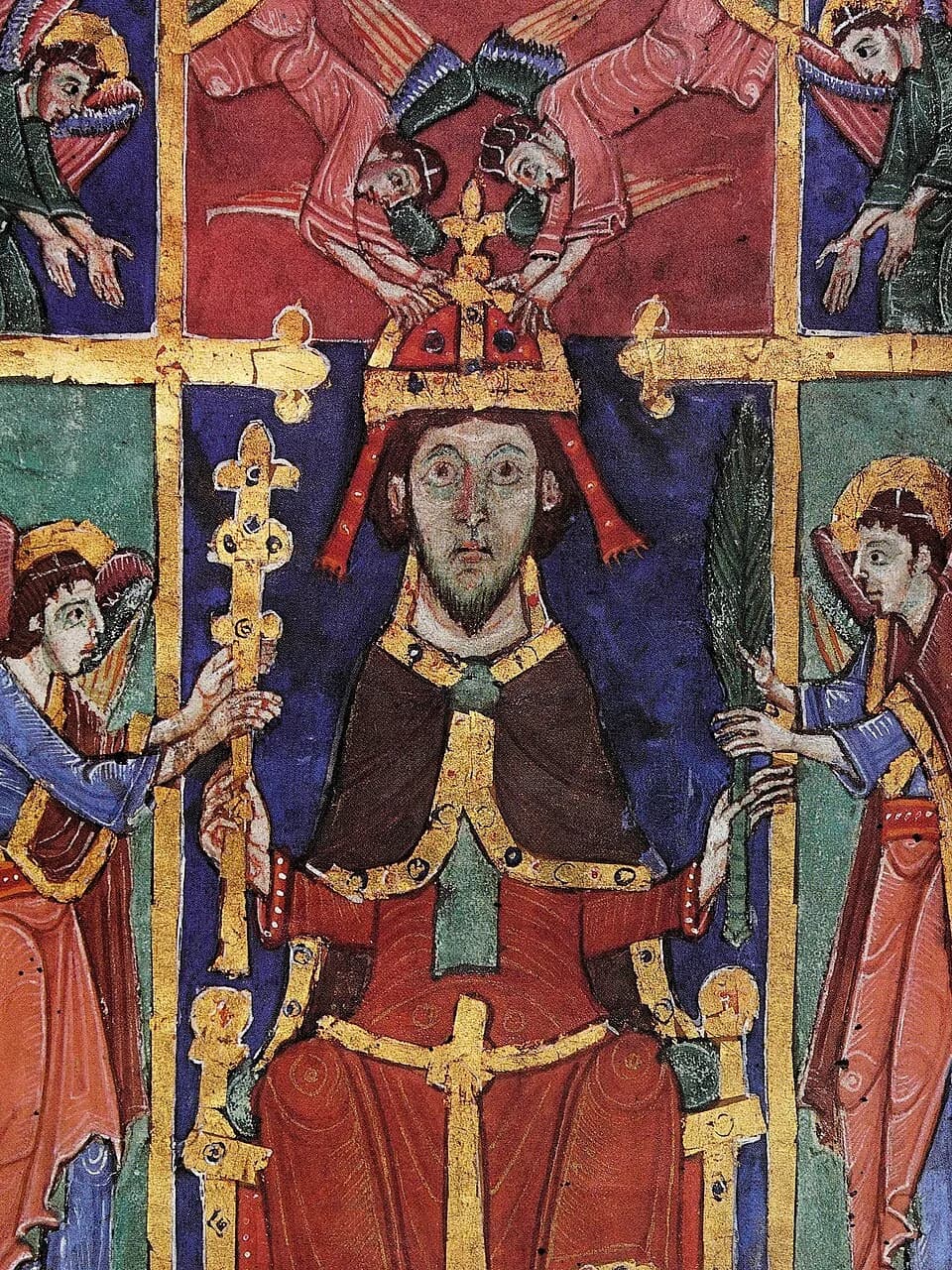
- Patron saint of
- Against plague; the Diocese of East Anglia; kings; torture victims; wolves, according to Catholic Culture 4. Invoked in time of plague and pandemic 6. Formerly patron of England 356
- Died
- November 20, 870, according to the 1909 Catholic Encyclopedia 134; the Diocese of East Anglia dates the Danish attack to 869 57
Saint Edmund the Martyr was the Christian king of the East Angles who was captured by an invading Danish army, refused their terms, and was beaten, shot with arrows and beheaded. 13 The 1909 Catholic Encyclopedia dates his death to November 20, 870, at Hoxne in Suffolk; writers for the Catholic Diocese of East Anglia put the Danish attack in 869 and the place elsewhere. 157 His body became the treasure of the abbey at Bury St Edmunds, and for centuries he was counted the patron saint of England. 236
A boy king
The encyclopedia gives his birth as about 840. 1 It says the earliest and most reliable accounts make him a descendant of the kings who had ruled East Anglia before him, and that the story of his birth at Nuremberg, as the son of an otherwise unknown King Alcmund of Saxony, belongs to "later legends." 1 Nick Walmsley, writing for the Diocese of East Anglia, tells the other version: that Edmund came over from Germany at the invitation of a royal house in danger of dying out, and landed at Hunstanton in Norfolk. 5
He was crowned in 855. 1 Duffy and Walmsley both put the coronation on Christmas Day, and Walmsley places it at Bures, near Sudbury. 35 The encyclopedia and Duffy make him about fifteen; Walmsley and Catholic Culture say fourteen. 1345 Catholic Culture, excerpting uCatholic, says the men of Norfolk hailed him first and those of Suffolk the following year. 4
The encyclopedia describes a model ruler "from the first," anxious to treat everyone with equal justice and deaf to flatterers and untrustworthy informers. 1 The one detail it gives of his private life is about prayer: he withdrew for a year to his royal tower at Hunstanton and learned the whole Psalter by heart, so that he could recite it regularly afterward. 13 Catholic Culture adds that he seemed to take King David as his model, especially in the public recitation of the Psalms. 4
The Danes
Danish raids were the reason for his reign, in Walmsley's telling: he was chosen to lead resistance to the piracy that plagued the eastern coast. 5 Catholic Culture's excerpt dates the serious threat to 866 and describes four years of a broken peace, ending when the Danes burned Thetford and the East Anglian army failed to drive them off. 4
The encyclopedia names the Danish leaders as Hinguar and Hubba. Edmund at first repulsed them, but they came back in overwhelming numbers and "pressed terms upon him which as a Christian he felt bound to refuse." 1 Duffy says the terms meant betraying his people and rejecting his faith; Catholic Culture says they would have made him a vassal under the Danes and forbidden the practice of Christianity. 34 To avoid what the encyclopedia calls "a fruitless massacre," he disbanded his troops and withdrew toward Framlingham, and on the way he was taken. 1
Not every account follows that route. Walmsley writes that the Danes attacked in 869 and that Edmund, after a battle at Thetford, escaped with some of his men, at which point "the story becomes confused." 5 The traditional version has him captured at Hoxne; "more modern scholarship," he says, points north instead, to Hellesdon near Norwich and a last fight in the marshes. 5 John Saunders, a Bury St Edmunds historian writing for the same diocese, gives Edmund's retreat as a choice "to save further bloodshed" and favors Bradfield St Clare, on the archaeologist Stanley West's research of 1978. 7
The martyrdom
Edmund was loaded with chains and brought before Hinguar, and he refused him again, "declaring his religion dearer to him than his life." 1 The Danes beat him with cudgels, tied him to a tree and whipped him. 1 Through all of it, the encyclopedia says, he kept calling on the name of Jesus, until his captors began shooting arrows at him and went on "until his body had the appearance of a porcupine." 1 Duffy uses a hedgehog for the same picture. 3 Then Hinguar ordered his head cut off. 1 Duffy gives his age as twenty-nine. 3
Walmsley passes on the legend of what happened next: that the Danes, angered by the name of Jesus on his lips, threw the head into a thicket, and that when his followers went looking for it, it "is said to have cried out 'Here! Here!'" and was found between the paws of a wolf. 5 He suggests the wolf may have been Edmund's own wolfhound. 5 Saunders tells it more briefly: the head was found in the woods guarded by a wolf, and its reunion with the body was the first miracle claimed for him. 7 Catholic Culture lists the head between a wolf's paws among the ways he is shown in art. 4
The oak at Hoxne that tradition named as the place of his death stood until 1849, according to Catholic Culture's excerpt, and when it fell an arrowhead was found in its trunk. 4 Saunders notes that wood from the oak "allegedly" used for the martyrdom was made into an alms box, given to the Catholic church of St Edmund at Bury in 1878 and still kept there. 6
Bury St Edmunds
He was buried first near where he died. 17 The encyclopedia says his relics were moved in the tenth century to Beodricsworth, the town that came to be called St Edmundsbury; its article on the abbey there gives the year as 903. 12 Saunders writes that a blind man was among those healed and that "within 30 years Edmund was proclaimed a saint." 7 Walmsley adds that the relics were taken to London for safety from 1009 to 1013, while the Danish raids continued. 5
Under Canute the abbey passed to Benedictine monks, and in 1095 the relics were solemnly moved into Abbot Baldwin's new church. 2 The shrine grew until the monastery was thought second only to Glastonbury. 2 In 1214 the barons met in the abbey church and heard Archbishop Stephen Langton read the charter that became Magna Carta. 2 Henry VIII dissolved the abbey in 1539. 2
Where the body went is a question the encyclopedia calls undecided. 2 One tradition says Prince Louis of France carried the relics off in 1217, and relics said to be Edmund's were long kept at Toulouse; in 1901 Cardinal Vaughan obtained leave to bring them to England, doubts were raised, and the Holy See's commission of inquiry published no report. 2 Saunders writes that the bones sent in 1901 were found to be a mix of male and female remains and were conceded not to be the saint's, and that they are now at Arundel. 6
What is Saint Edmund the Martyr the patron saint of?
Catholic Culture lists him as patron against plague, and of the Diocese of East Anglia, kings, torture victims and wolves. 4 Saunders names him among the saints recognized as intercessors in time of plague, with Sebastian, Roch, Giles and Rosalia. 6 He records that the people of Toulouse, struck by plague between 1628 and 1631, prayed to Edmund, whose relics they believed they had, and kept their promise to him with a new casket. 6 In 2020 the parish at Bury held a votive Mass of Saint Edmund as "one of the saints to pray to in the time of a pandemic." 6
He was once patron of England. Duffy says Edmund was regarded as such until he was partly eclipsed by Edward the Confessor under Henry II, and that George came to be recognized as patron of the English monarchy under Edward III. 3 Saunders says simply that Edmund was patron until 1348; Walmsley, that he held the title until the crusaders came home with George. 56 Catholic Culture's excerpt still names him, with George, as one of England's patron saints. 4 Duffy and Walmsley both mention a campaign to restore him. 35
Saint Edmund the Martyr's feast day
His feast is November 20, the date the encyclopedia gives for his death. 1 Duffy marks him on that day, Catholic Culture lists him that day among the Roman Martyrology's commemorations, and the Diocese of East Anglia keeps it as the feast of one of its patrons. 345
He is not on the national calendar for England published by the Liturgy Office of the bishops of England and Wales, which lists no celebration on November 20 and keeps November 16 for a different Edmund, the archbishop Edmund of Abingdon. 8 The two are easily confused. Catholic Culture also gives a collect "for Saint Edmund the Martyr, King" under his feast of November 20. 9
Praying with Saint Edmund the Martyr
The thing the encyclopedia chose to record about his piety was a year spent learning the Psalms by heart, and the thing it recorded about his death was that he kept saying the name of Jesus. 1 Those are the two facts about his inner life that the sources agree on, and they are of a piece.
He was a king who lost. The accounts of the war disagree about the route and the battlefield, but none of them gives him a victory at the end. 157 The encyclopedia and Saunders both describe him giving up the fight rather than spend his men's lives on it, and then refusing the terms that would have saved his own. 17
Much of what came afterward is legend, and the diocese that keeps his feast tells it as legend: the head, the voice in the wood, the wolf. 57 The relics are another uncertainty, honestly admitted; the encyclopedia says their fate "has never been decided." 2
Those who ask his prayers in time of plague are following people who did the same before them, at Toulouse in the seventeenth century and at Bury in 2020. 6 The sources record that they prayed. They do not claim to know what the prayers achieved.
Saint Edmund the Martyr, pray for us.
Sources
- 1.George Phillips, "St. Edmund the Martyr," The Catholic Encyclopedia, Vol. 5 (New York: Robert Appleton Company, 1909).
- 2.Edwin Burton, "The Abbey of Bury St. Edmund's," The Catholic Encyclopedia, Vol. 3 (New York: Robert Appleton Company, 1908).
- 3.Patrick Duffy, "Nov 20 - St Edmund martyr, king, (841-870)," Saints of the Day, CatholicIreland.net, November 20, 2012.
- 4."November 20," Liturgical Year, Catholic Culture (Trinity Communications), with entries excerpted from CatholicSaints.info and uCatholic.
- 5.Nick Walmsley, "East Anglia's own former Patron Saint of England," Catholic Diocese of East Anglia, October 28, 2023.
- 6.John Saunders, "Could prayers to St Edmund help end the pandemic?" Catholic Diocese of East Anglia, May 4, 2020.
- 7.John Saunders, "Faith, Power and Legacy in Bury St Edmunds," Catholic Diocese of East Anglia, February 9, 2026.
- 8."National Calendar for England," Liturgy Office, Catholic Bishops' Conference of England and Wales.
- 9."Collect for Saint Edmund the Martyr, King," Catholic Prayers, Catholic Culture (Trinity Communications).
Saints to turn to next
Others in this collection who are turned to for some of the same things.