Saint Simon de Rojas
October 28, 1552 - September 29, 1624
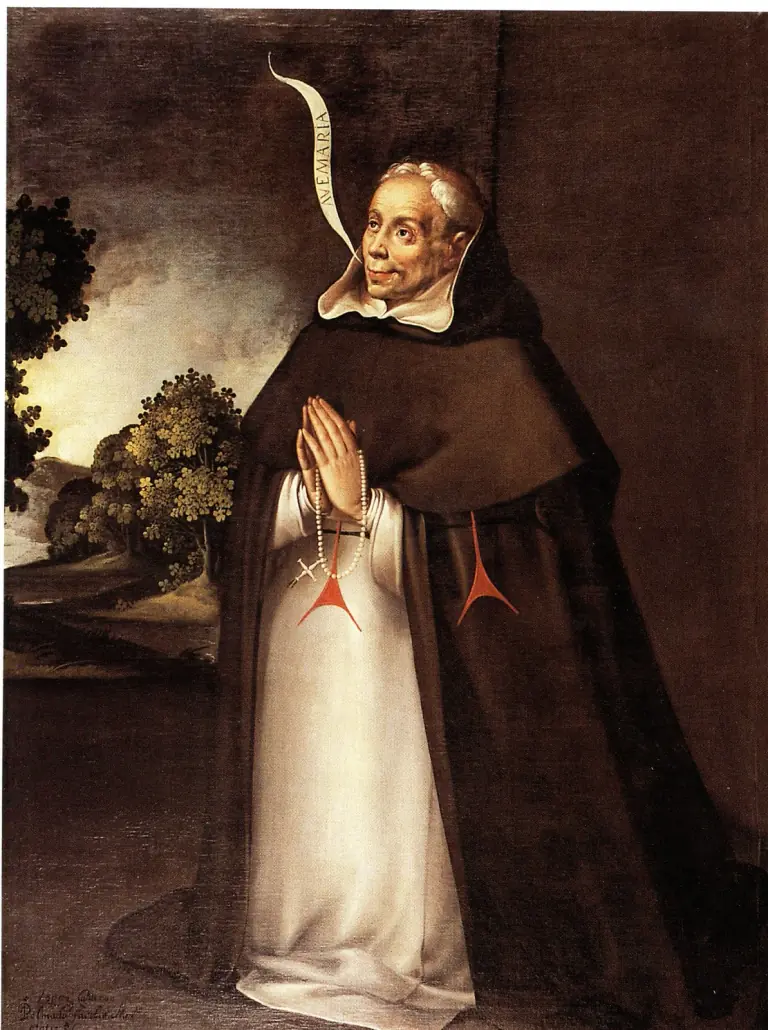
- Born
- Valladolid, Spain, October 28, 1552 1
- Order
- Order of the Most Holy Trinity, professed October 28, 1572 1
- Founded
- The Congregation of the Slaves of the Sweet Name of Mary, April 14, 1612 1
- At court
- Tutor to the royal princes from 1619; confessor to Queen Isabel of Bourbon from January 1, 1622 12
- Beatified
- By Clement XIII in 1766, on March 19 (English text of the Holy See biography) or May 19 (Italian text) 12
- Feast day
- September 28 5
Saint Simon de Rojas was a Spanish Trinitarian friar who became confessor to the queen of Spain, founded a confraternity in Madrid through which the king and his children served the poor, and repeated the greeting "Ave Maria" so constantly that people called him "Father Ave Maria." 13 The Roman Martyrology remembers that in the royal household he never accepted a carriage or a salary. 5 He died in Madrid on September 29, 1624, and his feast is September 28. 15
First words
He was born at Valladolid in Castile on October 28, 1552, to Gregorio and Constanza, whom the Holy See's biography calls a devout couple constantly at prayer to the Virgin. 1 It credits his mother, "the virtuous Constanza," with planting the love of Mary in him. 1
He was slow as a small child, and stammered. 1 When at fourteen months he said his first words, the biography says, they were "Ave, Maria." "He was only repeating the prayer so frequently recited by his parents." 1
A Trinitarian
At twelve he entered the Trinitarian friary of Valladolid, and he made his profession there on October 28, 1572, the day he turned twenty. 1 He studied at the University of Salamanca from 1573 to 1579, was ordained a priest in 1577, and taught philosophy and theology at Toledo from 1581 to 1587. 1
From 1588 until his death he served as superior of one friary after another in his province, and was sent twice as apostolic visitor to his own province of Castile and once to Andalusia. 1 He was elected Provincial of Castile on May 12, 1621. 12
The Trinitarians, as John Paul II reminded their pilgrims the day after the canonization, were founded by Saint John of Matha some eight hundred years before. 4 Their charism was the ransom of captives. "Faithful to the Trinitarian charism," the biography says, Simon "promoted the ransom of captives," relieved the poor and consoled the sick and the destitute. 1 The pope, in his homily, called that charism "redeeming and merciful," and said that the poor saw in "Father Rojas," as the people called him, their protector, defender and father, and thought of him as one of themselves. 3
The Slaves of the Sweet Name of Mary
On April 14, 1612, he founded the Congregation of the Slaves of the Sweet Name of Mary. 1 It was meant for lay people of every social class, and its members, who came to include the king and his children, bound themselves to honor Mary by giving "maternal help to her favorite children: the poor." 1 The biography says the work still continued in Spain at the time of his canonization. 1
The biography explains the name. He held that "for everyone to be completely of God, as Mary had been, it was necessary to become her slaves, or better, slaves of God in Mary." For him, belonging to her meant "Totus tuus," in order to be united more closely to Christ, and in him, through the Spirit, to the Father. 1 John Paul II called the confraternity's members mostly lay people committed to sharing their goods and helping the poor, and said that Simon worked tirelessly to make its charitable work grow. 3
At the court of Spain
In 1619 he was named tutor to the royal princes, and on January 1, 1622, he was chosen as confessor to Queen Isabel of Bourbon. 12 He accepted duties at court, the biography says, "only on the condition that he be able to continue his work with the poor, whom he helped in a thousand ways, always with a smile on his face and at any hour of the day or night." 1
The Roman Martyrology adds the detail that has stayed attached to him: as a member of the queen's household he never accepted a carriage or any payment, and among royal splendors he always showed himself humble, poor, merciful to the wretched and ardent in devotion to God. 5
He used his position for the Ave Maria. Through his influence, the biography says, the angelic greeting was carved "in letters of gold on the facade of the royal palace in Madrid." 1 He had thousands of images of the Virgin printed with the words "Ave Maria" and sent abroad, and he had rosaries made of seventy-two blue beads on a white cord, for the Assumption and the Immaculate Conception and for the seventy-two years that, by the belief of the time, Mary had lived. He sent them everywhere, even to England. 1
On June 5, 1622, he asked the Holy See to approve a liturgical text he had written in honor of the Sweet Name of Mary, which Pope Innocent XI later extended to the universal Church. 1
"Father Ave Maria"
The biography counts him "one of the greatest contemplatives of his time," and says that in his book on the greatness of prayer he wanted the contemplative life joined to the active one through works of mercy. 1 John Paul II said that for all his activity he gave to contemplative prayer "long stretches of time during the day and also during the night, after the common office at midnight." 3
He said "Ave Maria" so often that he was called "Father Ave Maria," and the painters who portrayed him, the biography notes, put the greeting on his lips. 1 The pope recalled two of his sayings: "Lady, let me be all yours, and I shall have nothing to fear," and, as advice, "Seek, do or think nothing that is not in homage to Our Lady." 3 Lope de Vega, the biography says, compared him to Saint Bernard and to Saint Ildefonsus of Toledo. 1
Death and canonization
He died in Madrid on September 29, 1624. 12 His funeral, the biography says, "took on the aspect of an anticipated canonization": for twelve days the best-known preachers of Madrid praised his virtues. 1 On October 8, impressed by the unanimous veneration, the papal nuncio ordered the opening of the process. 1
Clement XII declared his virtues heroic on March 25, 1735. 1 Clement XIII beatified him in 1766; the English text of the Holy See's biography gives the date as March 19, the Italian text as May 19. 12
John Paul II canonized him on July 3, 1988, together with Rose Philippine Duchesne, and noted that Providence had made his canonization the last of the Marian Year. 13 He called him "a man full of the Holy Spirit, docile to his promptings and deeply evangelical in every moment of his life." 3
What is Saint Simon de Rojas the patron saint of?
Saint Simon de Rojas's feast day
Saint Simon de Rojas's feast day is September 28. The current Roman Martyrology, in the text published by the Italian bishops, enters him on that day at Madrid, as a priest of the Order of the Most Holy Trinity for the ransom of slaves. 5
The Holy See's biography gives the day of his death as September 29, 1624. 12 None of the sources consulted explains why the Martyrology keeps him on the day before.
Praying with Saint Simon
He spent his last years in the queen's household and refused its carriages. 5 The condition he set for serving the court was that he could go on serving the poor. 1
His devotion was simple enough for a child of fourteen months to repeat, and he never tired of it. 1 He printed it on cards, strung it on cords of blue beads and had it set in gold on the king's house. 1
John Paul II found the center of his life in the words of the Gospel read at his canonization: "Whoever loves his life loses it, and whoever hates his life in this world will keep it for eternal life." 3 The confraternity he founded asked a king to serve the poor, and the king joined it. 1
Saint Simon de Rojas, pray for us.
Sources
- 1."Simon de Rojas (1552-1624)," biography for the canonization of July 3, 1988, Office for the Liturgical Celebrations of the Supreme Pontiff, Holy See (English text).
- 2."Simone de Rojas (1552-1624)," biography for the canonization of July 3, 1988, Office for the Liturgical Celebrations of the Supreme Pontiff, Holy See (Italian text).
- 3.John Paul II, Homily for the Canonization of Simon de Rojas and Rose Philippine Duchesne, July 3, 1988, Holy See (in Italian).
- 4.John Paul II, Address to Pilgrims Who Came for the Canonizations, July 4, 1988, Holy See (in Italian).
- 5.Roman Martyrology, entries for September 28, Santo del giorno, Conferenza Episcopale Italiana (in Italian).
Saints to turn to next
Others in this collection who are turned to for some of the same things.
- Saint Agnes of Bohemiac. 1200-1205 - March 1281 or 1282Poverty and simplicityPrayer
- Saint Aidan of Lindisfarnec. 590 - August 31, 651Poverty and simplicityPrayer
- Saint Alexius of RomeFifth century, by traditionPoverty and simplicityPrayer
- Saint Alonso de OrozcoOctober 17, 1500 - September 19, 1591PrayerPoverty and simplicity