Saint Severinus of Noricum
c. 406 - 482
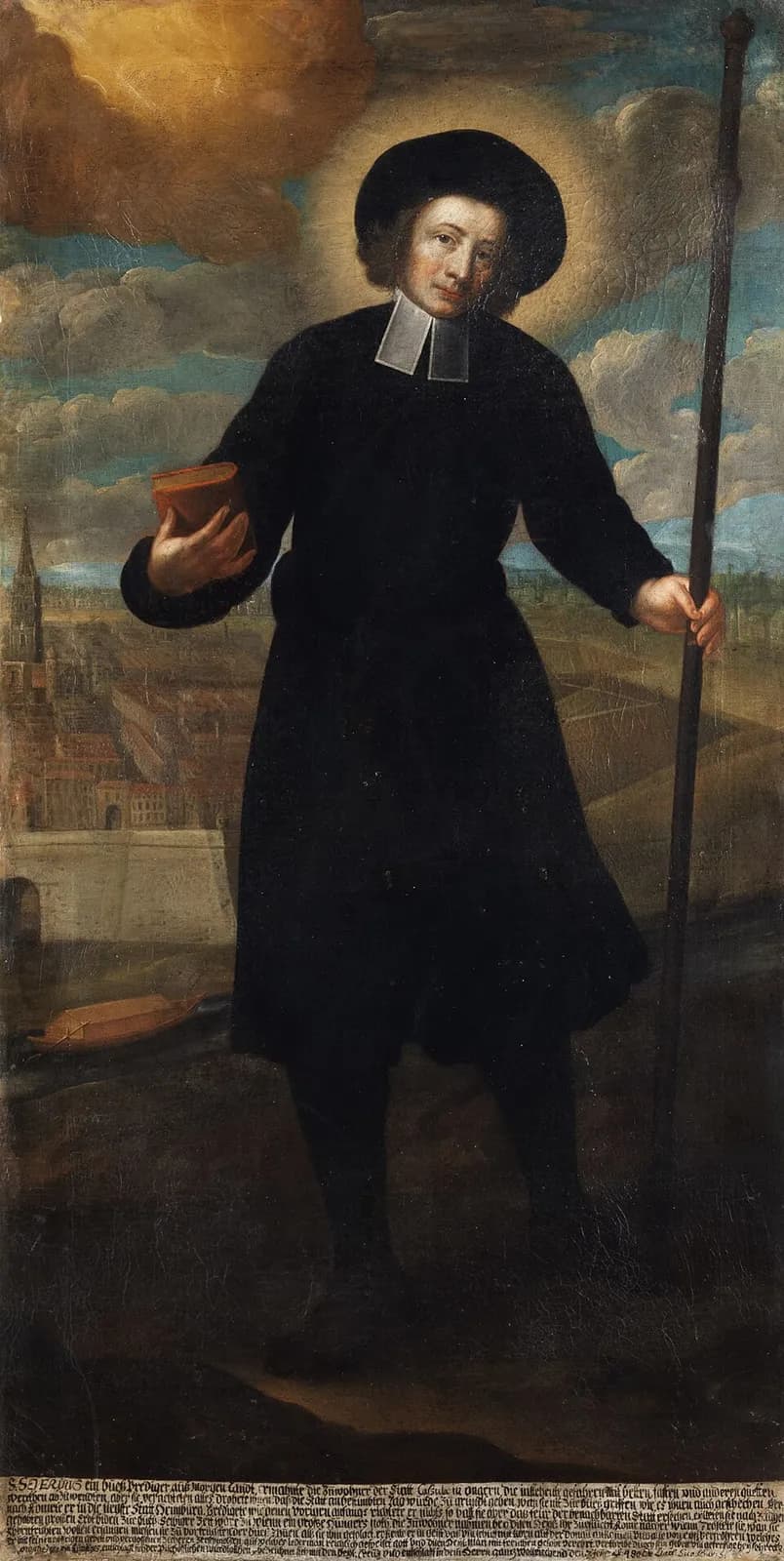
- Born
- About 406; his origin is unknown 1
- Arrived in Noricum
- After the death of Attila, in 453 or 454, along the Danube in what is now Austria 13
- Known for
- Protecting the Roman provincials, ransoming captives, organizing relief, founding monasteries 123
- Relics
- Carried to Italy by his monks six years after his death; now at Frattamaggiore, near Naples 12
- Patron saint of
- Bavaria, linen weavers, vine-growers and prisoners; second patron of the Diocese of Linz 1
Saint Severinus of Noricum was a monk who appeared on the Danube frontier in the 450s, as Roman rule there was collapsing, and spent about thirty years feeding, ransoming and defending the people left behind. 13 He never said where he had come from. 1 He died in 482, six years before the last Romans left the province and took his body with them to Italy, and his feast is January 8. 123
One book
Everything known about Severinus comes from the Life written by his disciple Eugippius, who became abbot of the community that carried the saint's body to Italy and wrote about 511. 1 The Catholic Encyclopedia calls that Life "the only written document we have for the history of the Danubian provinces during the last years of the Roman occupation." 2 It describes Severinus as the "last representative of Christian culture among the Roman inhabitants of the Danube district." 2 The accounts used for this page all draw on Eugippius, and they do not always agree about what he means.
A man who would not say where he was from
He was born about 406, and his origin is unknown. 1 The Catholic Church in Norway's biography gives two versions. In one, his name and the quality of his Latin suggest a prominent family in North Africa or Rome, and he may have been a Roman from Carthage. In the other, he was born at Favianis on the Danube, in the province of Noricum Ripense, and his parents fled when the country was invaded soon after his birth. 1
He gave up his property to live as a hermit somewhere in the East. Egypt, Palestine and Asia Minor are all suggested. 1 There he heard of the death of Attila, king of the Huns, in 453, and either homesickness for the land along the Danube or, as his biographer tells it, a vision called him there. 1 The Roman Martyrology also dates his coming to Noricum after Attila's death. 3
He arrived in 453 or 454 as a monk, and never hinted that he was returning home. Asked where he came from, he would answer that our homeland is heaven, and heaven is what we should strive for. 1
The Danube frontier
Noricum Ripense was the strip of land along the Danube between Passau and Vienna. 1 After Attila died the Huns withdrew east, but the migrations they had set off shook the empire, and the distant provinces north of the Alps were coming apart because Rome could no longer help them. 1 Germanic peoples moving south passed through, plundering and besieging the towns. The one fixed point in the general chaos, the Norwegian account says, was the Church. 1
The sources place him differently. The encyclopedia says he "settled near the present city of Vienna, built a monastery for himself and his companions." 2 The Norwegian biography says he came to Favianis, which it identifies with the present Mautern, founded monasteries there, at Passau, at Lorch and near Vienna, and stayed in none of them; it puts his hermit's cell at what is now Göttweig. 1 Both agree that he ranged widely. The encyclopedia has him traveling as far as Passau and inland to Salzburg. 2
He lived hard. He insisted on owning one tunic, never wore shoes, did not eat before sunset, and in Lent allowed himself one meal a week. 1 The encyclopedia adds that "even in winter, when the Danube was frozen, he walked up and down over the ice barefoot," and that these journeys were "errands of consolation to the despairing provincials, who saw themselves threatened on all sides by bands of marauding barbarians." 2
Famine, captives and kings
His preaching was often ignored. He warned the people of one town, Astura, that they would be invaded unless they changed their ways, and they answered with contempt. When raiders laid the town waste the survivors sent for him, and he came quietly and organized the relief. 1
Much of what Eugippius records is practical. At Favianis, during a famine, Severinus found out that a rich woman had hidden a large store of food; he called her to repentance and she distributed it to the poor, while the ice on the rivers thawed and the barges got through with more. 1 He persuaded landowners to give a tithe every year for the relief of the needy. 1 He went unprotected into enemy camps to win the release of prisoners, and he organized help for captives through exchanges. 1 The Martyrology sums him up in the same terms: he defended defenseless people, tamed the violent, converted unbelievers, founded monasteries and taught those who had no religious instruction. 3
The rulers of the country were the Rugians, Germanic Christians of the Arian confession, and before them Severinus defended the rights of the Catholic, Roman population. 1 He was respected on both sides. The Alamannic king Gibold visited him at Passau, and "the saint begged as a personal grace that the king cease from ravaging the Roman territory." 2
The best-known visitor was Odoacer, on his way to Italy. The Norwegian account says he was astonished that the hermit's cell was too low for a grown man to stand in; Severinus told him to stoop, and he did, and went in for a blessing. 1 The encyclopedia gives the saint's words: "Go forward, my son. Today thou art still clad in the worthless skins of animals, but soon shalt thou make gifts from the treasures of Italy." 2 After Odoacer had made himself master of Italy he invited Severinus to ask a favor, and "Severinus only asked the pardon of one who had been condemned to banishment." 2
His death and the journey south
Several towns tried to make him their bishop, and he refused to be tied to one place. 1 Whether he was a priest at all is not agreed. The Martyrology calls him a priest and monk, Vatican News lists him as an abbot, and the Norwegian biography thinks it doubtful that he was ever ordained. 134
He worked for thirty years. 1 At the end, the encyclopedia says, "the sobs of his disciples prevented their praying; he himself began to recite the last psalm," and he died on its closing words, "Omnis spiritus laudet Dominum": let everything that has breath praise the Lord. 12 The encyclopedia dates his death to 482. The Norwegian biography says it happened some time between 476 and 482, by tradition on January 8, 482. 12
He had foreseen that the Romans would leave Noricum for good, and had asked that the last to go take his remains with them. 1 "Six years later," the encyclopedia says, "the Romans withdrew from this region, taking the body of the saint with them, and returned to Italy." 2 He was buried at Luculanum, near Naples, where a monastery was built and Eugippius soon became abbot. 12 From 910 the relics lay in the Benedictine monastery of San Severino in Naples, and since 1807 they have been in the parish church of Frattamaggiore, near Aversa. 1
What is Saint Severinus of Noricum the patron saint of?
The Catholic Church in Norway lists Saint Severinus of Noricum as patron of Bavaria, of linen weavers, vine-growers and prisoners, and of vines, as a saint invoked against famine, and as the second patron of the Diocese of Linz in Austria. 1 None of the other sources used here names a patronage. The list fits the life: he ransomed captives and ended a famine, and that account says he died among the vineyards. 1 It also calls him the apostle of present-day Austria, since his influence reached as far as Salzburg, Tyrol, Styria and Carinthia. 1
Saint Severinus of Noricum's feast day
Saint Severinus of Noricum's feast day is January 8. Vatican News lists him on that day as "St. Severin, Abbott, Apostle of Norico," and the Roman Martyrology commemorates him on the same date as a priest and monk in Noricum on the Danube, in what is now Austria. 34 It is the traditional day of his death. 1
Praying with Saint Severinus of Noricum
Severinus wanted to be a hermit and was not allowed to be. The Norwegian biography returns to this more than once: the more he longed for solitude, the greater the demands on him became, and towns competed to keep him inside their walls because they believed no enemy would break in while he was there. 1 He went back to his cell for long stretches when the worst had passed, and came out again when he was sent for. 1
His charity was organized. He found the hidden grain, set up a yearly tithe for the poor, and arranged exchanges of prisoners. 1 The same man walked barefoot on the frozen Danube and ate once a week in Lent. 12 The sources tell both as parts of one life and do not try to balance them. 12
He did not succeed at everything. The Norwegian account says he was deeply sad that he was never able to heal the blindness of one of his closest friends, and that he went on trusting God. 1 He also knew that the world he was defending would end, and planned for it: his last instruction was about what the survivors should carry with them when they left. 1
His usual greeting, the encyclopedia records, was "Sit nomen Domini benedictum," blessed be the name of the Lord, and he died reciting the last line of the last psalm. 2
Saint Severinus of Noricum, pray for us.
Sources
- 1.Per Einar Odden, "Den hellige Severin (~406-482)," Den katolske kirke (the Catholic Church in Norway), katolsk.no, updated March 11, 1999 (in Norwegian).
- 2.Cölestin Wolfsgrüber, "The Austro-Hungarian Monarchy," The Catholic Encyclopedia, vol. 2 (New York: Robert Appleton Company, 1907).
- 3.Roman Martyrology, entry for January 8, "San Severino, sacerdote e monaco," as printed in "Santo del giorno," Conferenza Episcopale Italiana (in Italian).
- 4."St. Severin, Abbott, Apostle of Norico," Saint of the Day, 8 January, Vatican News.
Saints to turn to next
Others in this collection who are turned to for some of the same things.
- Saint Leonard of NoblacSixth century; died 559 by one accountProtectionPrayerPoverty and simplicity
- Saint Anthony the Abbotc. 251 - c. 356PrayerPoverty and simplicityProtection
- Saint Gilesc. 650 - early 8th centuryPoverty and simplicityProtectionPrayer
- Saint Agnes of Bohemiac. 1200-1205 - March 1281 or 1282Poverty and simplicityPrayer