Saint Severinus Boethius
c. 480 - 524
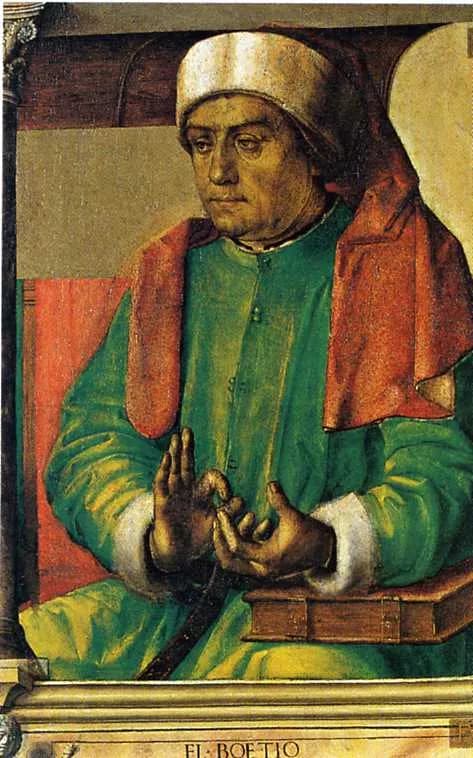
- Died
- Pavia, October 23, 524, executed on the orders of King Theodoric 24; 524 or 525 in the Catholic Encyclopedia 1
Saint Severinus Boethius was a Roman senator and philosopher who was put to death on the orders of the Ostrogothic king Theodoric in 524, after writing, in prison, The Consolation of Philosophy, one of the most widely read books of the Middle Ages. 12 Benedict XVI called him the last representative of ancient Roman culture and the first of the medieval intellectuals. 2 His cult is local: the Church of Pavia, where he died, honors him as a martyr on October 23, a custom Rome confirmed in 1883. 123
A Roman under Gothic kings
Anicius Manlius Severinus Boethius was born in Rome around 480, into the Anicii, one of the great noble families of the city. 12 Rome was no longer the capital of an empire. Odoacer had ended the Western Empire in 476, and the Ostrogoths under Theodoric had taken Italy from him soon after. 2 Boethius lost his father early and was brought up by the senator Symmachus, whose daughter he married. Turner, in the Catholic Encyclopedia, gives her name as Rusticana; Vatican News gives it as Rusticiana, and says they had two sons, both consuls in 522. 14
He went into public life young. Benedict XVI says he was a senator by twenty-five, and Vatican News that he was sole consul from 510. 24 By 507 he was known as a learned man, and Theodoric trusted him with important missions. 1 Benedict XVI describes what he was trying to do: to bring the classical Roman culture and the new culture of the Goths together, in the conviction that the old Roman order could be tempered by the values of the new peoples. 2
The teacher of the Middle Ages
Through all of this he kept studying. He wrote manuals of arithmetic, geometry, music and astronomy, meant, in Benedict XVI's words, to pass on the great Greco-Roman culture to the new generations. 2 He translated Aristotle's works on logic and Porphyry's introduction to them into Latin and wrote commentaries on both. 1 Turner says the schoolmen, down to the beginning of the twelfth century, "depended entirely on Boethius for their knowledge of Aristotle's doctrines," and took over his definitions of terms such as "person" and "eternity." 1 Vatican News calls him the founder of medieval Scholasticism. 4
He also wrote theology: a treatise on the Trinity, two short works addressed to John the Deacon, who later became Pope John I, and a book against Eutyches and Nestorius. 1 Benedict XVI notes that he used the categories of Greek philosophy to present the Christian faith, looking for a synthesis between the Hellenistic and Roman inheritance and the Gospel. 2
Arrest, prison and death
The accounts of his fall differ in their details. Turner says his enemies accused him of disloyalty to the king, alleging that he plotted to restore "Roman liberty," and added a charge of "sacrilege," meaning astrology. 1 Benedict XVI says he was accused of plotting against Theodoric for taking the side of his friend the senator Albinus in a court case, and calls that a pretext. The real reason, he says, was that Theodoric, "an Arian and a barbarian," suspected Boethius of sympathizing with the Byzantine emperor Justinian. 2 Turner, describing the old tradition of his martyrdom, names the emperor Justin as the champion of the Catholic cause at the time. 1
Neither his birth nor his popularity helped him. He was thrown into prison and, as Turner puts it, "condemned unheard." 1 Vatican News says he was held at Pavia. 4 Benedict XVI speaks of his being tortured, and gives the date of his execution as October 23, 524, when he was forty-four. 2 Turner gives the year as 524 or 525. 1 The Roman Martyrology says simply that he served God with integrity until the death inflicted on him by King Theodoric. 3
The Consolation of Philosophy
In prison he wrote the book that made him famous. The Consolation of Philosophy is a dialogue in which Philosophy, personified as a woman, comes to the condemned statesman and argues with him. 1 Turner quotes a judgment that it is "by far the most interesting example of prison literature the world has ever seen." 1 Its argument, he says, is that earthly greatness passes and is unreal, and the things of the mind are worth more. 1
Benedict XVI read it as a prisoner's search for light. Boethius learned to tell apparent goods, which disappear in prison, from true ones, such as real friendship, which do not; the highest good is God. 2 He refused the fatalism that puts out hope, and learned "that it is not the event but Providence that governs and Providence has a face." 2 The Pope quoted his closing advice: "Should you refuse to lie, the imposition you have suffered can change into the enormous advantage of always having before your eyes the supreme Judge, who sees and knows how things truly are." 2
The book never names Christ, and some modern critics concluded from this that Boethius was not a Christian, or gave up the faith before he died. 1 Turner rejects that. The theological tracts are genuine, he argues, and the Consolation is a formal philosophical dialogue that deliberately keeps to "natural truth"; it even hints that there are stronger remedies, validiora remedia, beyond what Philosophy can offer. 1 "There can be no reasonable doubt, then, that Boethius died a Christian," he concludes, "though it is not easy to show from documentary sources that he died a martyr for the Catholic Faith." 1
The book's afterlife was enormous. King Alfred the Great put it into Anglo-Saxon and Notker into Old German, and Turner traces its influence through Beowulf, Chaucer and the first Italian verse to Dante's Divine Comedy. 1 Vatican News adds that Dante called Boethius a holy soul. 4
How he came to be called a saint
Turner says the tradition of Boethius as a Christian martyr began very early: people believed that devotion to the Catholic cause, against the Arian king, was among the charges brought against him. 1 By the eighth century that tradition had taken a definite shape, and he was honored as a martyr in many places, with a feast on October 23. 1 Then in 1883, Turner writes, "the local cult of Boethius at Pavia was sanctioned" when the Sacred Congregation of Rites confirmed the diocese's custom of honoring St. Severinus Boethius on that day. 1
That remains his standing. Benedict XVI described him in 2008 as the one "whom the city of Pavia recognizes and celebrates in the liturgy as a martyr of the faith." 2 The current Roman Martyrology enters, under October 23, a commemoration at Pavia of Saint Severinus Boethius, martyr, famous for his learning and his writings. 3
What is Saint Boethius the patron saint of?
Saint Boethius's feast day
Saint Boethius's feast day is October 23, the day of his death as Benedict XVI gives it. 2 Turner records the feast on that date from the eighth century and its confirmation for Pavia in 1883, and the Roman Martyrology keeps the commemoration at Pavia on October 23. 13 Vatican News also lists him on that day. 5 It is a local celebration and not a feast of the whole Church.
Praying with Saint Boethius
Boethius had everything a Roman could have, a great name, a consulship, the trust of a king, and lost it all on a charge he could not answer. 12 He wrote his best book with death in front of him. 12
Benedict XVI found in that prison a lesson about hope. A man stripped of everything can still tell what is real from what only looks real, can still pray, and can still talk to the One who governs events, because Providence, as the Pope put it, has a face. 2 Boethius himself, the Pope noted, warned that resigning oneself to suffering as fate "eliminates at its roots the very possibility of prayer and of theological hope." 2
Nothing on this page settles every question about him. Turner admits the documents do not prove he died for the Catholic faith, and the Church's cult of him has stayed in the city where he died. 13 Benedict XVI thought he could still speak to everyone who suffers what he did, and he saw in him a way in to the "mysterious Crucified One of Golgotha." 2
Saint Severinus Boethius, pray for us.
Sources
- 1.William Turner, "Anicius Manlius Severinus Boethius," The Catholic Encyclopedia, Vol. 2 (New York: Robert Appleton Company, 1907).
- 2.Benedict XVI, General Audience, "Boethius and Cassiodorus," March 12, 2008.
- 3.Roman Martyrology, entry for October 23, "San Severino Boezio, martire," as printed in "Santo del giorno," Conferenza Episcopale Italiana (in Italian).
- 4."S. Severino Boezio, filósofo romano y mártir," Santo del día, Vatican News (in Spanish).
- 5."23 October," Saint of the Day, Vatican News.
Saints to turn to next
Others in this collection who are turned to for some of the same things.
- Saint Aelred of Rievaulx1109 - January 12, 1166 (or 1167)Suffering and illnessStudy and teaching
- Saint Catherine of AlexandriaDied c. 310Study and teachingSuffering and illness
- Saint Charles BorromeoOctober 2, 1538 - November 3, 1584Study and teachingSuffering and illness
- Saint Faustino MíguezMarch 24, 1831 - March 8, 1925Study and teachingSuffering and illness