Saint Faustino Míguez
March 24, 1831 - March 8, 1925
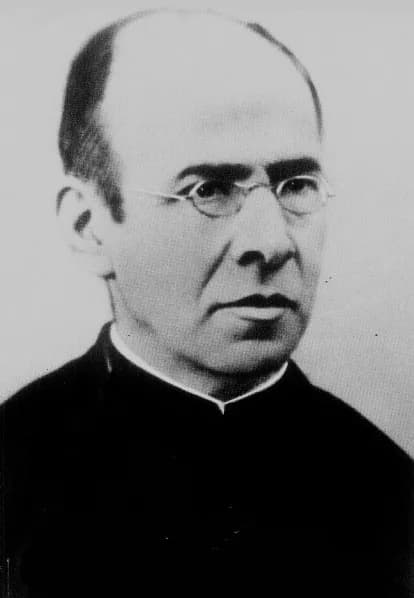
- Founded
- The Calasanctian Institute of the Daughters of the Divine Shepherdess, at Sanlúcar de Barrameda, for the education of girls 149
- Beatified
- October 25, 1998, by John Paul II 1
Saint Faustino Míguez was a Spanish Piarist priest and schoolteacher who analyzed the mineral springs of an Andalusian town, made medicines from plants until the local doctors' complaints helped get him moved, and in 1885 founded a congregation of sisters to teach girls who had no school to go to. 467 John Paul II, beatifying him in 1998, described him "in school and the street, in the confessional and the laboratory." 1 He died at Getafe in 1925 and was canonized by Francis in 2017. 24
From Xamirás to the Piarists
He was born Manuel Míguez on March 24, 1831, at Xamirás, a village in the parish of Acebedo del Río in the province of Ourense, in Galicia. 45 The Decree of Heroic Virtues, which Calderón reproduces, names his parents as Benito Míguez and María González, "farmers and good Christians," and says he was baptized the day after he was born. 4 That day was March 25, the feast of the Incarnation, which Calderón connects with the religious name he took later. 4
He studied humanities and Latin at the shrine of Our Lady of Miracles near Celanova, from 1847 to 1850, and it was there, the Piarists say, that he settled on being a priest and a teacher in the manner of Saint Joseph Calasanz. 46 He took the habit at the Piarist school of San Fernando in Madrid on December 5, 1850, as Faustino of the Incarnation, and made his solemn profession on January 16, 1853. 4
Calderón dates his ordination to March 8, 1856, in the parish of Saint Mark in Madrid, and his first solemn Mass to March 19, the feast of Saint Joseph. 4 The Piarists' 2017 page also gives March 8; their parishes page gives March 19 as the ordination itself. 67
Cuba, and the springs of Sanlúcar
His first posting was to the new Piarist school at Guanabacoa in Cuba, which was then a Spanish colony. 4 The decree says the religious went there at the invitation of Saint Anthony Mary Claret, and Calderón has him landing on November 3, 1857. 4 He taught at the school for future teachers, and the Piarist parishes page says this is where he learned the therapeutic use of plants. 7 One of his Getafe brothers later testified that he had learned the healing properties of medicinal plants "through direct observation of the natives of Guanabacoa." 4
He was back in Spain on March 3, 1860, and from then on the order moved him from house to house: San Fernando, Getafe, Celanova, Sanlúcar de Barrameda, the royal monastery of El Escorial as librarian, Monforte de Lemos as rector. 46 At Sanlúcar, a town at the mouth of the Guadalquivir, he taught physics, chemistry, natural history and physiology, and he heard the town's mineral waters praised by its residents and by the visitors who came every year to drink them. 4 His analysis of them was printed at Seville in 1872, and a local history of 1942, quoted by Calderón, calls it the most interesting of the works on the subject. 4
At Monforte he kept a plot in the school garden for medicinal plants. 4 The Piarists' centenary article puts the two sides of his work together plainly: "without ever abandoning school and work with the students, he researched the healing properties of plants." 5
The girls of Sanlúcar
He went back to Sanlúcar in October 1879. 4 Calderón's account of what he found there is that education "is the right of all, but in Sanlúcar de Barrameda it is only enjoyed by some, especially the boys, but not so much the girls!" 4 The Piarists' own page makes the comparison its founder would have recognized: he discovered that the girls of Sanlúcar needed schooling as Calasanz, years before, had discovered it about the street children of Rome. 6
He began by helping a woman who ran a small school for girls in her house, visiting after his own classes. 4 Calderón notes that not all of his community understood why a Piarist was working with a school run by a woman. 4 On January 2, 1885, the foundations of the Association of the Daughters of the Divine Shepherdess were approved with him as director, and the canonical installation followed a month later. 4 The Piarist parishes page also dates the foundation to 1885; the Holy See's biography gives 1875. 37
John Paul II said he "observed the conditions of ignorance and marginalization in which women lived, whom he regarded as the 'soul of the family and the most important part of society'." 1 His own words for the school's purpose, in Calderón's translation, were to make the girls "good Christian women, good daughters, good wives, good mothers and useful members of society, of which they will one day be the most interesting part." 4
The doctors and the laboratory
At Sanlúcar he also began preparing remedies from plants, and patients came. 4 Then the doctors complained. One witness in his cause, quoted by Calderón, put it bluntly: "The doctors of this city began a campaign against him, fearing that their income would decrease." 4 The rector forbade him to treat patients, and Calderón states that his care of the sick, together with his work for the new association, was the reason he was transferred to Getafe in 1888. 4 He arrived there on September 30 of that year and stayed for the rest of his life. 4
He did not stop. At Getafe he made the extracts and gave them to a pharmacist to sell, until he found the pharmacist was weakening the doses to multiply the bottles; he then asked the sisters to take the work over, and in 1906 some of them came to Getafe to do it. 4 In 1912 he left the remedies to the congregation by will, and sent one of the sisters to study pharmacy in Madrid; the laboratory received its official authorization in 1922. 4 John Paul II summed it up: "As a scientist, he was able to alleviate sickness by freeing humanity from physical suffering." 1
Old age, and one last separation
The institute grew. Calderón records the sisters leaving for Chile and Argentina, and the final approval of their Constitutions by Pius XI on July 27, 1922. 4 Of his golden jubilee as a priest, which by his own letter he did not want to celebrate, he wrote "fifty-two years of daily celebrations and so bad! What a responsibility I have!" 4
Then, in October 1923, the superior general, Mother Julia Requena, died, and the congregation divided over who should succeed her. 4 Calderón says that the Church intervened through the visitor of the diocese of Madrid and the nuncio, and that he was forbidden any contact with the sisters for six or seven months. 4
He died at Getafe on Sunday, March 8, 1925. 45 The Piarists' centenary article says that in his last moments he "was accompanied by the solitude of his room and the silence of midday." 5 A brother who looked after him remembered the rosary in his hands; one of the sisters remembered that he had told them, oddly, to come at two that afternoon, and that when they came he was dead. 4
John Paul II beatified him in Saint Peter's Square on October 25, 1998. 1 The Piarist order announced on April 20, 2017, that his canonization had been set for October 15 of that year, and Francis canonized him on that day. 29
What is Saint Faustino Míguez the patron saint of?
None of the sources consulted names a patronage for him, so this page does not claim one. 134 What John Paul II did say is that his example "continues today in the witness of his daughters and of the many teachers who courageously and joyfully work to imprint the image of Jesus on the minds and hearts of young people." 1
Saint Faustino Míguez's feast day
His feast is March 8. The Piarist parishes publish a liturgy for "San Faustino Míguez. 8 de marzo," and the Calasanzian Institute he founded marks the "Fiesta de San Faustino Míguez" on that date. 78 It is the day he died in 1925, and by Calderón's date it is also the anniversary of his ordination. 45
No source consulted says he is on the General Roman Calendar or on the calendar for the dioceses of the United States, so this page gives March 8 as the feast his religious family keeps.
Praying with Saint Faustino Míguez
The first thing his life shows is a man who looked at the town he was in. In Sanlúcar he noticed what the water was praised for and analyzed it, and then noticed which children were not in school and did something about that. 4
The second thing is less comfortable. His work with the sick made him enemies, and the outcome was that he was ordered to stop and moved away from the congregation he had just founded. 4 Calderón records that he offered no defense against the doctors' criticism and no argument against the superiors' decision. 4 Near the end of his life he was cut off from the sisters again, for months, while the Church settled a dispute over who should govern the congregation. 4 The sources do not make either episode come out well for him at the time.
He also kept working. Moved to Getafe, he went on making his remedies; finding them diluted for profit, he found a way to stop it. 4 One of his convictions, as Calderón gives it, was "To be as one should be or not to be." 4
John Paul II's phrase for him was "a 'man of the people and for the people'," and he placed him in four places at once: the school, the street, the confessional and the laboratory. 1 Those were the ordinary rooms of a long life, and the sources describe him in all of them.
Saint Faustino Míguez, pray for us.
Sources
- 1.John Paul II, Homily for the Beatification of Zefirino Agostini, Antônio de Sant'Anna Galvão, Faustino Míguez and Theodore Guérin, October 25, 1998.
- 2.Francis, Homily at the Holy Mass and Canonizations of the Blesseds Andrea de Soveral, Ambrogio Francesco Ferro, Matteo Moreira and 27 Companions, Cristóbal, Antonio and Juan, Faustino Míguez and Angelo da Acri, Saint Peter's Square, October 15, 2017.
- 3."Faustino Míguez (1831-1925)," biography published by the Holy See for the beatification of October 25, 1998 (Portuguese).
- 4.Sacramento Calderón, Seeking God's Will, Faustino Míguez, Piarist, translated by Antonio Marco Moreno, Sch.P. (Madrid: Ediciones Calasancias / Publicaciones ICCE).
- 5."Saint Faustino Míguez Sch.P. 1925-2025. One hundred years of life," Order of the Pious Schools (Piarists).
- 6."Faustino Míguez," Order of the Pious Schools (Piarists), 2017 (Spanish).
- 7."San Faustino Míguez. 8 de marzo," Parroquias Escolapias, Order of the Pious Schools (Spanish).
- 8."Fiesta de San Faustino Míguez," Instituto Calasancio Hijas de la Divina Pastora, March 8, 2019 (Spanish).
- 9."San Faustino Miguez, a new Piarist Saint," Order of the Pious Schools (Piarists), April 20, 2017.
Saints to turn to next
Others in this collection who are turned to for some of the same things.
- Saint Aelred of Rievaulx1109 - January 12, 1166 (or 1167)Work and vocationSuffering and illnessStudy and teaching
- Saint Charles BorromeoOctober 2, 1538 - November 3, 1584Work and vocationStudy and teachingSuffering and illness
- Saint Giuseppe MoscatiJuly 25, 1880 - April 12, 1927Work and vocationStudy and teachingSuffering and illness
- Saint Titus BrandsmaFebruary 23, 1881 - July 26, 1942Work and vocationSuffering and illnessStudy and teaching