Saint Servatius of Tongeren
d. 384 (traditional date)
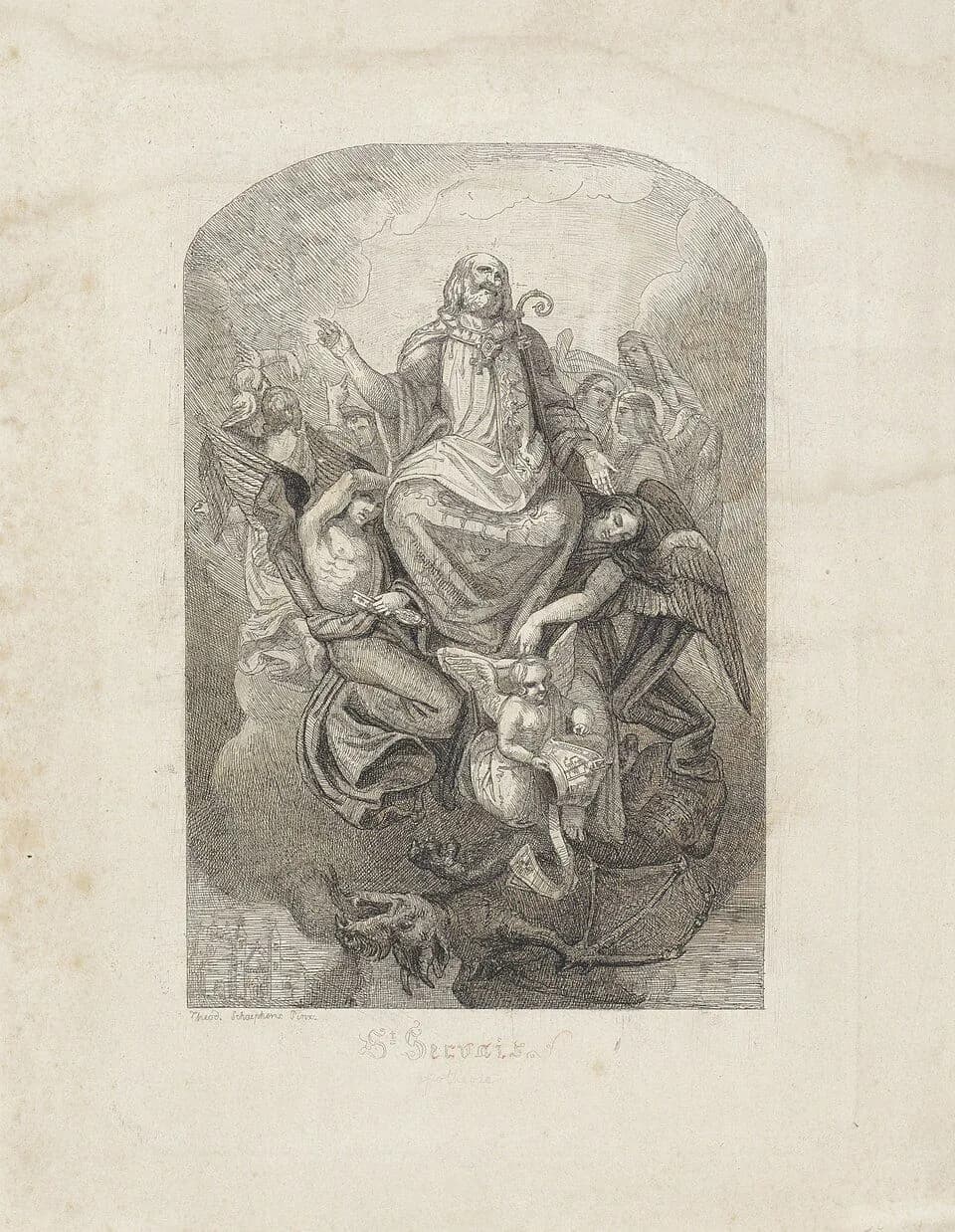
- Bishop of
- Tongeren, from 344 or 345, by the encyclopedia's dating 3
Saint Servatius was a fourth-century bishop of Tongeren, in what is now Belgium, who fought the Arian heresy at the councils of his day and was buried at Maastricht, where pilgrims have come to his grave ever since. 123 A bishop of his name turns up in writers of his own century: Athanasius lists a Sarvatius among the envoys sent to the emperor Constantius, and Sulpicius Severus counts "Servatio, bishop of the Tungri" among the last to hold out at the Council of Rimini. 45 Around that small core a great deal of legend has grown, and the Catholic Church in Norway's biography of him says plainly that over the centuries his story has been heavily mixed with legend. 1
The first bishop of Tongeren
Tongeren was the Roman Atuatuca Tungrorum, capital of the tribe of the Tungri, and one of the oldest sees in the Low Countries. 1 Its territory first belonged to the Diocese of Trier, then to Cologne; "after the first half of the fourth century," Joseph Brassinne writes in the 1910 Catholic Encyclopedia, "Tongres received autonomous organization." 3 Some traced its bishops back to the first century, he notes, "but the first Bishop was St. Servais, installed in 344 or 345." 3
Nothing reliable is known of his origins. The Norwegian biography reports an old tradition that he came from the East, from Armenia or Palestine, perhaps of Jewish parents, and a medieval legend that made him a kinsman of Christ through Saint Anne's mother, Emerentia. 1 It also tells the legend of his election: on the death of his predecessor Valentine, an angel carried Servatius from the Holy Sepulchre in Jerusalem to Tongeren, where he arrived on May 13, 329, and handed him the dead bishop's staff before the altar. 1
An envoy to the emperor
In 350 the officer Magnentius murdered the Western emperor Constans and made himself emperor in his place. 1 He sent an embassy to Constans's brother, Constantius II, and a bishop of Tongeren went with it. 14 The evidence is in Athanasius. Defending himself years later against the charge of having corresponded with the usurper, he urged Constantius to question the men Magnentius had sent: "These are the Bishops Sarvatius and Maximus and the rest, with Clementius and Valens." 4
The mission failed. Constantius did not recognize Magnentius, civil war followed, and by 353 Magnentius was dead by his own hand. 1 The Norwegian biography adds that on the journey Servatius came to Alexandria and renewed his friendship with Athanasius, and that he probably visited Rome at least twice. 1
Rimini, 359
The Roman Martyrology remembers him for one thing above all: in the many councils called to argue about the nature of Christ, he fought for the true faith of Nicaea. 2 Brassinne says he "assisted at the Council of Rimini (359-60)." 3 That council, summoned by Constantius to make the Western bishops accept a creed of the Arian party, is described by Sulpicius Severus. 5
Sulpicius tells how the bishops were held at Rimini month after month, how one group after another gave way, until "the number of our friends was diminished down to twenty." 5 Among those twenty, he writes, "the most steadfast among them was to be reckoned our friend Fœgadius, and Servatio, bishop of the Tungri." 5 The prefect Taurus pleaded with them in tears. Fœgadius yielded at last to a compromise, and "confessions drawn up by Fœgadius and Servatio began to be published," condemning Arius and declaring the Son equal to the Father. 5 Then the Arian bishop Valens added a phrase whose trap "escaped the notice of the hearers." 5 Sulpicius calls Rimini "a council which had a good beginning but a disgraceful conclusion." 5
The Norwegian biography tells the same story less kindly to its hero. It says Servatius was tricked into signing the ambiguous formula, the one that drew from Saint Jerome the famous line "Ingemuit totus orbis et arianum se esse miratus est," the whole world groaned and was amazed to find itself Arian, and that Saint Hilary of Poitiers later showed him what it really meant. 1
Is this the same man?
There is a complication, and the Norwegian biography is honest about it. It accepts that Servatius was without doubt a historical figure, but reports that identifying the Servatius of the councils with the bishop of the Tungri is disputed today, and that the newest research would rather place Servatius of Tongeren in the middle of the fifth century. 1
The oldest account of his grave points the same way. Gregory of Tours, writing in the sixth century and quoted in the Norwegian biography, says that Aravatius was said to be bishop of Maastricht at the time the Huns invaded Gaul. 1 The legend he passed on has Servatius praying at the tomb of Saint Peter in Rome to turn the Huns away from Tongeren and being told that the city would fall, but not in his lifetime. 1 The Martyrology and the encyclopedia keep him in the fourth century. 23
The grave at Maastricht
According to the legend, he moved from Tongeren to Maastricht at the end of his life, taking with him the relics of his predecessors, and died there on May 13, 384, the date the Bollandists fixed. 1 The Martyrology enters his death as having taken place near Maastricht, and the encyclopedia gives the year as 384 with a question mark. 23 He was the last bishop to live at Tongeren, though the see did not formally move to Maastricht until 549. 1
Gregory of Tours, as the Norwegian biography quotes him, says Aravatius was buried beside the road by the bridge, and that however hard it snowed, snow never lay on his grave. The faithful kept building wooden chapels over it, and the wind kept knocking them down, until someone put up a building worthy of a bishop. 1 Later Bishop Monulf built a great church in his honor and moved his remains into it. 1 Brassinne says the same: "St. Monulphus built over the tomb of St. Servais a sumptuous church, near which his successors often resided." 3 The church is still there, and his sarcophagus is in its crypt, together with a crozier, a drinking cup and a silver key said to have been a gift from the pope. 1
The pilgrimage grew enormous. By the fourteenth century there was a great display of relics at Maastricht every seventh year, and in 1496, the Norwegian biography says, more than 100,000 pilgrims came. 1 The custom lapsed, was revived in 1829, and is still kept every seven years, with the golden reliquary shrine at the center of the procession. 1 A life by a writer named Jocundus around 1075, and a verse legend by the poet Henric van Veldeke at the end of the twelfth century, added more miracles to the store. 1
What is Saint Servatius the patron saint of?
No source read for this page names a formal patronage for Saint Servatius. The Norwegian biography notes that his drinking cup, kept at Maastricht, is believed to help against fever. 1 In Germany he is one of the Eisheilige, the Ice Saints: Pancras, Servatius and Boniface, whose feasts on May 12, 13 and 14 fall in a spell of cold weather that farmers in Central Europe take as the last risk of frost, and before which nothing is planted. 6
Saint Servatius's feast day
Saint Servatius's feast day is May 13, the anniversary of his death, on which the Roman Martyrology enters him. 12 The Norwegian biography mentions June 7 as a further memorial, and says the Dutch Diocese of Roermond, to which Maastricht belongs, keeps all the holy bishops of Maastricht together on May 15. 1
Praying with Saint Servatius
The surest thing about him is a scene at a council. Four hundred bishops were shut up in one Italian city through a winter, worn down, promised a way home if they signed, and their number shrank to twenty, and he was among the last. 5 Sulpicius did not write about him as a hero, only as a friend who was "most steadfast." 5
The Norwegian biography's version, in which he was deceived at the end and had to be put right by Hilary, does not undo that. 1 It makes him look like most people who try to hold a line in an argument they only half understand: firm, tired, and capable of being fooled by a clever sentence. Sulpicius admits that the trap "escaped the notice of the hearers," and he was one of them. 5
After that, almost everything is legend, and the legends are about prayer. The bishop on his knees at Peter's tomb for three nights, asking that his city be spared, and told that it would not be, only that he would not live to see it fall. 1
Saint Servatius of Tongeren, pray for us.
Sources
- 1."Den hellige Servatius av Tongeren-Maastricht (d. 384)," Helgener, salige og andre, katolsk.no, the Catholic Church in Norway (in Norwegian).
- 2.Roman Martyrology, entry for May 13, "San Servazio, vescovo," as printed in "Santo del giorno," Conferenza Episcopale Italiana (in Italian).
- 3.Joseph Brassinne, "Liège," The Catholic Encyclopedia, Vol. 9 (New York: Robert Appleton Company, 1910).
- 4.Athanasius, Apologia ad Constantium, ch. 9, trans. M. Atkinson and A. Robertson, Nicene and Post-Nicene Fathers, Second Series, Vol. 4 (Buffalo: Christian Literature Publishing Co., 1892).
- 5.Sulpicius Severus, Sacred History, Book II, chs. 41-44, trans. Alexander Roberts, Nicene and Post-Nicene Fathers, Second Series, Vol. 11 (Buffalo: Christian Literature Publishing Co., 1894).
- 6."Eisheilige," Helgener, salige og andre, katolsk.no, the Catholic Church in Norway (in Norwegian).
Saints to turn to next
Others in this collection who are turned to for some of the same things.