Saint Sergius I
Died September 8, 701
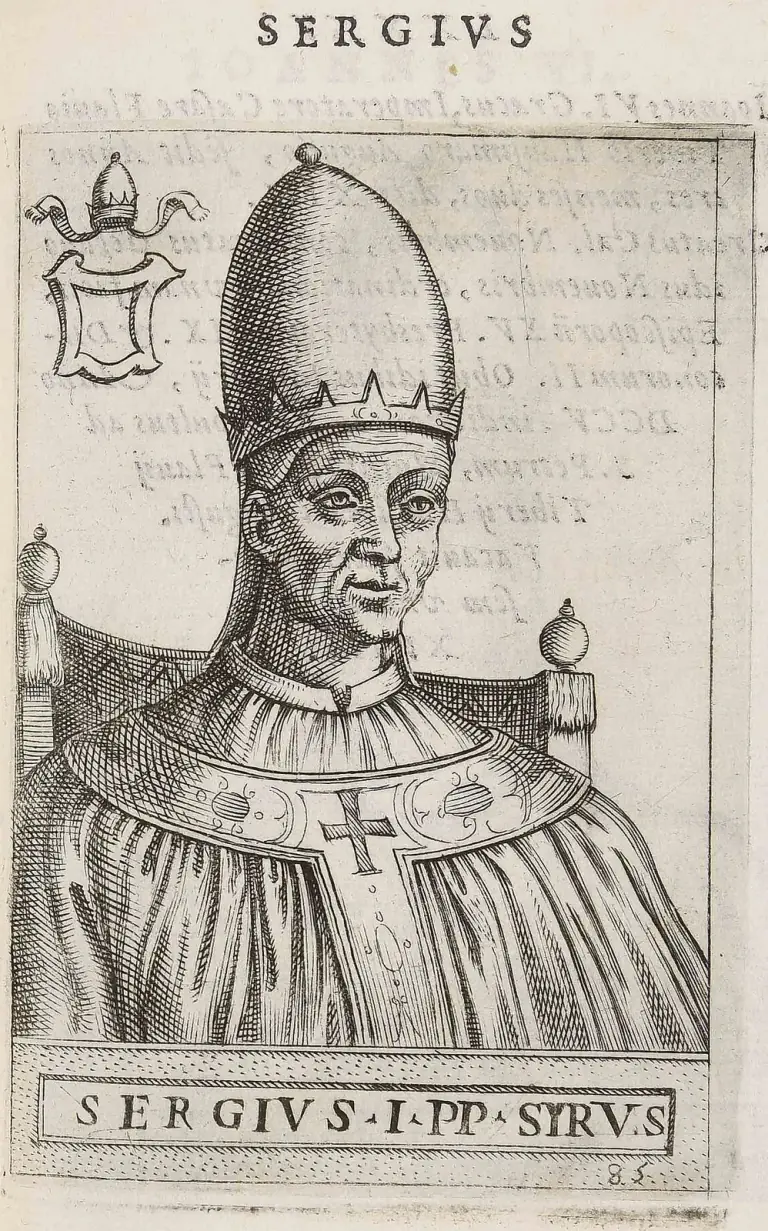
- Born
- Of a Syrian family 268; at Antioch, says Mann 1; in Sicily, possibly at Antioch, says katolsk.no 2; date unknown
Saint Sergius I was a pope of Syrian family who reigned from 687 to 701, and it was by his decree, the Catholic Encyclopedia says, that clergy and people began to sing the Agnus Dei, the Lamb of God, at the breaking of the bread in the Mass. 14 He refused to sign the canons of an Eastern council the emperor tried to impose on Rome, and when an imperial officer came to arrest him, the soldiers of Italy and the people of Rome would not let him be taken. 2 His feast is September 8. 6
From Syria by way of Sicily
Sergius was the son of a man named Tiberius. 12 Horace Mann, in the Catholic Encyclopedia, calls him "a native of Antioch" who was educated in Sicily. 1 katolsk.no thinks it more likely that the family had fled to Sicily from the Arab invasions and that he was born there, though perhaps at Antioch, and says he went to school in Palermo. 2 The Holy See's list gives his birthplace simply as Syria. 8
He came to Rome under Pope Adeodatus, studied in the cathedral school and was ordained; Mann says it was Saint Leo II who ordained him. 21 He became the titular priest of Santa Susanna on the Quirinal, and katolsk.no says he was known for his devotion to the martyrs and often said Mass in the catacombs. 2
A disputed election
When Pope Conon was dying in 687, the archdeacon Paschal offered the imperial exarch at Ravenna a large sum to have himself made pope. 1 One faction elected Paschal and another the archpriest Theodore. 12 Neither side would give way, and a meeting of the civil officials, the army officers and most of the clergy chose Sergius instead. "The mass of clergy and people," Mann writes, "set them both aside and chose Sergius." 12
The Lateran had to be stormed to install him, because the rival parties were occupying it. 2 Theodore submitted at once; Paschal did so only under pressure, and secretly asked the exarch to come and overturn the election. 2 The exarch, John Platyn, came, saw how strong the support for Sergius was, and confirmed him, but only after making him hand over the hundred pounds of gold Paschal had promised. 2 Sergius was consecrated, probably on December 15, 687. 18
The English
Mann notes that the new pope "had numerous relations with England and the English." 1 The most striking was the arrival of Caedwalla, king of the West Saxons, who gave up his crown to be baptized at the tomb of the apostles. Bede says Sergius baptized him on Holy Saturday, 689, and gave him the name Peter; Caedwalla fell ill while still in his white baptismal robes and died on April 20. 3 katolsk.no dates the baptism to April 10. 2 At the pope's command he was buried in Saint Peter's, with an epitaph that Bede copied out in full. 31
Sergius gave the pallium to Berhtwald of Canterbury and, according to Mann and katolsk.no, ordered that Saint Wilfrid be restored to York. 21 Mann adds that he "greatly favoured St. Aldhelm," the abbot of Malmesbury, and that he "is credited with endeavouring to secure the Venerable Bede as his adviser." 1
The Northumbrian monk Willibrord came to Rome in the first years of his mission to the Frisians, Bede says, "that he might undertake the desired work of preaching the Gospel to the Gentiles, with his licence and blessing," and to ask for relics for the churches he hoped to build. 3 Some years later Pepin of Herstal sent him back to be made archbishop of the Frisians. Bede says Sergius consecrated him in 696, in the church of Saint Cecilia on her feast, gave him the name Clement, and sent him home fourteen days after he arrived; katolsk.no dates the consecration to November 27, 695. 32
The Council in Trullo
In 692 the emperor Justinian II called a council of Eastern bishops in the same domed hall of his palace where the Sixth Ecumenical Council had met. 52 Its purpose was to supply the disciplinary canons that the Fifth and Sixth Councils had not written, so it took the name Quinisext, "Fifth-Sixth." 5 Thomas Shahan, in the encyclopedia's article on it, counts 215 bishops, "all Orientals," and 102 canons. 5
Several canons condemned Western practice. They allowed priests and deacons to keep the wives they had married before ordination and excommunicated anyone who tried to separate them, forbade the Lenten Saturday fast kept at Rome, and renewed the canon of Chalcedon that placed Constantinople next to Rome. 52 Shahan says the West never recognized them. 5
The pope's representative at Constantinople had been talked into signing. A copy was sent to the pope with a space left for his signature, and katolsk.no says it came with an order to accept the canons as binding on himself and on the West. 2 Sergius refused to sign, and would not even let the canons be read out. 21
Under the pope's bed
The emperor had the pope's chief advisers seized and deported, and then sent Zacharias, commander of his bodyguard, to Rome with orders to bring Sergius back to Constantinople. 21 It went badly for him. katolsk.no tells how the imperial troops in Italy, by then more an Italian militia than an Eastern army, refused to cooperate; the soldiers of Ravenna and the Pentapolis marched on Rome, and the Roman people rose for the pope. 2
Zacharias fled into the papal palace and hid under the pope's bed. In the end it was Sergius who had to calm the soldiers and beg them to spare the general's life, and Zacharias was driven out of the city in disgrace. 2 Mann puts it in one line: "the people protected the pope, and Justinian himself was soon afterwards deposed (695)." 1
The Agnus Dei and the Roman liturgy
His best-known legacy is liturgical. Hugh Henry, in the encyclopedia's article on the Agnus Dei, writes that the prayer was "not apparently introduced into the Mass until the year 687, when Pope Sergius I decreed that during the fraction of the Host both clergy and people should sing the Agnus Dei." 4 katolsk.no, which says Sergius was himself a gifted singer, dates the change to 701. 2
Henry also reports a suggestion that the editor of the papal chronicle, Louis Duchesne, took over from Cardinal Bona: that the decree may have been a protest against canon 82 of the Council in Trullo, which forbade showing Christ in the form of a lamb. 4 It is offered as a possibility, and the page leaves it there.
He gave the four great feasts of Mary (the Annunciation, the Dormition, her Nativity and the Presentation) solemn processions, katolsk.no says, including a night procession by candlelight for the feast now called the Assumption. 2 Mann says more generally that he "instituted processions to various churches" and "repaired and adorned many basilicas." 1 In 688 he moved the remains of Saint Leo the Great from an obscure grave to a monument inside Saint Peter's, where the public could see it. 2
Late in his reign he also healed an old wound in the north of Italy. Mann says he "succeeded in extinguishing the last remnants of the Schism of the Three Chapters in Aquileia"; katolsk.no dates the reconciliation to 700, after a council at Pavia. 12
What is Saint Sergius I the patron saint of?
Saint Sergius I's feast day
Saint Sergius I's feast day is September 8. 26 The Roman Martyrology, in the text published by the Italian bishops, enters on that day his burial at Saint Peter's: a pope of Syrian origin who worked with all his strength for the evangelizing of the Saxons and the Frisians, settled many quarrels, and preferred to die rather than approve error. 6 The 1897 English Martyrology also has him on September 8. 7
The day of his death is given as September 8, 701, by Mann and katolsk.no, and as September 7 by the Holy See; katolsk.no wonders whether the 8th was really the day of his burial. 128 It also notes that he is named in the calendar of Saint Willibrord, whom he consecrated, a sign that his cult began soon after he died. 2
Praying with Saint Sergius I
Most of what is known about Sergius concerns his quarrel with an emperor. What he left behind is a prayer. "Agnus Dei, qui tollis peccata mundi, miserere nobis," sung by "both clergy and people" while the Host is broken, is in Henry's account his decree. 4
He seems to have loved the liturgy. He said Mass in the catacombs as a young priest, he sang well, and as pope he gave the feasts of Mary their processions through Rome. 2 He also had the bones of a great predecessor brought out where people could pray at them. 2
When the officer sent to take him to Constantinople ended up hiding under his bed, it was the pope who calmed the soldiers and asked them to spare the man. 2 He had refused the emperor his signature, and he refused the crowd its revenge as well. 2
Saint Sergius I, pray for us.
Sources
- 1.Horace K. Mann, "Pope St. Sergius I," The Catholic Encyclopedia, vol. 13 (New York: Robert Appleton Company, 1912).
- 2."Den hellige pave Sergius I ( - 701)," Den katolske kirke (katolsk.no), Catholic Diocese of Oslo (in Norwegian).
- 3.Bede, Ecclesiastical History of the English Nation, Book V, chapters 7 and 11, Internet Medieval Sourcebook, Fordham University.
- 4.Hugh T. Henry, "Agnus Dei (in Liturgy)," The Catholic Encyclopedia, vol. 1 (New York: Robert Appleton Company, 1907).
- 5.Thomas Shahan, "Council in Trullo," The Catholic Encyclopedia, vol. 4 (New York: Robert Appleton Company, 1908).
- 6.Roman Martyrology, entry for September 8, "San Sergio I, papa," as printed in "Santo del giorno," Conferenza Episcopale Italiana (in Italian).
- 7.The Roman Martyrology, September 8 (Baltimore: John Murphy Company, 1897).
- 8."Sergius I," The Supreme Pontiffs, The Holy See.
Saints to turn to next
Others in this collection who are turned to for some of the same things.